

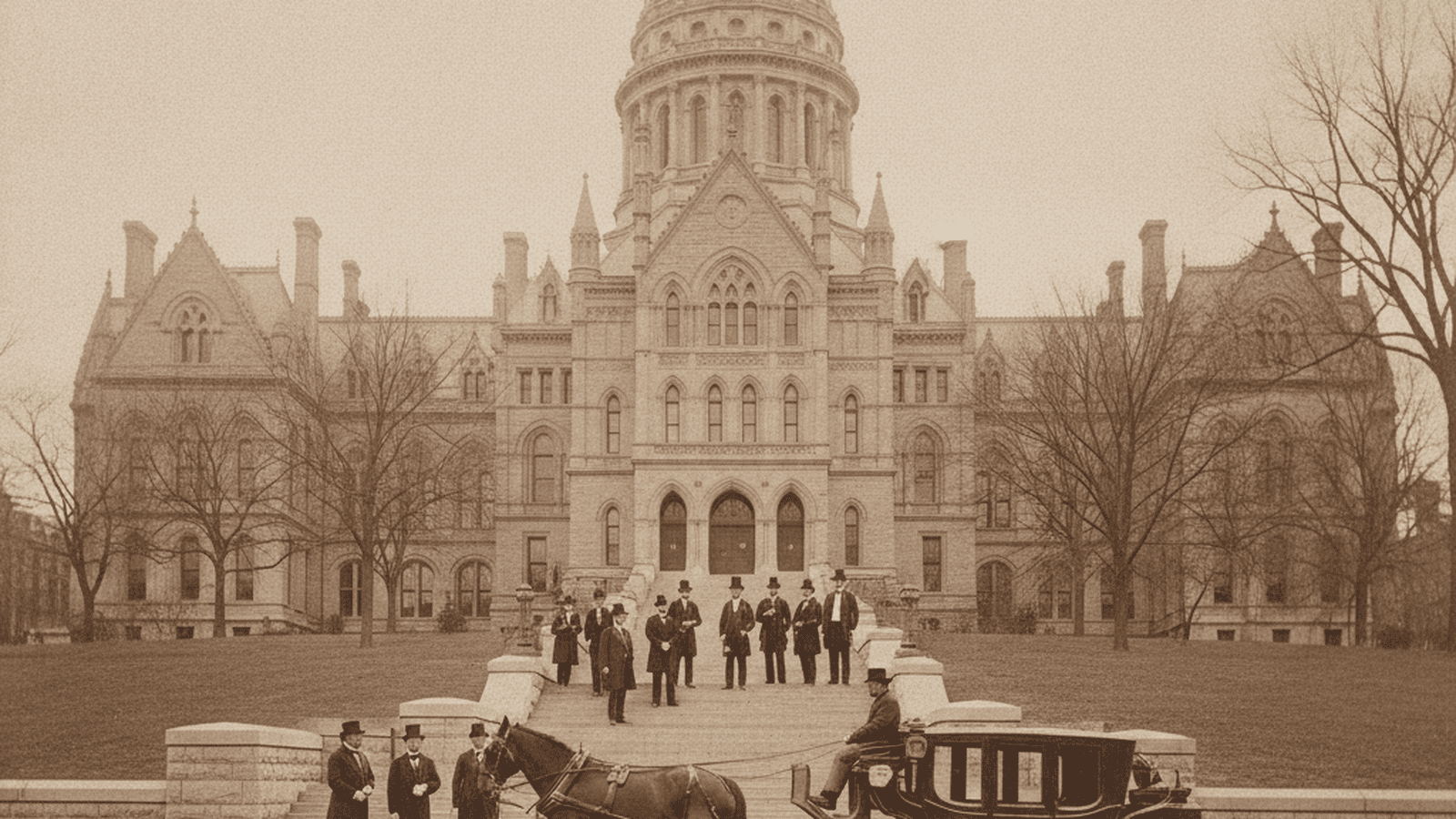
The Connecticut Legislative Deadlock of 1891 occurred when a disputed gubernatorial election paralyzed the state government for two years. Incumbent Governor Morgan Bulkeley remained in office throughout the crisis in the United States, as the divided General Assembly could not agree on a successor.
TLDR: In 1891, a dispute over ballot counting in Connecticut led to a two-year legislative stalemate. With the House and Senate unable to certify a winner, incumbent Governor Morgan Bulkeley stayed in power, earning the nickname “The Crowbar Governor” while the state operated without new laws or formal appropriations.
The 1890 gubernatorial election in Connecticut triggered a constitutional crisis that would leave the state without a newly elected leader for two full years. On November 4, 1890, Democratic candidate Luzon B. Morris appeared to have narrowly defeated Republican Samuel Merwin. However, the state’s 1818 Constitution mandated that a candidate must receive an absolute majority of all votes cast to be declared the winner. If no candidate reached this threshold, the responsibility for selecting the governor fell to the General Assembly.
The initial tally showed Morris with a razor-thin majority of 26 votes. However, Republicans in the House of Representatives immediately challenged the results, citing technicalities in ballot formatting. They argued that hundreds of ballots were invalid because they contained extra words or were printed on the wrong type of paper. By disqualifying these votes, the Republicans aimed to push Morris below the 50% mark, thereby throwing the election to the legislature, where they held a majority in the House. The Democratic-controlled Senate, conversely, insisted on the validity of the ballots and the popular will.
This partisan divide led to a total legislative paralysis when the General Assembly convened in January 1891. Because the two chambers could not agree on the election results, they could not formally organize or conduct business. For the next two years, not a single law was passed, and no official state budget was approved. The state government entered a period of unprecedented “silence,” operating solely on the momentum of existing statutes and the controversial leadership of the incumbent, Morgan Bulkeley.
Bulkeley, a Republican who had not even run for re-election in 1890, found himself in a unique legal position. The state constitution stipulated that a governor remained in office until a successor was “duly qualified.” Since the legislature could not agree on a winner, Bulkeley argued he was legally required to stay. His tenure was marked by high drama; when Democratic officials attempted to lock him out of the State House, Bulkeley famously used a crowbar to force entry into his office, earning him the nickname “The Crowbar Governor.”
The financial crisis posed by the deadlock was perhaps the most pressing issue. Without a budget, the state treasury could not legally disperse funds for payroll or public institutions. Bulkeley, who was also the president of the Aetna Life Insurance Company, took the extraordinary step of securing private loans to keep the government running. He used his personal credit and corporate influence to ensure that state employees were paid and that schools and asylums remained open. While his supporters praised his decisiveness, his detractors viewed his actions as a dangerous usurpation of legislative power.
The matter eventually reached the Connecticut Supreme Court of Errors in the case of State ex rel. Morris v. Bulkeley. In 1892, the court issued a ruling that favored the status quo. The justices determined that the power to certify the election rested solely with the General Assembly. Since the legislature had failed to act, the court declined to intervene, characterizing the dispute as a “political question” beyond judicial reach. This effectively sanctioned Bulkeley’s continued rule until the next election cycle.
The deadlock finally broke following the 1892 elections, which saw a decisive Democratic victory. Luzon Morris was finally inaugurated in 1893, ending the two-year stalemate. The crisis left a lasting mark on Connecticut politics, exposing the flaws of the 1818 Constitution. In 1901, voters approved a constitutional amendment replacing the absolute majority requirement with a plurality rule. This reform ensured that the candidate with the most votes would win, preventing a single partisan disagreement from ever again paralyzing the state’s democracy.

Dylan Brooks serves as the Senior Correspondent for Statehouses and Local Governance at Just Right News, where he brings a principled, constitutionalist lens to the often-overlooked machinery of state-level politics. As the lead voice behind the acclaimed feature series “Fifty Laboratories of Power,” Dylan has dedicated his career to the idea that the most impactful governance happens closest to home. His reporting consistently champions the Tenth Amendment, exploring how individual states can serve as testing grounds for innovative, conservative policy solutions that prioritize personal liberty and fiscal responsibility.
A native of Des Moines, Iowa, Dylan’s journalistic philosophy was forged in the heart of the American Midwest. Growing up in a community where local school board meetings and town halls were the bedrock of civic life, he developed a deep appreciation for the “retail politics” of the heartland. This upbringing instilled in him a fundamental belief that the American experiment is best preserved when power is decentralized. He carries the values of his Iowa roots into every assignment, maintaining a healthy skepticism of federal overreach and a steadfast commitment to the concerns of everyday citizens over the interests of the administrative state.
Now based in Madison, Wisconsin, Dylan operates from one of the nation’s most pivotal political battlegrounds. His location in a state capital known for its rigorous policy debates allows him to provide Just Right News readers with a front-row seat to the legislative process. From Madison, he tracks the ripple effects of statehouse decisions on local municipalities, ensuring that the connection between high-level policy and community impact is never lost. His work often highlights the success of conservative governors and legislatures in fostering economic growth, protecting parental rights, and securing the integrity of local institutions.
As an African American man in the conservative media landscape, Dylan offers a vital perspective on how limited government and free-market principles empower individuals and families. He frequently reports on how deregulation and school choice initiatives provide new avenues for success in underserved communities, challenging the monolithic narratives often presented by legacy media outlets. Dylan’s work is characterized by a commitment to the facts and a refusal to shy away from the complex realities of modern governance.
Throughout his tenure at Just Right News, Dylan has become a trusted authority for readers who value a rigorous, principled approach to the news. Whether he is dissecting a complex state budget or profiling a local grassroots movement, his goal remains the same: to provide the American public with the information they need to hold their local leaders accountable. By focusing on the “Fifty Laboratories of Power,” Dylan Brooks ensures that the vital work being done in statehouses across the country receives the national attention it deserves, always through a lens that respects the traditions and sovereignty of the American people.