

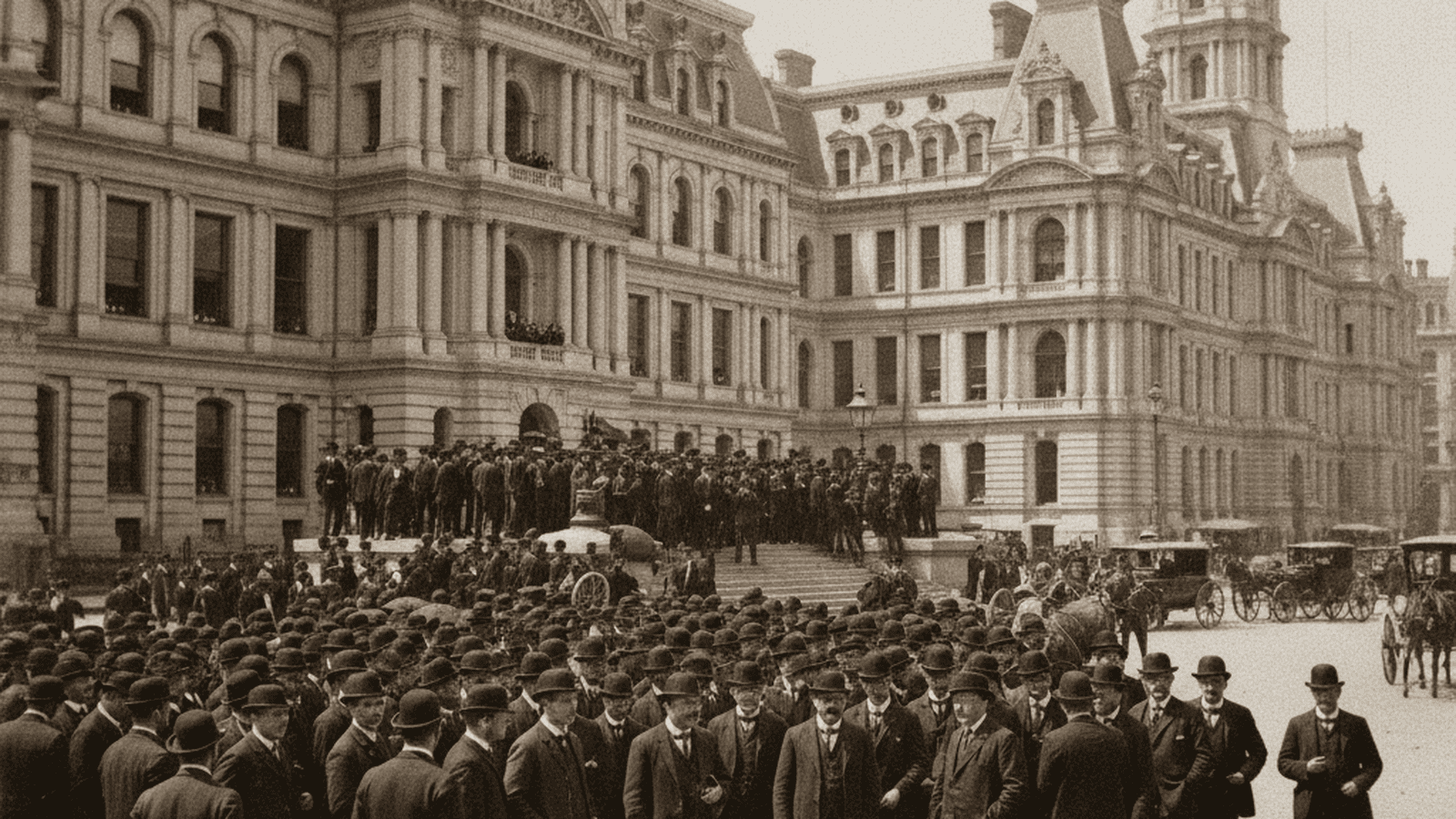
In 1905, Philadelphia citizens revolted against the “Gas Ring” political machine after a corrupt attempt to extend a gas works lease. The resulting Progressive Era reforms in the United States city led to significant civil service changes and the temporary downfall of boss-led governance.
TLDR: Philadelphia’s 1905 “Gas Ring” scandal erupted when political bosses tried to lease the city’s gas works for 75 years. Public outrage forced Mayor John Weaver to break with the machine, leading to the Shern Acts of 1906. These reforms established civil service protections and curbed systemic corruption in Pennsylvania’s largest city.
At the dawn of the twentieth century, Philadelphia earned a reputation as one of the most politically compromised cities in the United States. Journalist Lincoln Steffens famously labeled the city “corrupt and contented” in his 1903 exposé on municipal governance. The city’s political apparatus was dominated by the “Gas Ring,” a powerful Republican machine led by Israel Durham. This organization maintained control through a vast network of patronage, election fraud, and the manipulation of public utilities. For years, the machine operated with near-total impunity, ensuring that city contracts and jobs were funneled to loyalists while dissent was suppressed at the ballot box.
The tension between the machine and the public reached a breaking point in May 1905. The City Councils, acting under Durham’s direction, proposed a seventy-five-year extension of the lease for the Philadelphia Gas Works to the United Gas Improvement Company. The terms were widely viewed as a betrayal of the public interest, as they would have locked in high gas prices for decades while providing the machine with immediate cash for patronage projects. This blatant attempt to prioritize private profit over municipal welfare galvanized a previously dormant reform movement. The proposal sought to bypass competitive bidding, further highlighting the lack of transparency in city hall.
Mayor John Weaver, who had been elected with the machine’s support, became the unlikely hero of the anti-corruption drive. Recognizing the depth of public anger and the potential for a total collapse of civil order, Weaver broke ties with Durham and the Gas Ring. He took the bold step of removing machine-aligned officials from key administrative positions, including the Directors of Public Works and Public Safety. These dismissals stripped the machine of its primary tools for enforcing loyalty and managing city contracts. Weaver’s defection was a turning point, as it provided the reform movement with the executive power necessary to challenge the legislative branch.
Public mobilization intensified as the “Committee of Seventy,” a group of civic leaders, organized mass meetings and legal challenges. Citizens began wearing buttons featuring a hangman’s noose, a grim warning to councilmen who considered voting for the gas lease. The atmosphere in the city became so volatile that machine leaders feared for their physical safety. Protesters flooded the galleries of the council chambers, shouting down machine speakers and demanding accountability. Under this immense pressure, the City Councils eventually withdrew the gas lease proposal, marking a rare and decisive victory for the reformers.
The collapse of the gas deal served as a catalyst for broader structural changes in Pennsylvania’s largest city. In the November 1905 elections, a “City Party” composed of reformers and disillusioned Republicans swept many local offices, dealing a staggering blow to Durham’s organization. This electoral mandate provided the momentum needed to pass the Shern Acts in 1906. These laws established a formal civil service system, prohibited city employees from participating in political campaigns, and mandated more transparent accounting for municipal funds. The acts were designed to decouple city employment from political loyalty, striking at the heart of the machine’s power.
The 1905 uprising fundamentally altered the trajectory of Philadelphia’s governance during the Progressive Era. While political machines would eventually attempt to reorganize in later decades, the reforms established during this period created permanent legal barriers against the most egregious forms of patronage. The Shern Acts served as a model for other United States cities seeking to professionalize their administrations and protect public assets from exploitation. This era of reform underscored the necessity of executive independence and public oversight in maintaining the integrity of municipal utilities and services.

Dylan Brooks serves as the Senior Correspondent for Statehouses and Local Governance at Just Right News, where he brings a principled, constitutionalist lens to the often-overlooked machinery of state-level politics. As the lead voice behind the acclaimed feature series “Fifty Laboratories of Power,” Dylan has dedicated his career to the idea that the most impactful governance happens closest to home. His reporting consistently champions the Tenth Amendment, exploring how individual states can serve as testing grounds for innovative, conservative policy solutions that prioritize personal liberty and fiscal responsibility.
A native of Des Moines, Iowa, Dylan’s journalistic philosophy was forged in the heart of the American Midwest. Growing up in a community where local school board meetings and town halls were the bedrock of civic life, he developed a deep appreciation for the “retail politics” of the heartland. This upbringing instilled in him a fundamental belief that the American experiment is best preserved when power is decentralized. He carries the values of his Iowa roots into every assignment, maintaining a healthy skepticism of federal overreach and a steadfast commitment to the concerns of everyday citizens over the interests of the administrative state.
Now based in Madison, Wisconsin, Dylan operates from one of the nation’s most pivotal political battlegrounds. His location in a state capital known for its rigorous policy debates allows him to provide Just Right News readers with a front-row seat to the legislative process. From Madison, he tracks the ripple effects of statehouse decisions on local municipalities, ensuring that the connection between high-level policy and community impact is never lost. His work often highlights the success of conservative governors and legislatures in fostering economic growth, protecting parental rights, and securing the integrity of local institutions.
As an African American man in the conservative media landscape, Dylan offers a vital perspective on how limited government and free-market principles empower individuals and families. He frequently reports on how deregulation and school choice initiatives provide new avenues for success in underserved communities, challenging the monolithic narratives often presented by legacy media outlets. Dylan’s work is characterized by a commitment to the facts and a refusal to shy away from the complex realities of modern governance.
Throughout his tenure at Just Right News, Dylan has become a trusted authority for readers who value a rigorous, principled approach to the news. Whether he is dissecting a complex state budget or profiling a local grassroots movement, his goal remains the same: to provide the American public with the information they need to hold their local leaders accountable. By focusing on the “Fifty Laboratories of Power,” Dylan Brooks ensures that the vital work being done in statehouses across the country receives the national attention it deserves, always through a lens that respects the traditions and sovereignty of the American people.