

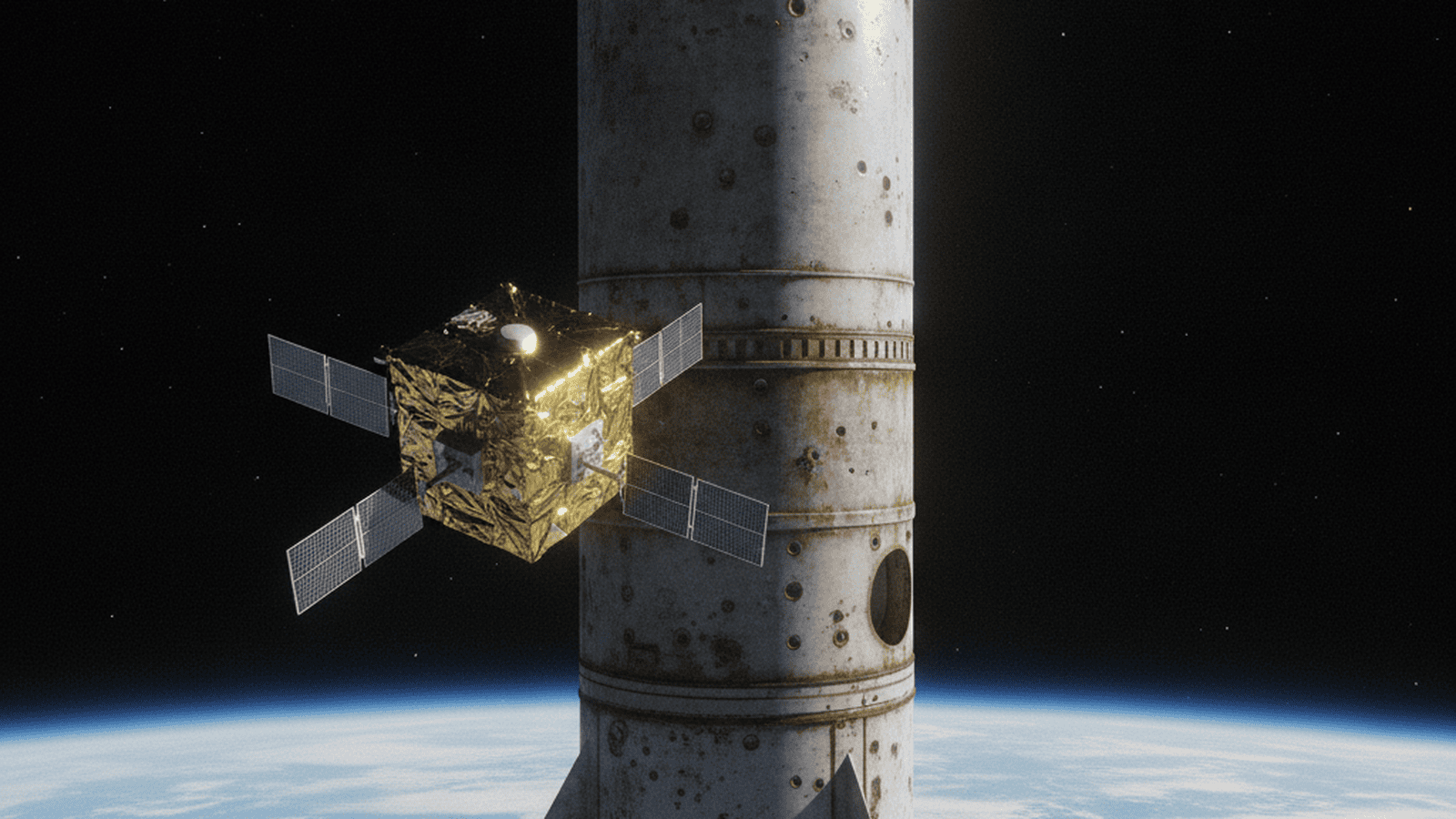
Astroscale’s ADRAS-J satellite successfully performed a close-range inspection of a discarded rocket upper stage, marking a breakthrough in space debris management. The mission demonstrated the ability to rendezvous with and characterize non-cooperative objects in orbit using advanced autonomous sensors.
TLDR: The ADRAS-J mission by Astroscale has successfully approached and imaged a massive piece of space junk, proving that satellites can safely navigate near uncooperative orbital debris. This milestone is a critical step toward active debris removal and ensuring the long-term sustainability of Earth’s orbital environment.
The accumulation of orbital debris has reached a critical threshold, posing a significant threat to global satellite infrastructure and the long-term viability of space exploration. In a landmark achievement for orbital sustainability, the private space company Astroscale recently announced the successful completion of a high-precision proximity operation involving its ADRAS-J (Active Debris Removal by Astroscale-Japan) satellite. This mission represents a historic first: a spacecraft has safely approached, rendezvoused with, and characterized a large, non-cooperative piece of space junk in low Earth orbit (LEO) using only autonomous onboard sensors.
The target of this ambitious mission was a discarded H-IIA rocket upper stage, which has been drifting in orbit since it launched a climate observation satellite in 2009. Measuring approximately 11 meters in length and 4 meters in diameter, and weighing several tons, this massive cylinder represents a significant collision hazard in a heavily populated orbital plane. Unlike active satellites, this piece of debris is “non-cooperative,” meaning it does not transmit location data, lacks GPS transponders, and possesses no docking ports or stabilization systems. Navigating toward such an object is an immense technical challenge, as the satellite must calculate its own trajectory relative to a target that may be tumbling or structurally compromised.
To bridge the gap between kilometers and meters, ADRAS-J utilized a sophisticated suite of sensors, including high-resolution cameras and Light Detection and Ranging (LiDAR) technology. During the initial phase of the mission, the satellite used ground-based tracking data to reach the general vicinity of the rocket stage. However, the final approach required a transition to relative navigation. ADRAS-J’s autonomous algorithms processed visual data in real-time to track the debris against the complex background of Earth and the void of space. This phase of the mission, known as Rendezvous and Proximity Operations (RPO), is critical for ensuring that the inspection craft does not accidentally collide with the debris, which would only create more fragments and exacerbate the problem.
This technical feat was managed from Astroscale’s mission control center in Tokyo, where engineers monitored the satellite’s autonomous systems as they adjusted thrusters to maintain a safe corridor. The imagery captured during the close-range fly-around provided unprecedented detail of the H-IIA stage’s physical condition. After fifteen years in the harsh environment of space, the rocket’s exterior showed signs of degradation, yet the data confirmed its structural integrity—a vital piece of information for future removal attempts. Furthermore, ADRAS-J was able to precisely measure the object’s spin rate. Understanding how a piece of debris tumbles is essential for designing capture mechanisms, such as robotic arms or harvesters, that must synchronize their movements with the target to achieve a secure grip.
The success of ADRAS-J addresses the “Kessler Syndrome,” a theoretical scenario where the density of objects in LEO is high enough that a single collision could trigger a cascade of further impacts, eventually rendering certain orbital altitudes unusable. Proactive removal of large debris pieces is widely considered the most effective strategy to prevent this chain reaction. While international space law is still evolving to address the mandatory removal of defunct hardware, Astroscale’s mission provides the technical proof-of-concept necessary to move from policy discussion to practical execution.
This mission was selected by the Japan Aerospace Exploration Agency (JAXA) for Phase I of its Commercial Removal of Debris Demonstration (CRD2) program. The data gathered during this inspection will directly inform Phase II, which aims to perform the actual capture and de-orbiting of the debris. By demonstrating that a commercial entity can safely navigate the complexities of non-cooperative rendezvous, Astroscale has laid the foundation for a new “on-orbit servicing” economy. This breakthrough ensures that space remains a sustainable resource for telecommunications, climate monitoring, and future exploration for generations to come.

Mason Reed serves as a Staff Writer for Just Right News, where he spearheads the Future Frontiers & Special Projects desk. In an era defined by rapid technological shifts and evolving social landscapes, Mason provides a steady, principled voice, examining the innovations of tomorrow through the lens of traditional American values. His work is most prominently featured in his signature series, “The Next Horizon,” where he explores the intersection of emerging technology, national sovereignty, and the preservation of individual liberty.
A native of San Diego, California, Mason’s worldview was shaped by the unique culture of his hometown. Growing up in a region defined by its strong military presence and its history of maritime industry, he developed a deep-seated respect for the institutions that provide national stability and the entrepreneurial spirit that drives the American economy. This upbringing instilled in him a belief that true progress is not found in discarding the past, but in building upon a foundation of proven principles. His reporting often reflects this San Diego influence, emphasizing the importance of a robust national defense and the necessity of maintaining a competitive edge in the global marketplace.
Now based in San Francisco, Mason operates from the heart of the world’s technological engine. Living and working in the Bay Area provides him with a front-row seat to the advancements—and the ideological challenges—emanating from Silicon Valley. While many in the region embrace a “move fast and break things” mentality, Mason’s reporting serves as a vital counterweight. He offers Just Right News readers a “boots on the ground” perspective, documenting how radical local policies and the concentration of tech power impact the everyday lives of citizens. His proximity to the industry allows him to cut through the marketing jargon of big tech to uncover the real-world implications for privacy, free speech, and the nuclear family.
In his “Future Frontiers” beat, Mason tackles complex subjects ranging from the ethics of artificial intelligence to the burgeoning private space race. He approaches these topics with a healthy skepticism toward centralized bureaucracy, championing instead the decentralized innovations that empower individuals. Through “The Next Horizon,” he highlights the pioneers and thinkers who are working to ensure that the future remains a place where human dignity and constitutional rights are protected. He believes that the rapid pace of change requires more than just technical expertise; it requires a moral compass rooted in the Western tradition.
Throughout his tenure at Just Right News, Mason has remained committed to the idea that the future is something to be shaped, not merely accepted. His writing is characterized by a rigorous defense of American exceptionalism and a belief that the country’s best days lie ahead, provided it remains true to its founding ideals. Whether he is investigating the impact of automation on the American workforce or profiling the next generation of aerospace engineers, Mason Reed ensures that his readers are equipped with the insights they need to navigate a changing world with confidence and clarity.