

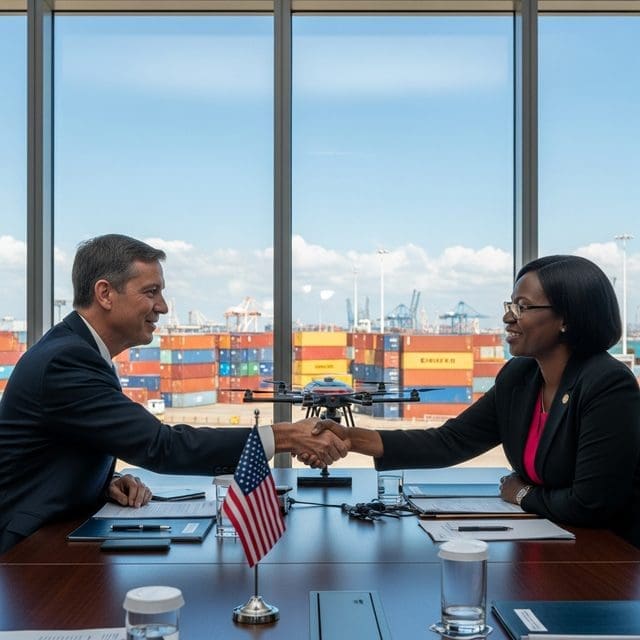
The Trump administration’s $1 billion humanitarian commitment marks a pivot toward tangible disaster response, challenging the bureaucratic status quo of international health and climate-adaptation financing.
The landscape of international development is undergoing a fundamental realignment as the United States leverages its financial influence to prioritize immediate humanitarian outcomes over the expansive, often opaque, climate-health agendas of global bureaucracies. On June 16, 2026, the U.S. announced more than $1 billion in new humanitarian and disaster-response macro awards for UNICEF and the World Food Programme. This funding, spanning more than 40 countries, is a direct implementation of the December 2025 Humanitarian Reset memorandum of understanding with UN OCHA. By tying these funds to specific disaster-response metrics, the administration is signaling a preference for measurable results over the long-term, abstract goals that have come to characterize the World Health Organization’s recent policy shifts.
This move toward targeted intervention is finding a parallel in Africa, where health leaders are increasingly focusing on domestic sovereignty and specific disease burdens. On June 19, 2026, African health leaders launched the Imara Sickle Cell Framework, a continent-wide initiative designed to coordinate diagnosis and lifelong care for sickle cell disease. This follows a June 18 briefing from the Africa CDC, which highlighted over $910 million in new Ebola-related pledges. These developments suggest a strategic pivot toward epidemic response and tangible health infrastructure rather than broad climate-health links that often lack clear accountability mechanisms.
The tension between immediate health needs and the global climate-adaptation narrative is particularly evident in the current state of loss-and-damage funding. While Kenya recently became the first African nation to receive climate disaster funding via the UN Santiago Network, the allocation of roughly $700,000 to identify eligible communities is a drop in the bucket compared to the continent’s needs. Total UN-linked loss-and-damage resources currently sit at approximately $822 million, with only $440 million released. For American policymakers, the modest scale and slow disbursement of these funds underscore the inefficiency of multi-lateral climate mechanisms compared to direct, bilateral humanitarian aid.
Furthermore, the implementation of the WHO Pandemic Agreement remains mired in procedural delays. The treaty’s entry into force hinges on an annex for pathogen access and benefit-sharing, requiring 60 ratifications to move forward. This procedural choke point has allowed the U.S. to chart a more independent course, focusing on market-driven solutions and private sector partnerships. For instance, the recent U.S. Navy contract awarded to MSHS Pacific Power Group for global diesel engine services demonstrates a commitment to maintaining the logistical backbone required for aid delivery without relying solely on international administrative bodies.
However, this transition to a results-oriented model comes amid structural pressures on traditional aid. OECD projections indicate that bilateral official development assistance to sub-Saharan Africa could fall by as much as 28 percent by late 2026. This decline reflects a broader skepticism toward open-ended development projects that fail to demonstrate a clear return on investment or a direct benefit to national security. The administration’s focus on reopening trade routes, such as the Strait of Hormuz, further emphasizes that economic stability and market access are viewed as the primary drivers of global development, rather than perpetual aid cycles.
As the U.S. continues to reshape its role in global health and development, the emphasis remains on fiscal transparency and the prioritization of American interests. By funding specific humanitarian responses and supporting domestic African health frameworks like the Imara initiative, the administration is challenging the necessity of the massive, centralized global health architecture. For the American taxpayer, this shift represents a move toward a more disciplined and accountable form of international engagement, where aid is a tool for stability rather than a vehicle for expansive global governance.

Rachel Vaughn serves as a Senior Correspondent for Just Right News, where she leads the network’s coverage of Global Health, Climate, and Development. With a career defined by intellectual rigor and a commitment to principled reporting, Rachel provides a vital conservative perspective on some of the most complex and high-stakes issues facing the world today. Her work is characterized by a refusal to accept bureaucratic narratives at face value, focusing instead on how international policies impact national sovereignty, individual liberty, and the American taxpayer.
Raised in New Haven, Connecticut, Rachel grew up in an environment dominated by elite academic discourse. This upbringing provided her with a front-row seat to the inner workings of the American establishment, but it also instilled in her a healthy skepticism of the “ivory tower” consensus. She learned early on that while academic theories may sound promising in a lecture hall, they often fail to account for the practical realities of the working class. This background drives her to bridge the gap between high-level policy discussions and the common-sense concerns of everyday citizens, ensuring that her reporting remains grounded and accessible.
Now based in Burlington, Vermont, Rachel operates from a unique vantage point within one of the nation’s most progressive political landscapes. Living and working in a region that often serves as a testing ground for radical social and environmental experiments allows her to witness the real-world consequences of these policies firsthand. From her base in the Green Mountain State, she provides Just Right News readers with essential “boots on the ground” reporting, documenting the friction between local mandates and the constitutional freedoms of the individual. Her presence in Burlington ensures that her critiques of globalist agendas are informed by a direct understanding of how those ideologies manifest at the local level.
In her acclaimed feature series, “Planetary Stakes,” Rachel explores the intersection of international development and environmental stewardship. She rejects the alarmism often found in mainstream media, opting instead for a sober analysis of the economic and geopolitical costs of global climate agreements. Her reporting frequently highlights the importance of market-driven innovation and the role of American leadership in fostering global health without ceding authority to unelected international bodies. Through “Planetary Stakes,” she has become a leading voice for those who believe that true conservation and public health are best achieved through transparency, accountability, and the protection of private property rights.
Throughout her tenure at Just Right News, Rachel has distinguished herself as a journalist who is unafraid to ask difficult questions of global institutions. Whether she is investigating the influence of non-governmental organizations on domestic policy or analyzing the fiscal transparency of international health initiatives, her goal remains the same: to provide her audience with the facts necessary to navigate an increasingly interconnected world. Her blend of East Coast intellectual heritage and her current immersion in the political heart of the Northeast makes her an indispensable asset to the newsroom and a trusted source for readers seeking a principled, conservative take on the issues that define our era.