

Vice President JD Vance opens formal negotiations in Switzerland to finalize a regional peace deal, facing Iranian demands for Israeli compliance and a 60-day ultimatum from President Trump.
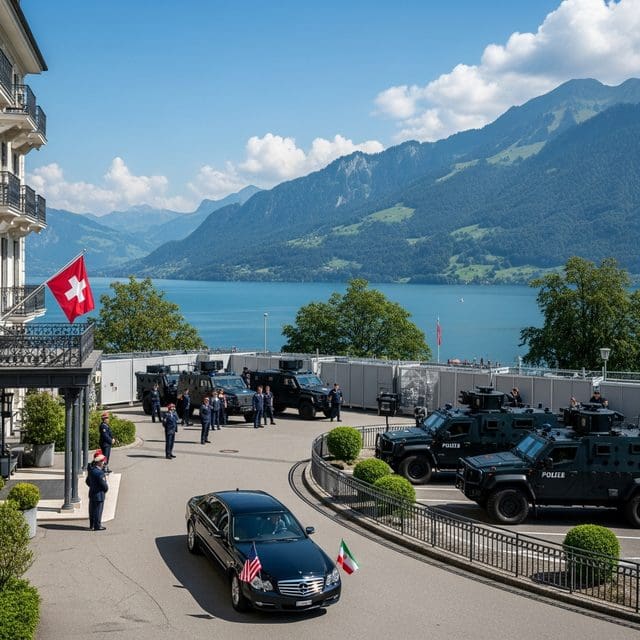
Formal diplomatic engagement between the United States and Iran commenced Sunday at the Bürgenstock resort in Switzerland, marking a pivotal moment in the Trump administration’s strategy to restore order to global energy corridors. Vice President JD Vance is leading the American delegation in quadrilateral sessions alongside Iranian Speaker Mohammad Bagher Ghalibaf and Foreign Minister Abbas Araghchi. Mediators from Pakistan and Qatar are facilitating these high-level sessions, which seek to transform the tentative June 14 ceasefire into a comprehensive regional settlement.
The negotiations unfold against renewed friction in the Strait of Hormuz. Despite the diplomatic channel, Iran’s Islamic Revolutionary Guard Corps has again declared the waterway “closed,” citing alleged Israeli ceasefire violations in Lebanon. U.S. Central Command has countered this, insisting the waterway remains open under international control. American forces continue to monitor traffic closely, signaling that Washington will not permit Tehran to use the world’s most critical energy chokepoint as a tactical bargaining chip. This tension is heightened by President Trump’s 60-day deadline to finalize the accord. Trump warned that if Iran seeks to levy tolls in Hormuz, Washington may impose U.S.-collected transit charges on shipping instead.
Tehran’s leadership is signaling a hard line. Senior adviser Mohammad Mokhber warned that Tehran will not “sign a piece of paper” unless Washington enforces Israeli compliance with ceasefire terms in Lebanon. This demand effectively links the maritime security of the Persian Gulf to the kinetic conflict in the Levant. Vice President Vance has framed the summit as an opportunity to lock in a “full regional ceasefire” encompassing Lebanon and potentially opening parallel discussions on Iran’s nuclear program. However, continued Israeli strikes remain a core obstacle, with Iranian negotiators insisting American influence must restrain its ally before a final signature.
While diplomats deliberate, regional powers are repositioning. India’s refiners have ramped up Russian crude imports to 2.66 million barrels per day this month, hedging against Hormuz instability. Even as some Indian-flagged tankers resume transit, New Delhi is diversifying its mix with volumes from Venezuela and the Atlantic Basin, viewing Russian supply as a cornerstone of its security regardless of the summit’s outcome. Simultaneously, Turkish President Recep Tayyip Erdogan has moved to align with the Trump administration’s objectives. Erdogan recently ordered negotiations to reopen the Orthodox Halki seminary near Istanbul, a move explicitly tied to his upcoming visit with President Trump. By addressing a priority for American Christian constituencies, Turkey is positioning itself as a pragmatic partner in the administration’s wider initiatives.
The logistical footprint of the summit has already caused ripples, with security measures disrupting air traffic at Zurich airport. These disruptions underscore the gravity of the talks, which have received tentative support from G7 leaders. The administration must now balance its commitment to Israeli security with the realist necessity of a functional Iran deal to prevent economic instability. As the 60-day clock begins to tick, the Bürgenstock summit represents a high-stakes test of whether American diplomatic pressure can successfully decouple regional grievances from the free flow of global commerce.

Olivia Kendall serves as the Senior Correspondent for Geopolitics, Defense, and Foreign Policy at Just Right News, where she provides a principled, conservative perspective on the complex forces shaping the global stage. With a career dedicated to deconstructing the intricacies of international relations, Kendall has become a trusted voice for readers who value national sovereignty, a robust military, and a foreign policy that prioritizes American interests above all else.
A native of Washington, D.C., Kendall’s professional journey is deeply rooted in her upbringing within the nation’s capital. Growing up in the epicenter of American political life, she developed an early and profound understanding of how policy is crafted and, more importantly, how it often fails to account for the values of the American heartland. This unique vantage point allowed her to witness firsthand the rise of globalist bureaucracies, fueling her commitment to reporting that champions the constitutional foundations of the United States. Her background as a British White American further informs her worldview, providing her with a keen appreciation for the Western tradition and the enduring importance of the “Special Relationship” in maintaining global stability.
Now based in Arlington, Virginia, Kendall operates from the doorstep of the Pentagon and the heart of the nation’s defense establishment. Her proximity to the decision-makers in the military and intelligence communities allows her to provide boots-on-the-ground reporting that is both timely and deeply informed. For Kendall, Arlington is more than just a base of operations; it is a daily reminder of the sacrifices made by the men and women in uniform. This connection to the defense community drives her rigorous coverage of military readiness and her advocacy for a “peace through strength” approach to diplomacy.
At Just Right News, Kendall is perhaps best known for her acclaimed feature series, “The World’s Shadow on America.” In this ongoing project, she explores the direct correlation between international developments and the daily lives of American citizens. Whether she is analyzing the encroachment of foreign adversaries in domestic supply chains or the impact of international treaties on local economies, Kendall’s work serves as a vital bridge between distant geopolitical shifts and their consequences at home. She rejects the notion that foreign policy is an abstract concern for elites, instead proving that what happens in the corridors of power in Brussels or Beijing has a tangible “shadow” that falls across every American doorstep.
Throughout her tenure, Kendall has remained a steadfast critic of international overreach and a vocal proponent of a clear-eyed, realistic foreign policy. She brings a sharp analytical mind to her beat, often challenging the prevailing narratives of the mainstream media to uncover the underlying truths that affect national security. Her reporting is characterized by a refusal to compromise on the truth and a dedication to the idea that a strong, secure America is the world’s best hope for liberty. As a Senior Correspondent, Olivia Kendall continues to lead the charge in providing the essential context and conservative insight necessary to navigate an increasingly volatile world.