

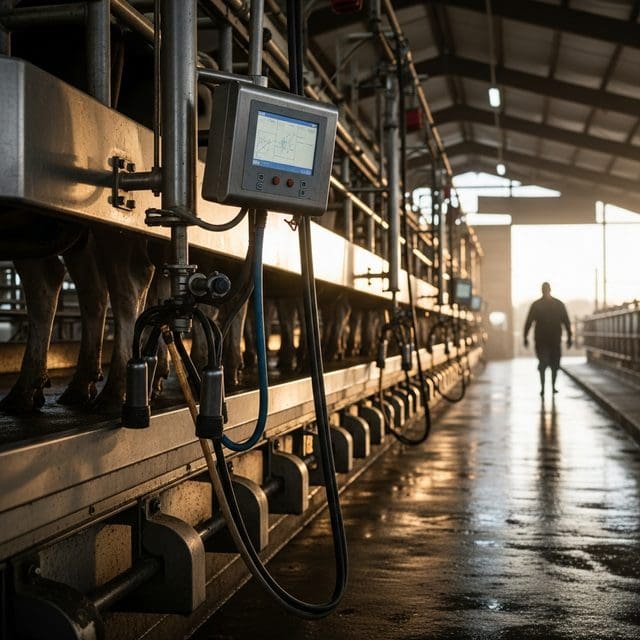
New federal rules allow dairy farms to utilize temporary foreign labor, while California leadership remains locked in a fiscal standoff with healthcare unions over a billionaire tax.
The landscape for American agricultural labor shifted this week as federal agencies opened a new door for the dairy industry. On June 17, the USDA, alongside the Departments of Labor and Homeland Security, issued guidance confirming that dairy operations are now eligible to seek workers through the H-2A visa program. This move addresses a long-standing grievance from farm owners struggling to staff milking parlors amidst a tightening domestic labor market.
Under the new guidance, dairy work is explicitly categorized as an agricultural activity eligible for H-2A consideration. However, the federal government noted this does not create a new visa category or a path for permanent year-round staffing. To qualify, operations must demonstrate a specific temporary or seasonal labor need. USCIS will review petitions case-by-case, maintaining the requirement that employers first attempt to recruit domestic workers. This mandate remains a cornerstone of the program, intended to ensure American workers are not bypassed for lower-cost foreign labor.
The implementation comes at a critical time. While the clarification provides a safety valve for farms facing seasonal surges, it leaves open questions regarding the definition of “temporary” in an industry that operates 365 days a year. For the blue-collar worker, the expansion of guest worker programs often signals downward pressure on wage growth as the labor pool expands. Federal officials say the change took effect immediately, adding compliance expectations around labor certification and domestic recruitment.
In California, the tension between labor priorities and economic management is manifesting in a high-stakes legislative battle. Governor Gavin Newsom’s office reaffirmed its opposition to a revised billionaire tax proposed by the SEIU-UHW. The union scaled back its demand to a one-time 2% levy to secure support before a June 25 ballot deadline. Newsom remains steadfast, arguing the tax would destabilize the state economy. This clash shows California labor allies are split, with organized labor pushing for healthcare revenue while the administration warns of broader economic fallout.
Beyond the fields, the broader economy grapples with the rising costs of the technological frontier. Apple recently announced price increases are unavoidable as the AI boom drives semiconductor costs higher. This inflationary pressure, combined with the Federal Reserve’s move toward stricter customer identification for digital payments, suggests a volatile environment for household budgets. Kevin Warsh signaled a shift in Fed communication toward less fine-tuning, leaving workers with less clarity on interest rate trajectories.
As automation and energy scarcity reshape the industrial heartland, the dignity of manual trades remains caught between global tech demands and shifting labor rules. The AI boom is driving companies into the energy business as electricity emerges as a scarce commodity. While memory chip demand outpaces supply, the immediate question for the dairy sector is how much relief operations can actually get under the seasonal test. For the American worker, these shifts represent a dual challenge: navigating a market increasingly reliant on foreign guest workers while facing the rising costs of an AI-driven economy.

Tom Blake serves as the Senior Correspondent for Labor, Wages, and Automation at Just Right News, where he brings a grounded, principled perspective to the most pressing economic issues facing the American heartland. As the lead voice behind the acclaimed feature series “The Price of Work,” Tom focuses his reporting on the intersection of traditional industry and the rapidly evolving technological landscape, always prioritizing the dignity of the individual worker and the health of the American family.
Tom’s deep understanding of the labor market is not merely academic; it is rooted in his upbringing in Detroit, Michigan. Growing up in the shadow of the automotive industry, he witnessed firsthand the triumphs and tribulations of the American blue-collar workforce. He saw how the stability of a manufacturing job could build a community and, conversely, how the erosion of those industries could tear the social fabric apart. This background instilled in him a lifelong respect for the trades and a healthy skepticism toward economic policies that prioritize globalist interests over the well-being of local communities.
Now based in Pittsburgh, Pennsylvania, Tom continues to report from the front lines of the shifting economy. Pittsburgh, a city that has reinvented itself while maintaining its gritty, industrious spirit, provides the perfect vantage point for his beat. From the steel mills that remain to the high-tech robotics labs reshaping the city’s future, Tom explores how automation is changing the nature of employment. His reporting often highlights the tension between innovation and tradition, arguing that while progress is inevitable, it must not come at the expense of the American worker’s ability to provide for their family through honest, meaningful labor.
In his role at Just Right News, Tom has become a vital voice for those who feel overlooked by mainstream economic coverage. He rejects the notion that the decline of American manufacturing is an unavoidable casualty of the modern era. Instead, his work often examines how regulatory overreach, rising energy costs, and the unchecked rise of automation impact the take-home pay of everyday citizens. Through “The Price of Work,” Tom delves into the true cost of economic shifts, looking beyond the raw data to tell the stories of the people behind the statistics.
Tom’s reporting is characterized by a commitment to the conservative values of self-reliance, fiscal responsibility, and the preservation of the American dream. He believes that a strong nation is built on a foundation of stable jobs and fair wages, and his work seeks to hold both government and corporate entities accountable to that standard. Whether he is interviewing a shop floor manager about the implementation of new AI technology or analyzing the impact of wage inflation on small businesses, Tom provides a clear-eyed analysis that resonates with readers who value hard work and common sense.
Through his dedicated coverage, Tom Blake remains a steadfast advocate for the American workforce, ensuring that the voices of those in the industrial heartland are heard loud and clear in the national conversation. His perspective is essential for anyone seeking to understand the complex realities of labor and automation in the twenty-first century.