

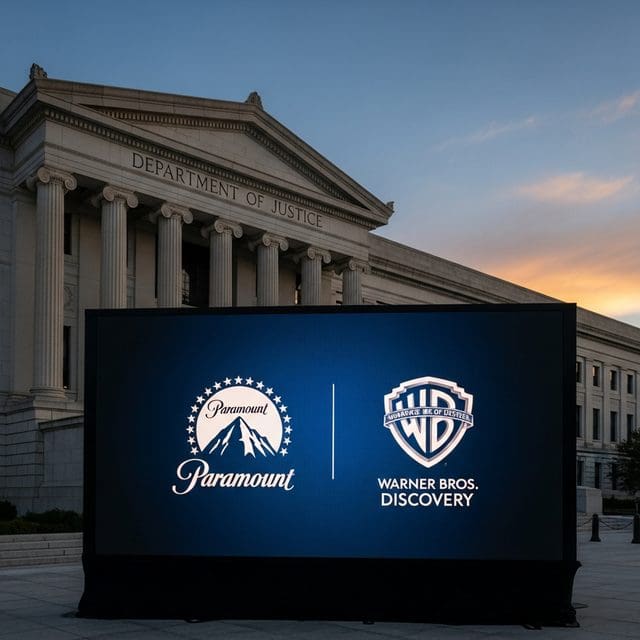
The Department of Justice cleared the Paramount-Warner Bros. Discovery merger despite internal warnings, as international regulators and state attorneys general prepare for potential legal challenges.
The Department of Justice Antitrust Division formally closed its investigation into the merger between Paramount and Warner Bros. Discovery on June 11, signaling a green light for one of the most significant media consolidations in recent history. The department framed the decision as a win for consumers and workers, concluding that the tie-up is unlikely to cause harm across streaming, linear television, or theatrical markets. However, the move has sparked internal friction and external skepticism regarding the integrity of the merger review process.
Reports emerging since June 15 indicate that senior political leadership at the DOJ effectively overruled career antitrust staff to secure this outcome. Internal investigators had reportedly been leaning toward a recommendation to block the deal on anti-competitive grounds, citing long-term concerns over market concentration. This disconnect between career experts and political appointees raises uncomfortable questions about the consistency of federal enforcement and whether the rigorous standards of the Antitrust Division are being sacrificed for political expediency or industry pressure.
While the federal government has stepped back, the merger remains under heavy fire from other jurisdictions. California Attorney General Rob Bonta is conducting an active review and has not ruled out a state-level lawsuit to block the transaction. Historically, state attorneys general have served as a critical backstop against corporate concentration when federal appetite for litigation wanes. Furthermore, the UK Competition and Markets Authority opened its own inquiry on June 9, adding a significant jurisdictional hurdle that could prolong regulatory uncertainty and force structural remedies.
The European Commission is also examining the deal under both standard merger rules and the EU Foreign Subsidies Regulation. This specific scrutiny focuses on the roughly $24 billion in backing from Gulf sovereign wealth funds, raising questions about how foreign capital influences domestic market competition. With provisional review deadlines set for early and mid-July, the global regulatory landscape remains a minefield for the two media giants despite the DOJ’s favorable ruling.
For the workforce, the human cost of this market power shift is becoming increasingly clear. Paramount has informed investors it intends to close the deal by the third quarter of 2026, promising at least $6 billion in cost savings. Local officials in Los Angeles estimate these “efficiencies” will translate to the loss of approximately 2,500 jobs in the region and 6,000 jobs globally. This pattern of consolidation followed by mass layoffs highlights the recurring tension between shareholder returns and the stability of the industrial labor market in the entertainment sector.
In a separate but related clash over regulatory boundaries, the CME Group filed a federal lawsuit on June 18 against the Commodity Futures Trading Commission and Chair Michael Selig. The suit seeks to void the CFTC’s May 29 approval of Kalshi and Coinbase perpetual futures, arguing the agency illegally bypassed stricter Dodd-Frank rules by misclassifying the products. Much like the DOJ’s internal rift, the CME’s challenge underscores a broader trend of institutional friction as regulators and market incumbents struggle to define the limits of corporate expansion and product innovation.
As the FTC simultaneously ramps up enforcement against deceptive pricing in the auto retail sector—prompting new industry training programs like RockED to address transparency—the Paramount-WBD clearance stands as a stark contrast. It suggests a bifurcated enforcement environment where small-scale consumer protection remains a priority, yet the largest corporate titans may still find a path to consolidation if they can navigate the political layers of Washington. For those concerned with the health of free-market competition, the DOJ’s willingness to ignore its own staff’s warnings suggests a troubling shift toward allowing massive market power to go unchecked.

Greg Sanders serves as the Senior Correspondent for Corporate Power and Antitrust at Just Right News, where he brings a principled, conservative perspective to the complex intersection of big business, government regulation, and the American consumer. With a career dedicated to investigative depth and economic clarity, Greg has become a leading voice in examining how the consolidation of industry power impacts the foundational values of the free market and individual liberty.
Raised in Denver, Colorado, Greg’s reporting is deeply informed by the Western spirit of independence and a healthy skepticism of centralized authority. Growing up in the shadows of the Rockies, he witnessed firsthand the importance of local entrepreneurship and the vital role that small-medium enterprises play in sustaining vibrant communities. This upbringing instilled in him a belief that the American Dream is best preserved when the playing field remains level and when competition—rather than backroom deals between corporate lobbyists and federal regulators—dictates success. For Greg, the rugged individualism of his home state serves as a constant reminder that the economy should serve the people, not the other way around.
Now based in Chicago, Illinois, Greg operates from the heart of the nation’s industrial and financial crossroads. His location in the Midwest provides him with a unique vantage point to observe the real-world consequences of corporate overreach. From the boardrooms of the Loop to the manufacturing hubs that define the region, he tracks the movement of capital and the shifting tides of market influence. Chicago’s history as a center of trade and labor offers a rich backdrop for his work, allowing him to bridge the gap between high-level economic theory and the lived experiences of hardworking Americans who feel the squeeze of monopolistic practices.
At Just Right News, Greg’s beat focuses on the “new monopolies” and the rise of “woke” corporate culture. He argues that when corporations become too large, they often abandon their fiduciary duties to shareholders in favor of social engineering and political posturing. His reporting seeks to hold these “Titans” accountable, ensuring that the power of the purse is not used to silence dissent or bypass the democratic process. He is a firm advocate for the idea that true conservatism requires a vigilant defense of competition, preventing any single entity—public or private—from exerting undue control over the lives of citizens.
This mission is most clearly seen in his acclaimed feature series, “The Titans and the Toll.” In this ongoing project, Greg explores the human cost of market consolidation, from the erosion of consumer choice to the decline of local economies. Through rigorous analysis and boots-on-the-ground reporting, he documents how the concentration of power in sectors like tech, agriculture, and finance creates a “toll” paid by the average family.
Greg Sanders remains committed to the idea that a transparent, competitive market is the greatest engine for prosperity ever devised. Through his work at Just Right News, he continues to provide the essential oversight necessary to protect that engine from the encroaching influence of corporate giants and the bureaucratic structures that enable them.