

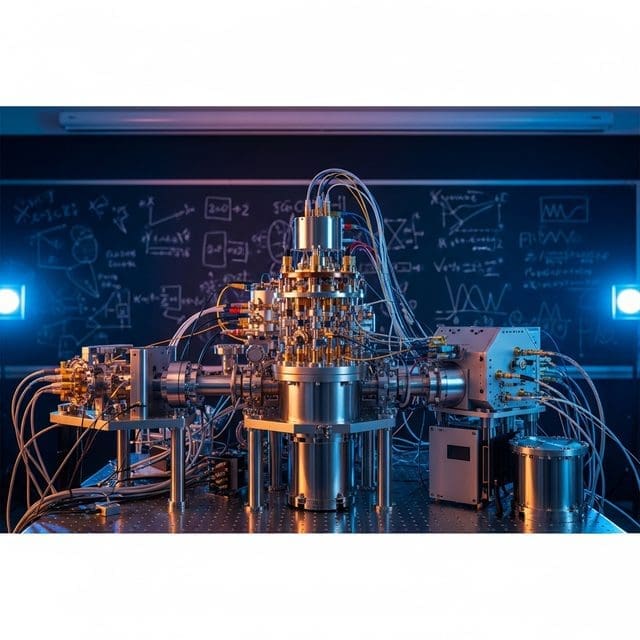
Recent breakthroughs at Oxford and CERN are redefining quantum reliability and hinting at undiscovered forces that could rewrite the Standard Model of physics.
The landscape of modern physics is undergoing a profound transformation this June as researchers bridge the gap between abstract quantum theory and the hard realities of engineering. From the hallowed halls of Oxford University to the massive subterranean rings of CERN, scientists are reporting breakthroughs that not only expand the catalog of known particles but also offer a path toward the long-sought goal of reliable, error-corrected quantum computing. These discoveries arrive at a pivotal moment for national sovereignty and technological leadership, as the race to master the subatomic realm intensifies.
At Oxford University, physicists have successfully realized a “new family” of Schrödinger’s cat states within a single trapped calcium ion oscillator. In quantum mechanics, a “cat state” refers to a system existing in a superposition of two vastly different states simultaneously. The Oxford team utilized engineered ion-motion entangling interactions and mid-circuit projective measurements to collapse these systems into arbitrary superpositions of highly nonclassical states. This achievement is significant because these states are built from components that are themselves inherently quantum. By widening the design space for these exotic states, researchers are creating more resilient encodings that could protect quantum information from the noise and decoherence that typically plague modern processors.
While Oxford focuses on the stability of the very small, the Large Hadron Collider (LHC) near Geneva continues to push the boundaries of high-energy physics. The ATLAS collaboration recently announced the first observation of the Bc*+ meson, an excited state composed of a charm quark and a bottom antiquark. This discovery marks the 84th new hadron identified at the LHC. To detect this particle, the team had to reconstruct very low-energy photons that convert into electron-positron pairs with transverse momenta as low as 100 MeV. The measured mass splitting of 64.5 MeV between the excited and ground states provides a precision benchmark for the strong nuclear force, the fundamental interaction that binds the core of all matter.
However, it is the data coming from rare “penguin decays” at the LHC that has the scientific community on edge. A recent analysis has detected a four-sigma tension with the Standard Model, the mathematical framework that has governed particle physics for decades. This statistical anomaly suggests that unknown particles or forces may be influencing the behavior of these rare decays. While a four-sigma result is not yet a formal discovery, it represents one of the strongest hints of “new physics” beyond the Standard Model ever recorded. If verified, it would necessitate a total re-evaluation of our understanding of the universe’s fundamental building blocks.
Practical applications of these theories are already appearing in the private sector and specialized research institutions. Florida State University physicists recently discovered unusual superconducting states in graphene, a material that could revolutionize quantum sensors. Simultaneously, the RIKEN institute has proposed a “one-way street” for phonons, or sound particles, which could allow for directional synchronization in quantum systems. This would effectively act as a noise-routing mechanism, reducing the crosstalk that currently limits the scale of quantum hardware.
As institutions like the Cleveland Clinic develop quantum models operating 500 times faster than previous methods, and companies like Amazon and QuEra promise useful error correction by 2028, the transition from theory to utility is accelerating. For the principled observer, these advancements represent more than just academic milestones; they are the precursors to a new era of decentralized innovation. Ensuring these powerful tools remain grounded in transparent, constitutional frameworks will be the next great challenge for the pioneers of the Future Frontier.

Mason Reed serves as a Staff Writer for Just Right News, where he spearheads the Future Frontiers & Special Projects desk. In an era defined by rapid technological shifts and evolving social landscapes, Mason provides a steady, principled voice, examining the innovations of tomorrow through the lens of traditional American values. His work is most prominently featured in his signature series, “The Next Horizon,” where he explores the intersection of emerging technology, national sovereignty, and the preservation of individual liberty.
A native of San Diego, California, Mason’s worldview was shaped by the unique culture of his hometown. Growing up in a region defined by its strong military presence and its history of maritime industry, he developed a deep-seated respect for the institutions that provide national stability and the entrepreneurial spirit that drives the American economy. This upbringing instilled in him a belief that true progress is not found in discarding the past, but in building upon a foundation of proven principles. His reporting often reflects this San Diego influence, emphasizing the importance of a robust national defense and the necessity of maintaining a competitive edge in the global marketplace.
Now based in San Francisco, Mason operates from the heart of the world’s technological engine. Living and working in the Bay Area provides him with a front-row seat to the advancements—and the ideological challenges—emanating from Silicon Valley. While many in the region embrace a “move fast and break things” mentality, Mason’s reporting serves as a vital counterweight. He offers Just Right News readers a “boots on the ground” perspective, documenting how radical local policies and the concentration of tech power impact the everyday lives of citizens. His proximity to the industry allows him to cut through the marketing jargon of big tech to uncover the real-world implications for privacy, free speech, and the nuclear family.
In his “Future Frontiers” beat, Mason tackles complex subjects ranging from the ethics of artificial intelligence to the burgeoning private space race. He approaches these topics with a healthy skepticism toward centralized bureaucracy, championing instead the decentralized innovations that empower individuals. Through “The Next Horizon,” he highlights the pioneers and thinkers who are working to ensure that the future remains a place where human dignity and constitutional rights are protected. He believes that the rapid pace of change requires more than just technical expertise; it requires a moral compass rooted in the Western tradition.
Throughout his tenure at Just Right News, Mason has remained committed to the idea that the future is something to be shaped, not merely accepted. His writing is characterized by a rigorous defense of American exceptionalism and a belief that the country’s best days lie ahead, provided it remains true to its founding ideals. Whether he is investigating the impact of automation on the American workforce or profiling the next generation of aerospace engineers, Mason Reed ensures that his readers are equipped with the insights they need to navigate a changing world with confidence and clarity.