

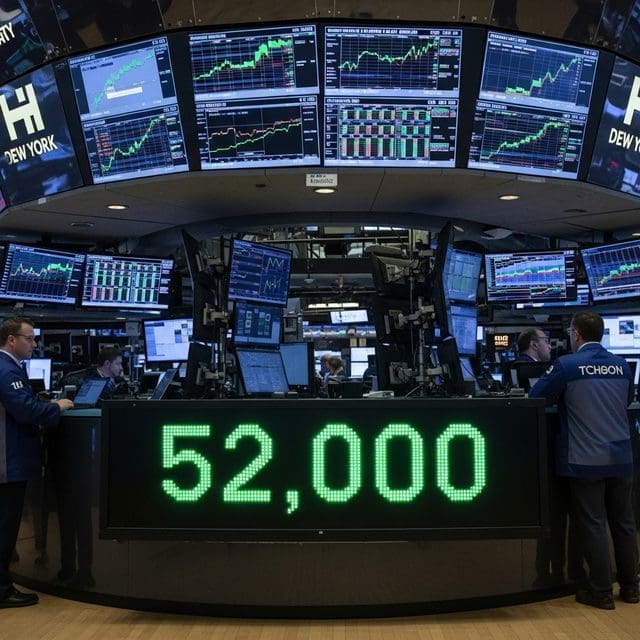
The Dow Jones Industrial Average reached a historic milestone as falling oil prices spurred a rotation into industrials, even as a sharp sell-off in semiconductor stocks weighed on the tech-heavy Nasdaq.
The American economic landscape shifted significantly on Tuesday as the Dow Jones Industrial Average climbed above the 52,000 mark for the first time. This milestone was driven by a decisive rotation of capital away from high-flying semiconductors and into the industrial heart of the U.S. economy. While the blue-chip index celebrated a record close of 51,999.67, the broader market reflected a complex reality. The S&P 500 slipped 0.57% and the Nasdaq Composite retreated 1.15%. Despite the intraday volatility, the SPY benchmark maintained a gain of 0.76% on the session, illustrating a tug-of-war between old-guard industrials and modern tech.
The primary catalyst for this divergence was the dramatic cooling of energy prices following the announcement of a ceasefire between the United States and Iran. With President Donald Trump confirming the termination of military operations and the reopening of the Strait of Hormuz, global energy markets reacted with force. Brent crude futures fell 5.06% to $78.96 a barrel, while West Texas Intermediate futures plummeted 5.82% to $76.05. For working households, this represents a reprieve at the pump, marking the first time both benchmarks have settled below $80 since early March. President Trump further clarified that the vital shipping passageway would remain toll-free, providing long-term clarity for global supply chains.
Industrials and financials led the charge higher as the prospect of lower energy overhead promised to invigorate domestic manufacturing. Caterpillar rose more than 1%, signaling confidence in heavy machinery, while JPMorgan Chase advanced more than 3%. This shift suggests a return to fundamental value, where tangible production and traditional banking are viewed as stable harbors compared to tech volatility. Investors are betting that lower energy prices will act as a de facto tax cut, potentially spurring a re-acceleration in the broader U.S. economy.
In contrast, the technology sector faced a harsh correction. Major chipmakers, the previous engines of market gains, saw a sharp reversal as investors locked in profits. Advanced Micro Devices dropped over 7%, while Micron Technology and Broadcom shed 6% and 4% respectively. Nvidia lost more than 2%. This sell-off occurred despite AI-related developments elsewhere, such as Rumble acquiring 22,000 Nvidia chips and Adecco reporting one million AI-powered candidate interactions. The divergence highlights a market increasingly sensitive to valuation and the scarcity of electricity as a commodity, as the AI boom drives companies across the economy into the energy business.
SpaceX remained a notable exception to the tech gloom, surging nearly 5% to close at $201.80. The company, which recently priced its IPO at $135, has seen historic demand from foreign investors and briefly surpassed the market caps of both Microsoft and Amazon during intraday trading. This performance underscores a continued appetite for national sovereignty in aerospace, even as traditional software firms like Adobe hit seven-year lows following executive departures. Meanwhile, fintech innovations continue to expand, with Digital Wallet Group launching its Smiles Mobile Remittance service and Binance enabling 24/7 trading of select stocks through its new bStocks tokenized securities.
As the market adjusts, all eyes turn to the Federal Reserve. Chair Kevin Warsh, presiding over his first meeting this week, faces the task of balancing a cooling energy market with a resilient consumer base. Analysts note that while falling oil prices lower headline inflation, they also put more money back in consumers’ pockets, which could fuel inflationary pressures. For the American worker, the day’s trade represents a transition toward a more stable monetary environment where Wall Street must finally align with the fiscal realities of Main Street production and energy independence.

Jordan Lee serves as the Senior Correspondent for Wall Street, Finance, and Monetary Systems at Just Right News. Based in the heart of the world’s financial capital, New York City, Lee brings a sharp, principled eye to the complex mechanisms that drive the global economy. His reporting is defined by a commitment to fiscal responsibility, the defense of the free market, and a deep-seated belief that a transparent monetary system is the bedrock of a free society.
Raised in Portland, Oregon, Lee’s perspective was forged in a city that has undergone significant cultural and economic shifts. His upbringing in the Pacific Northwest instilled in him a profound appreciation for the industriousness of small business owners and the importance of local economic stability. Watching the evolution of his hometown’s landscape sparked an early interest in how federal fiscal policy and large-scale financial trends eventually trickle down to the average citizen. This background provides him with a unique vantage point; he understands the growing disconnect between the policy-making elite and the reality of Main Street, a theme that frequently resonates throughout his work.
Now operating from his base in New York City, Lee bridges the gap between the high-stakes trading floors of Manhattan and the households of everyday Americans. He views the financial sector not merely as a collection of numbers and tickers, but as a vital engine of American prosperity that requires constant vigilance and accountability. His reporting often highlights the dangers of centralized financial control and the necessity of maintaining a system that rewards merit, risk-taking, and innovation.
As the creator and lead of the featured series, “The Invisible Economy,” Lee pulls back the curtain on the often-opaque world of monetary systems. He specializes in translating the dense jargon of central banking and international finance into actionable insights for the Just Right News audience. His work explores the “invisible” forces—such as inflationary pressures, regulatory creep, and the expansion of the administrative state—that erode the purchasing power of American families. By focusing on these systemic issues, Lee empowers readers to understand the hidden forces shaping their financial independence.
Lee’s journalistic philosophy is rooted in a steadfast commitment to traditional American values. As an Asian American professional who has navigated the competitive corridors of the financial world, he is a vocal advocate for meritocracy and the preservation of the American Dream. He believes that a stable currency and a predictable regulatory environment are essential for national sovereignty and individual liberty. His reporting frequently warns against the risks of government overreach in the private sector, arguing that the most effective solutions to economic challenges arise from competition and individual enterprise rather than bureaucratic mandates.
At Just Right News, Jordan Lee remains dedicated to providing a clear-eyed defense of the taxpayer. Whether he is analyzing market volatility or investigating the long-term implications of national debt, his mission is to provide the truth about where the money is going and what it means for the future of the country. Through his rigorous analysis and principled stance, Lee has become a trusted voice for those who value a strong, sovereign, and fiscally sound America.