

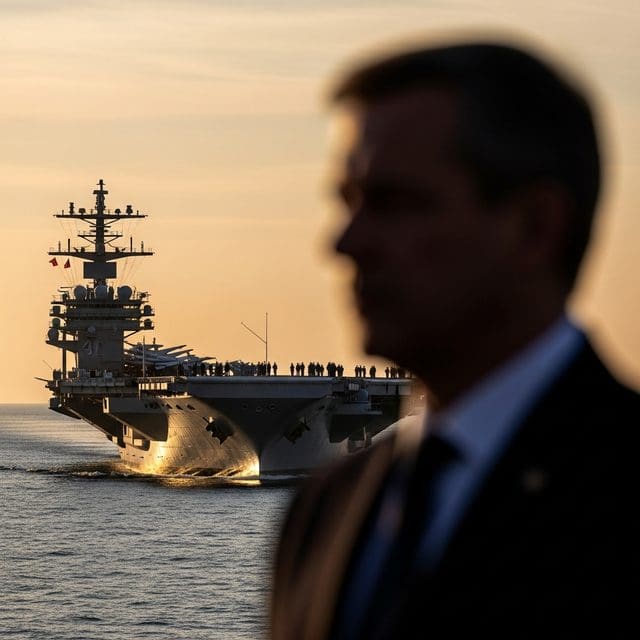
President Trump maintains a hardline stance at the G7 summit while the Pentagon recalibrates European defense commitments to prioritize the Indo-Pacific theater.
The landscape of American global leadership underwent a significant recalibration this week as the Trump administration balanced a high-stakes diplomatic opening with Iran against a broader structural pivot toward the Indo-Pacific. At the G7 summit in France, President Trump characterized the emerging peace framework with Tehran as a non-binding memorandum of understanding rather than a finalized treaty, warning world leaders that he remains prepared to resume military strikes if the terms shift against U.S. interests. In a characteristically blunt assessment, the President stated he would “go right back to dropping bombs” if Tehran misbehaves, explicitly contrasting his approach with the 2015 nuclear accord, which he mocked as a failed legacy of the Obama administration.
This “peace through strength” posture comes as the administration prepares for a formal signing ceremony in Switzerland this Friday. Mediated by Pakistan, the deal reportedly includes a 60-day ceasefire and a commitment from Tehran to halt the funding of regional proxy groups. However, the President clarified on Tuesday that the United States will not contribute to a previously discussed $300 billion reconstruction fund for Iran, insisting that the deal must stand on its own merits without American taxpayer investment. This reversal on the reconstruction fund has created a rift in the diplomatic narrative, as earlier reports suggested significant financial commitments were already on the table. Trump has countered this by signaling he will submit the final agreement to Congress for approval, a move intended to provide the constitutional legitimacy he argued was missing from previous executive-led diplomacy.
Domestic pressure regarding the agreement has intensified, particularly from conservative media and congressional allies who have labeled the framework “too vague” and “concerning.” Vice President JD Vance, who has been a primary architect of the administration’s foreign policy outreach, faces sharp criticism over the lack of public text regarding enforcement timelines and the status of frozen Iranian assets. Critics have begun labeling the arrangement as “his deal,” placing the political risk squarely on the Vice President’s shoulders. Despite these internal tensions, the administration remains focused on the broader strategic picture, maintaining that the deal can survive even as regional volatility persists, including ongoing Israeli operations in Lebanon.
Simultaneously, the Pentagon is executing a quiet but profound shift in its global force posture. U.S. defense planners have begun scaling back crisis commitments in Europe, removing at least one carrier strike group, a submarine, aerial refuelers, and dozens of fighter jets to prioritize the Indo-Pacific theater. This withdrawal has forced NATO allies to confront a new reality of self-reliance. Gen. Alexus Grynkewich has urged European nations and Canada to fill these gaps with their own manned and unmanned assets, even as intelligence suggests Russia is currently avoiding direct conflict with the alliance while occupied in Ukraine. The message from Washington is clear: the era of the American taxpayer bearing the primary burden for European security is evolving toward a model of regional responsibility.
Finland has emerged as a pivotal voice in this transition. As NATO’s newest front-line state, Helsinki has moved to lift its ban on nuclear weapons and continues to push for the sustained militarization of Ukraine. This hawkish stance reflects a growing realization among European capitals that the American security umbrella is being reconfigured to address the rising challenge of China. While G7 leaders have generally praised the prospect of reopening the Strait of Hormuz, they remain largely in the dark regarding the specific provisions of the U.S.-Iran framework. As the Friday deadline in Switzerland approaches, the administration’s focus remains on ensuring that any reduction in Middle Eastern or European tension serves the primary goal of freeing American resources for the mounting competition in the Pacific.

Olivia Kendall serves as the Senior Correspondent for Geopolitics, Defense, and Foreign Policy at Just Right News, where she provides a principled, conservative perspective on the complex forces shaping the global stage. With a career dedicated to deconstructing the intricacies of international relations, Kendall has become a trusted voice for readers who value national sovereignty, a robust military, and a foreign policy that prioritizes American interests above all else.
A native of Washington, D.C., Kendall’s professional journey is deeply rooted in her upbringing within the nation’s capital. Growing up in the epicenter of American political life, she developed an early and profound understanding of how policy is crafted and, more importantly, how it often fails to account for the values of the American heartland. This unique vantage point allowed her to witness firsthand the rise of globalist bureaucracies, fueling her commitment to reporting that champions the constitutional foundations of the United States. Her background as a British White American further informs her worldview, providing her with a keen appreciation for the Western tradition and the enduring importance of the “Special Relationship” in maintaining global stability.
Now based in Arlington, Virginia, Kendall operates from the doorstep of the Pentagon and the heart of the nation’s defense establishment. Her proximity to the decision-makers in the military and intelligence communities allows her to provide boots-on-the-ground reporting that is both timely and deeply informed. For Kendall, Arlington is more than just a base of operations; it is a daily reminder of the sacrifices made by the men and women in uniform. This connection to the defense community drives her rigorous coverage of military readiness and her advocacy for a “peace through strength” approach to diplomacy.
At Just Right News, Kendall is perhaps best known for her acclaimed feature series, “The World’s Shadow on America.” In this ongoing project, she explores the direct correlation between international developments and the daily lives of American citizens. Whether she is analyzing the encroachment of foreign adversaries in domestic supply chains or the impact of international treaties on local economies, Kendall’s work serves as a vital bridge between distant geopolitical shifts and their consequences at home. She rejects the notion that foreign policy is an abstract concern for elites, instead proving that what happens in the corridors of power in Brussels or Beijing has a tangible “shadow” that falls across every American doorstep.
Throughout her tenure, Kendall has remained a steadfast critic of international overreach and a vocal proponent of a clear-eyed, realistic foreign policy. She brings a sharp analytical mind to her beat, often challenging the prevailing narratives of the mainstream media to uncover the underlying truths that affect national security. Her reporting is characterized by a refusal to compromise on the truth and a dedication to the idea that a strong, secure America is the world’s best hope for liberty. As a Senior Correspondent, Olivia Kendall continues to lead the charge in providing the essential context and conservative insight necessary to navigate an increasingly volatile world.