

Schools and specialized professions face a mounting workforce crisis as Clark County cuts positions and medical attrition rates climb, signaling a need for market-aligned educational reform.
The traditional pipeline from the classroom to the workforce is facing an intense structural correction as public institutions and high-skill professions grapple with shifting demographics and economic pressures. In Nevada, the Clark County School District (CCSD) is navigating a projected enrollment drop of over 5,000 students, leading to the elimination of roughly 1,200 positions for the 2026–27 academic year. These cuts, including 680 licensed educator roles, reflect a necessity for districts to align staffing with actual student populations rather than relying on bloated administrative formulas. Analysis suggests that by embracing efficiency recommendations, CCSD could save $79 million while improving outcomes for multilingual and special needs students.
While CCSD leadership emphasizes that these moves are part of a transition toward a “Pupil-Centered Funding Plan” rather than across-the-board pay cuts, the shift underscores the fragility of the K-12 status quo. The district’s “Open Book” materials highlight a pivot toward school-level staffing formulas, yet the slow scale of specialized programs remains a concern. For instance, a Spanish-English dual-language pilot launched in 2022 remains a small, opt-in program serving only 120 students. This gap between national rhetoric and local implementation highlights the difficulty of scaling targeted solutions within massive bureaucratic frameworks.
This pressure on human capital is global. Russian President Vladimir Putin recently characterized artificial intelligence as an irreversible force that will reshape labor markets, tying AI adoption to national competitiveness. However, the reality of the Russian educational landscape is marred by conflict. Reports regarding a strike on a college building in the occupied Luhansk region—resulting in the deaths of 21 students aged 14 to 18—serve as a grim reminder of how geopolitical instability disrupts the cultivation of the next generation and creates wartime precarity for postsecondary education.
In the United States, the workforce crisis is visible in highly specialized fields where the return on educational investment is being questioned. A May 2026 study led by The Ohio State University found that nearly 10 percent of surgeons exit the profession within eight years of starting. This mid-career attrition has risen sharply since 2020, disproportionately affecting oral, OB-GYN, and plastic surgeons. A concurrent survey by Johnson & Johnson indicates that over 50 percent of surgeons report burnout, with 40 percent considering leaving the field. This suggests that even rigorous educational pathways fail to produce a sustainable workforce if the professional environment does not reward longevity.
Federal policy adds to these local and professional challenges. While Congress recently preserved core funding for Title I and IDEA grants, the Office of Management and Budget introduced significant uncertainty. Under Memo M-25-13, the administration delayed $6.2 billion in formula funds and paused discretionary grants. For school districts, this lack of fiscal predictability hinders long-term planning and the ability to pivot toward market-aligned training. True upward mobility requires an educational system that is both fiscally disciplined and responsive to economic demands. As the semiconductor industry sees a 14 percent increase in billings driven by AI investment, the need for a workforce that can adapt to high-tech demands has never been more urgent.
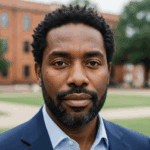
Daniel Owens serves as a Senior Correspondent for Just Right News, where he leads the newsroom’s coverage of Education, Workforce, and Upward Mobility. In an era where the national conversation often overlooks the practical foundations of success, Owens brings a principled perspective to the forefront of the media landscape. His work is defined by a commitment to the idea that a strong society is built on the pillars of quality education, a robust work ethic, and the removal of bureaucratic barriers to individual achievement.
Born and raised in Cleveland, Ohio, Owens’s worldview was shaped by the industrial landscape of the Midwest. Growing up in a city known for its grit and resilience, he witnessed firsthand the transformative power of steady employment and the devastating effects of economic stagnation. This background instilled in him a deep respect for the American worker and a healthy skepticism toward top-down government solutions that often fail to reach the communities they intend to help. As an African American man who has navigated the path to professional success, Owens approaches his beat with a nuanced understanding of how meritocracy and personal responsibility intersect with opportunity. He frequently draws on his roots to highlight the importance of family stability and community-led initiatives in fostering the next generation of leaders.
At Just Right News, Owens is the architect of the acclaimed feature series, “The Learning Curve.” Through this platform, he explores the evolving landscape of American schooling, from the rise of the school choice movement to the revitalization of trade schools and vocational training. He frequently challenges the status quo of higher education, advocating for a return to academic rigor and the practical alignment of degrees with market demands. For Owens, education is not merely about obtaining credentials; it is about equipping young people with the tools necessary to lead self-sufficient, meaningful lives. His reporting on “The Learning Curve” has become essential reading for parents and policymakers who believe that educational competition and parental rights are the keys to a brighter future.
Now based in Raleigh, North Carolina, Owens finds himself at the heart of one of the nation’s most dynamic regions for innovation and growth. Raleigh’s unique blend of traditional values and a fast-paced economy provides the perfect backdrop for his reporting on the modern workforce. From the tech hubs of the Research Triangle to the rural communities of the South, he tracks how shifts in the economy are impacting families and local industries. His reporting often highlights the success stories of entrepreneurs and workers who are thriving by embracing the values of hard work and innovation.
Throughout his career, Daniel Owens has remained a steadfast voice for the student seeking a better path and the worker striving for a better life. His reporting for Just Right News serves as a vital resource for readers who value common-sense solutions to the challenges of the 21st-century economy. By focusing on the intersection of policy and the human spirit, Owens continues to provide a roadmap for how individuals and communities can achieve lasting upward mobility.