

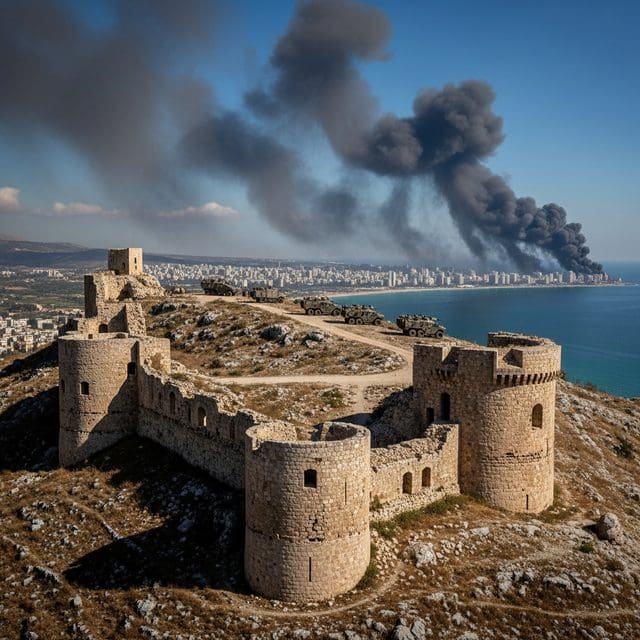
Israel expands its Lebanon ground campaign to seize Beaufort Castle while the U.S. Treasury blacklists Chinese front companies to sever the IRGC’s remaining financial lifelines.
The geopolitical landscape in the Middle East shifted sharply this week as Israel transitioned from border containment to a broader anti-Hezbollah campaign in Lebanon. Prime Minister Benjamin Netanyahu ordered air and ground forces to strike targets in Beirut’s southern suburbs, a move regional analysts interpret as a bid for maximum leverage in ongoing U.S.-Iran ceasefire negotiations. This escalation follows the deepest Israeli incursion into Lebanon in 26 years, marked by the capture of the strategic Beaufort Castle beyond the Litani River. The move prompted France to demand an emergency UN Security Council session to address the shift from border security to a full-scale campaign that risks an open Israel-Lebanon war.
In Washington, the Trump administration is doubling down on its ‘peace through strength’ doctrine. President Trump signaled on May 27 that Iran is currently “negotiating on fumes,” asserting that domestic political cycles will not alter his administration’s war strategy. This posture was reinforced during a White House Situation Room meeting on May 29, where officials deliberated on the extension of a potential Iran ceasefire deal. To further tighten the squeeze, the U.S. Treasury and OFAC blacklisted three individuals and nine firms across Hong Kong, the UAE, and Oman for facilitating IRGC-linked oil shipments to China. These measures target the ‘shadow fleet’ of some 40 shippers that have allowed Tehran to bypass international restrictions.
Beijing has responded with unprecedented legal friction. For the first time, China activated its anti-foreign-sanctions law, ordering domestic firms to ignore U.S. penalties on at least five refiners. While China officially claims it has imported no Iranian oil since 2022, the reliance on ship-to-ship transfers remains a vital energy artery for the Chinese economy. This legal standoff underscores a growing rift between Western enforcement and Chinese energy security needs, as Beijing seeks to shield its discount Iranian barrels from American secondary sanctions.
The human and economic costs of the conflict are mounting. Lebanon’s government reports over 3,370 deaths and 1.2 million displaced citizens since the campaign began. Despite the violence, Lebanese President Michel Moawad has signaled that Beirut remains committed to a diplomatic track, though he cautioned that negotiations with Israel “need time.” This diplomatic window remains open even as Hezbollah continues rocket and drone fire into Israeli territory, providing a fragile track for mediators in Washington, Paris, and Doha to pursue while the kinetic conflict intensifies on the ground.
Global energy markets are now explicitly pricing the Lebanon front and the U.S.-Iran tit-for-tat into risk premia. Brent crude has jumped back above $93 per barrel, and WTI has climbed toward $91, reversing a significant portion of the price slides seen in May. Traders are increasingly concerned about the security of the Strait of Hormuz, a chokepoint that carries roughly a quarter of global seaborne oil. The threat of Iranian mines or maritime interference has sharpened as the U.S.-Israel campaign against Tehran’s proxies reaches a fever pitch.
At the United Nations, diplomats are grappling with the reality of a reduced UNIFIL footprint as Israeli forces push deeper into sovereign Lebanese territory. The capture of Beaufort Castle is seen as a symbolic and tactical turning point, giving Israel oversight of the Litani valley. For the United States, the challenge remains balancing the support of a key ally’s security objectives with the necessity of preventing a total collapse of regional maritime trade. As the midterm elections approach, the administration remains firm that its strategy is dictated by national security interests rather than political expediency.

Olivia Kendall serves as the Senior Correspondent for Geopolitics, Defense, and Foreign Policy at Just Right News, where she provides a principled, conservative perspective on the complex forces shaping the global stage. With a career dedicated to deconstructing the intricacies of international relations, Kendall has become a trusted voice for readers who value national sovereignty, a robust military, and a foreign policy that prioritizes American interests above all else.
A native of Washington, D.C., Kendall’s professional journey is deeply rooted in her upbringing within the nation’s capital. Growing up in the epicenter of American political life, she developed an early and profound understanding of how policy is crafted and, more importantly, how it often fails to account for the values of the American heartland. This unique vantage point allowed her to witness firsthand the rise of globalist bureaucracies, fueling her commitment to reporting that champions the constitutional foundations of the United States. Her background as a British White American further informs her worldview, providing her with a keen appreciation for the Western tradition and the enduring importance of the “Special Relationship” in maintaining global stability.
Now based in Arlington, Virginia, Kendall operates from the doorstep of the Pentagon and the heart of the nation’s defense establishment. Her proximity to the decision-makers in the military and intelligence communities allows her to provide boots-on-the-ground reporting that is both timely and deeply informed. For Kendall, Arlington is more than just a base of operations; it is a daily reminder of the sacrifices made by the men and women in uniform. This connection to the defense community drives her rigorous coverage of military readiness and her advocacy for a “peace through strength” approach to diplomacy.
At Just Right News, Kendall is perhaps best known for her acclaimed feature series, “The World’s Shadow on America.” In this ongoing project, she explores the direct correlation between international developments and the daily lives of American citizens. Whether she is analyzing the encroachment of foreign adversaries in domestic supply chains or the impact of international treaties on local economies, Kendall’s work serves as a vital bridge between distant geopolitical shifts and their consequences at home. She rejects the notion that foreign policy is an abstract concern for elites, instead proving that what happens in the corridors of power in Brussels or Beijing has a tangible “shadow” that falls across every American doorstep.
Throughout her tenure, Kendall has remained a steadfast critic of international overreach and a vocal proponent of a clear-eyed, realistic foreign policy. She brings a sharp analytical mind to her beat, often challenging the prevailing narratives of the mainstream media to uncover the underlying truths that affect national security. Her reporting is characterized by a refusal to compromise on the truth and a dedication to the idea that a strong, secure America is the world’s best hope for liberty. As a Senior Correspondent, Olivia Kendall continues to lead the charge in providing the essential context and conservative insight necessary to navigate an increasingly volatile world.