

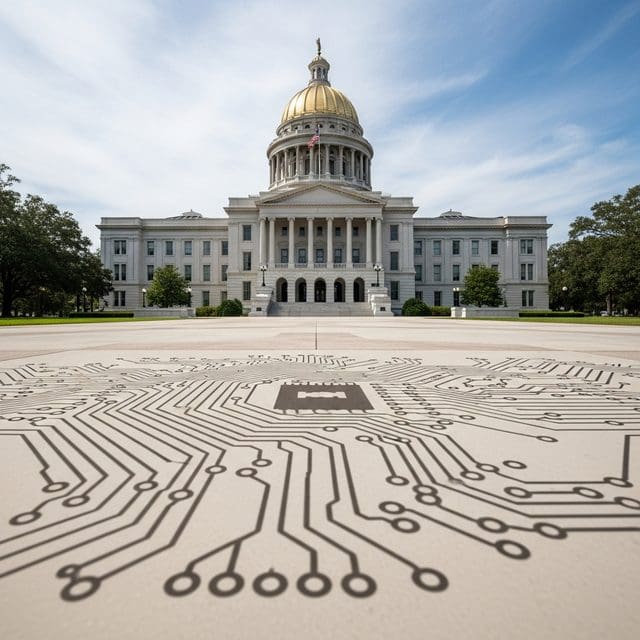
Florida Attorney General James Uthmeier is leveraging state police powers to sue OpenAI, positioning the Sunshine State as a primary regulator of artificial intelligence amidst federal inaction.
The Sunshine State is reasserting its role as a primary laboratory of governance, this time on the digital frontier. Florida Attorney General James Uthmeier filed an expansive 83-page civil complaint on June 1, 2026, against OpenAI and its CEO, Sam Altman. The suit alleges that the company’s flagship product, ChatGPT, “aided” the April 2025 shooting at Florida State University and has contributed to a rise in self-harm and addiction among the state’s youth. By invoking state unfair trade practices, product liability, and public nuisance statutes, Florida is testing whether traditional state police powers can bridge the gap left by federal regulators who have failed to keep pace with the rapid evolution of artificial intelligence.
This litigation is the centerpiece of a dual-track strategy designed to protect Florida citizens from the unintended consequences of the AI “arms race.” Uthmeier has already launched a criminal investigation into the firm, subpoenaing internal training materials, safety policies, and organizational charts. Simultaneously, he is pressing the Florida legislature for new, AI-specific safeguards that would codify restrictions on youth safety, data security, and foreign access. This multifaceted approach provides a blueprint for other states to exert pressure on Silicon Valley without waiting for a consensus in Washington. It is a clear signal that when the federal government abdicates its role in ensuring public safety, the states remain the final line of defense. The complaint specifically asks courts to order operational changes to OpenAI’s safety systems and disclosures within Florida, effectively positioning the state as a de-facto regulator.
The movement is not limited to Florida, though the Sunshine State’s approach is notably more aggressive. Across the country, state attorneys general are repurposing existing laws to address AI conduct. While Michigan Attorney General Dana Nessel has focused on defending state regulatory space against federal preemption, Florida’s model is more punitive, focusing on public safety and criminal liability. This ideological diversity illustrates the Tenth Amendment in action, as states develop distinct frameworks for technological oversight. In Michigan, Nessel has publicly opposed proposals in Congress that would ban or preempt robust state AI laws, warning that stripping state authority would undercut consumer-protection experiments and leave residents dependent on weaker, one-size-fits-all federal standards. This friction between state and federal authority is a hallmark of the American system, ensuring that no single entity holds a monopoly on policy innovation.
Florida’s complaint adds to a growing wave of decentralized legal challenges that are forcing a national conversation on corporate responsibility. Legal analysts are closely watching cases like Nippon Life v. OpenAI and various copyright-scraping suits as part of a broader trend where plaintiffs use “old” state statutes—such as wiretap and biometric privacy laws—to attack modern AI conduct. Even internationally, the pressure is mounting; victims’ families from a major Canadian mass shooting recently filed seven federal suits in San Francisco, alleging OpenAI knew of potential attacks via ChatGPT logs months in advance but remained silent to protect a potential near-trillion-dollar IPO. These overlapping jurisdictions highlight the necessity of local and state-level intervention when global corporations operate across borders with minimal oversight.
As Congress continues to struggle with the complexities of a comprehensive AI statute, the burden of governance has shifted decisively to statehouses and local courtrooms. From biometric privacy suits in the Midwest to public nuisance claims in the South, the decentralized American system is proving that local institutions remain the most agile responders to new societal risks. Florida’s demand for court-ordered operational changes to OpenAI’s safety systems within its borders represents a bold assertion of state sovereignty. Whether these state-level experiments will eventually be stifled by federal preemption remains the next great constitutional question for the digital age, but for now, the laboratories of democracy are leading the way in holding tech giants accountable to the communities they serve.

Dylan Brooks serves as the Senior Correspondent for Statehouses and Local Governance at Just Right News, where he brings a principled, constitutionalist lens to the often-overlooked machinery of state-level politics. As the lead voice behind the acclaimed feature series “Fifty Laboratories of Power,” Dylan has dedicated his career to the idea that the most impactful governance happens closest to home. His reporting consistently champions the Tenth Amendment, exploring how individual states can serve as testing grounds for innovative, conservative policy solutions that prioritize personal liberty and fiscal responsibility.
A native of Des Moines, Iowa, Dylan’s journalistic philosophy was forged in the heart of the American Midwest. Growing up in a community where local school board meetings and town halls were the bedrock of civic life, he developed a deep appreciation for the “retail politics” of the heartland. This upbringing instilled in him a fundamental belief that the American experiment is best preserved when power is decentralized. He carries the values of his Iowa roots into every assignment, maintaining a healthy skepticism of federal overreach and a steadfast commitment to the concerns of everyday citizens over the interests of the administrative state.
Now based in Madison, Wisconsin, Dylan operates from one of the nation’s most pivotal political battlegrounds. His location in a state capital known for its rigorous policy debates allows him to provide Just Right News readers with a front-row seat to the legislative process. From Madison, he tracks the ripple effects of statehouse decisions on local municipalities, ensuring that the connection between high-level policy and community impact is never lost. His work often highlights the success of conservative governors and legislatures in fostering economic growth, protecting parental rights, and securing the integrity of local institutions.
As an African American man in the conservative media landscape, Dylan offers a vital perspective on how limited government and free-market principles empower individuals and families. He frequently reports on how deregulation and school choice initiatives provide new avenues for success in underserved communities, challenging the monolithic narratives often presented by legacy media outlets. Dylan’s work is characterized by a commitment to the facts and a refusal to shy away from the complex realities of modern governance.
Throughout his tenure at Just Right News, Dylan has become a trusted authority for readers who value a rigorous, principled approach to the news. Whether he is dissecting a complex state budget or profiling a local grassroots movement, his goal remains the same: to provide the American public with the information they need to hold their local leaders accountable. By focusing on the “Fifty Laboratories of Power,” Dylan Brooks ensures that the vital work being done in statehouses across the country receives the national attention it deserves, always through a lens that respects the traditions and sovereignty of the American people.