

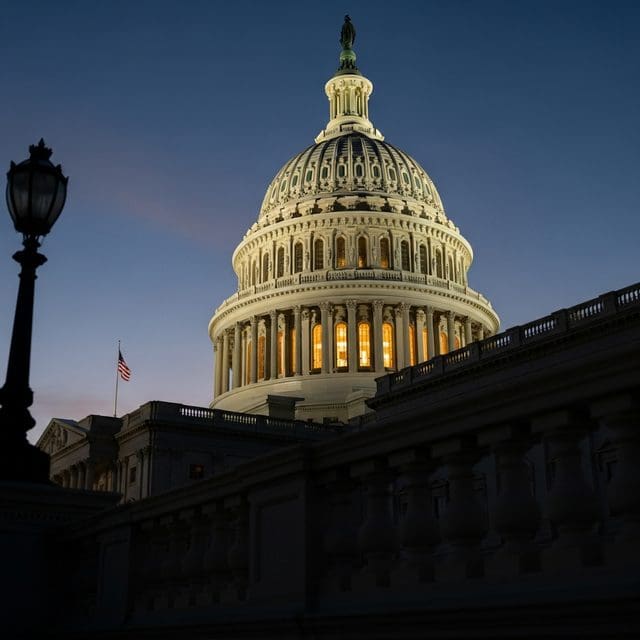
A bipartisan Senate coalition moved to restrict military action in Iran while House Republicans prepared to abandon a controversial $1 billion security plan for the White House ballroom.
The constitutional balance of power shifted toward the legislative branch this week as the Senate moved to assert its Article I authority over the executive’s conduct of foreign hostilities. In a narrow 50–47 procedural vote, the chamber opted to begin formal debate on a war-powers resolution that would require President Donald Trump to terminate military operations against Iran unless Congress provides a specific Authorization for Use of Military Force. The measure, sponsored by Senator Tim Kaine, represents one of the sharpest challenges to the administration’s military discretion since the conflict began roughly two months ago.
The coalition that advanced the measure was notably bipartisan, with four Republicans—Senators Susan Collins, Lisa Murkowski, Rand Paul, and Bill Cassidy—breaking ranks to join the Democratic caucus. This defection is particularly significant in the case of Senator Cassidy, who recently faced a primary defeat; his vote is being viewed by some within the party as a warning sign regarding the President’s floor support for future national security and oversight fights. The White House has argued that the resolution is unnecessary, claiming that hostilities have terminated due to a ceasefire, but critics point to continued U.S. deployments as evidence of an ongoing conflict lacking a clear legislative mandate.
While the Senate grapples with foreign policy, a separate fiscal battle is unfolding over the domestic seat of power. Congressional Republicans are now expected to abandon a $1 billion security package intended for the White House complex. This proposal became a lightning rod for criticism after it was revealed that $220 million of the funds were earmarked for high-tech security features—including bulletproof glass, drone detection, and chemical filtration systems—specifically for a new $400 million ballroom addition. The broader ballroom project has faced intense scrutiny from preservation groups, who argue it represents an inappropriate overhaul of the historic residence without proper legislative review.
The Department of Justice attempted to frame the ballroom project as a national security necessity, citing a recent shooting incident at the White House Correspondents’ Dinner. However, the National Trust for Historic Preservation has refused to drop its lawsuit against the administration. A federal judge had previously ordered a halt to construction unless Congress explicitly approved the change, creating a legal bottleneck that has made Republican leadership in the House increasingly wary of the project’s political optics. This retreat suggests that even a friendly Congress has limits when the price tag for executive projects reaches the billion-dollar threshold.
Beyond the halls of the Capitol, the administrative state continues to expand its footprint. On May 19, the Department of Justice established a $1.776 billion ‘anti-weaponization fund’ as part of a settlement following the President’s litigation against the IRS. This move was immediately met with resistance from Representative Jamie Raskin, who introduced legislation on May 20 to block the fund from making payouts. These maneuvers over federal funds occur as the American public faces significant economic pressure, with average gasoline prices exceeding $4 per gallon in all 50 states and the District of Columbia.
As the Senate prepares for a final vote on the Iran resolution, the measure faces long odds in the Republican-controlled House and an almost certain presidential veto. Nevertheless, the willingness of the Senate to force a public debate on war powers and the simultaneous collapse of the White House security funding plan signal a renewed appetite for oversight. For a conservative audience concerned with the expansion of the administrative state and executive overreach, these developments represent a critical test of whether the legislature can successfully reclaim its role as a steward of the public trust and a check on the executive branch.

Miles Harrington serves as the Senior Correspondent for Federal Systems & Executive Power at Just Right News, where he brings a disciplined, constitutionalist lens to the inner workings of the American government. With a focus on the mechanics of the federal bureaucracy and the limits of executive authority, Harrington has established himself as a vital voice for readers who value transparency, accountability, and the preservation of the separation of powers.
A native of Richmond, Virginia, Harrington’s perspective is deeply rooted in the traditions of the Old Dominion. Growing up in a city defined by its historical significance and its role as a center of American jurisprudence, he developed an early appreciation for the foundational principles of the Republic. His upbringing in Richmond—a place where the legacy of the Founding Fathers is woven into the landscape—instilled in him a belief that the federal government should remain within its constitutional bounds. This background informs his skepticism of centralized overreach and his commitment to reporting on the ways in which the administrative state impacts the lives of everyday citizens.
In his current role, Harrington specializes in the complexities of federal systems. He doesn’t just report on the headlines of the day; he digs into the structural shifts within the executive branch that often go unnoticed by the mainstream press. Whether he is analyzing the implications of a new federal regulation or investigating the expansion of agency jurisdiction, his work is characterized by a rigorous adherence to the facts and a dedication to the rule of law.
Harrington is perhaps best known for his signature feature series, “How Washington Works.” Through this ongoing project, he demystifies the often-opaque processes of the nation’s capital, pulling back the curtain on the “Deep State” and the unelected officials who wield significant influence over national policy. By breaking down complex legislative maneuvers and executive orders, he empowers Just Right News readers to understand the true levers of power in Washington. His reporting serves as a necessary check on the federal government, ensuring that the actions of those in power are held up to the light of public scrutiny.
Now based in Washington, D.C., Harrington operates at the epicenter of the political world, yet he remains intentionally distanced from the “Beltway bubble.” His proximity to the halls of power allows him to maintain a robust network of sources across the federal landscape, but his heart remains in the principled conservatism of his Virginia roots. He views his role not merely as a reporter, but as a steward of the public trust, dedicated to providing the clarity and context that conservative voters need to navigate an increasingly complex political environment.
Through his sharp analysis and unwavering commitment to the truth, Miles Harrington continues to be a cornerstone of the Just Right News team. His work ensures that the principles of limited government and executive restraint remain at the forefront of the national conversation, providing a crucial service to those who believe in a government that is truly of, by, and for the people.