

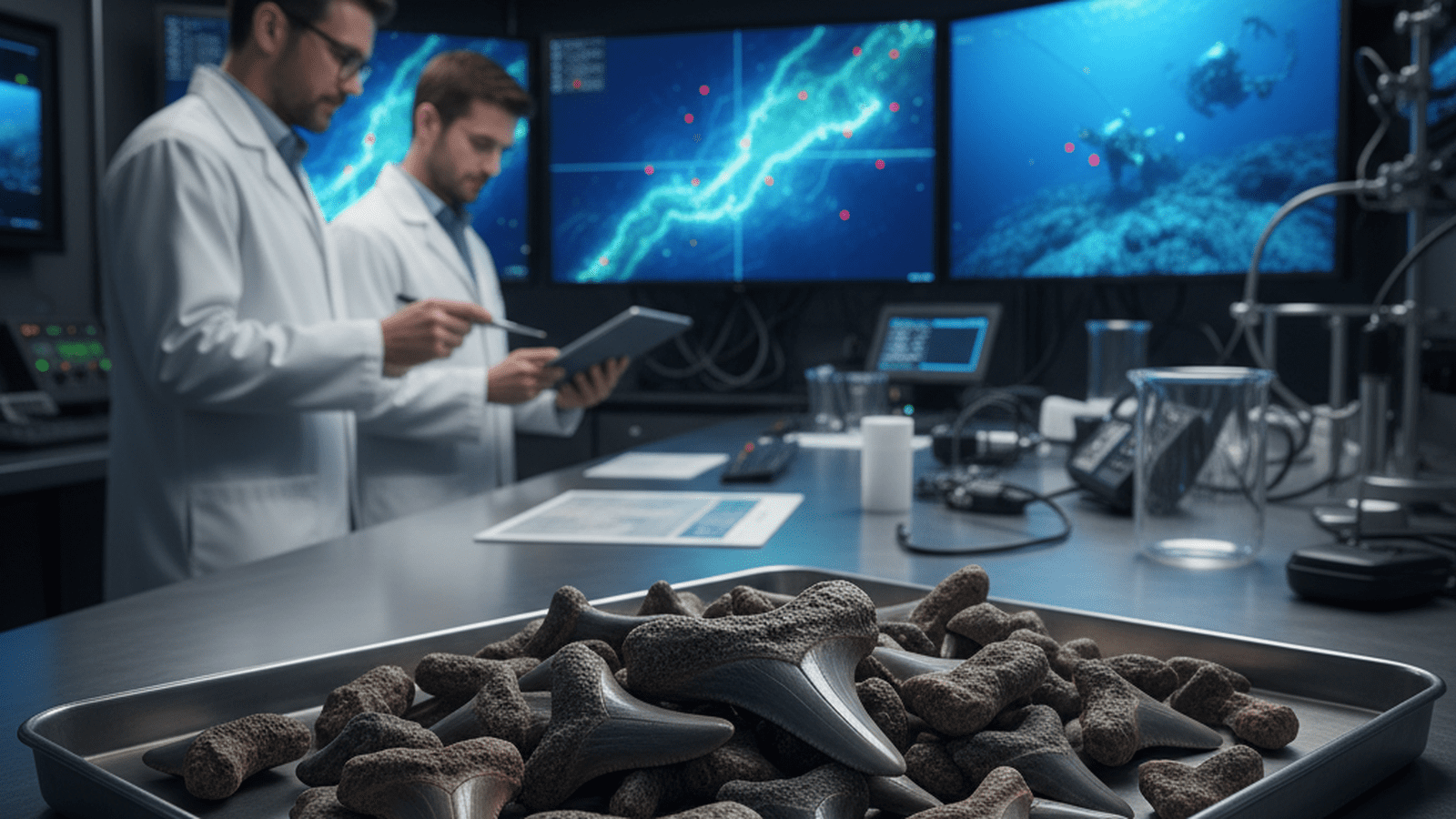
Scientists from Australia’s national science agency, CSIRO, discovered a vast graveyard of shark teeth 5,400 meters below the Indian Ocean. The collection includes over 750 teeth from both modern species and ancient ancestors of the megalodon, offering a unique record of marine evolution.
TLDR: Researchers aboard the CSIRO vessel RV Investigator discovered a massive shark tooth graveyard in the Indian Ocean. The haul contains over 750 teeth from diverse species, including prehistoric ancestors of the megalodon. This discovery provides unprecedented insights into the long-term biodiversity and evolutionary history of deep-sea apex predators.
Marine scientists operating under the auspices of Australia’s national science agency, CSIRO, have documented a remarkable find on the floor of the Indian Ocean. During a biodiversity survey of the Gascoyne Marine Park, researchers aboard the RV Investigator deployed a trawl at depths reaching 5,400 meters. When the equipment returned to the surface, it contained a concentrated collection of more than 750 shark teeth. This graveyard represents a significant chronological cross-section of marine life, spanning millions of years of evolutionary history.
The discovery occurred near the Cocos (Keeling) Islands, a remote territory where the seafloor drops into vast, under-explored abyssal plains. The teeth recovered vary significantly in size and state of preservation. Some belong to modern species, such as the mako and great white sharks, while others are heavily mineralized fossils from the distant past. The most striking specimens are those belonging to the direct evolutionary ancestor of the megalodon, the largest shark to ever inhabit the Earth’s oceans.
Dr. Will White, a shark expert from CSIRO’s Australian National Fish Collection, noted that the sheer density of the find is unusual. While shark teeth are commonly found in the fossil record due to their high mineral content, finding such a large volume in a single location on the modern seafloor is rare. The site appears to be a natural deposition point where currents or seafloor topography have concentrated biological remains over millennia. This provides a unique opportunity for biologists to study the transition of species within a single geographic context.
The RV Investigator is a state-of-the-art research vessel equipped with specialized dredging tools and deep-sea cameras. During this specific leg of the voyage, the team was surprised to find that the dredge was almost entirely filled with teeth rather than the expected sediment and rock samples. Among the collection were teeth from the Carcharodon carcharias and various species of threshers. However, the most scientifically significant find was the teeth of the Otodus lineage, which includes the ancestors of the massive megalodon. These teeth show the transition from smaller, serrated forms to the massive structures that defined the prehistoric giant.
The Gascoyne Marine Park, where the discovery was made, is one of the most remote marine environments on the planet. The park’s deep-sea plains are characterized by low nutrient levels, yet the abundance of shark remains suggests that the upper water columns have historically been teeming with life. This disconnect between the surface productivity and the abyssal floor is a key area of interest for the CSIRO team. They are investigating whether the graveyard is the result of a natural accumulation over millions of years or if it marks a specific migratory corridor used by these predators across epochs.
Beyond the shark teeth, the mission also yielded discoveries of new fish species and complex deep-sea habitats. The team utilized advanced multibeam sonar to map the rugged terrain of the seafloor, identifying underwater mountains and canyons that serve as hotspots for biodiversity. These geological features often dictate the movement of nutrient-rich currents, which in turn support the large populations of prey necessary to sustain diverse shark communities.
The implications of this discovery extend to the field of paleo-oceanography. By dating the fossilized teeth and examining the sediment layers in which they were found, scientists can gain insights into past ocean temperatures and nutrient levels. This historical data is crucial for climate modeling, as it helps researchers understand how marine ecosystems responded to previous periods of global environmental change. Future research will focus on the chemical composition of the teeth to determine the specific eras they represent, ensuring that marine conservation efforts are grounded in a deep understanding of evolutionary history.

Mason Reed serves as a Staff Writer for Just Right News, where he spearheads the Future Frontiers & Special Projects desk. In an era defined by rapid technological shifts and evolving social landscapes, Mason provides a steady, principled voice, examining the innovations of tomorrow through the lens of traditional American values. His work is most prominently featured in his signature series, “The Next Horizon,” where he explores the intersection of emerging technology, national sovereignty, and the preservation of individual liberty.
A native of San Diego, California, Mason’s worldview was shaped by the unique culture of his hometown. Growing up in a region defined by its strong military presence and its history of maritime industry, he developed a deep-seated respect for the institutions that provide national stability and the entrepreneurial spirit that drives the American economy. This upbringing instilled in him a belief that true progress is not found in discarding the past, but in building upon a foundation of proven principles. His reporting often reflects this San Diego influence, emphasizing the importance of a robust national defense and the necessity of maintaining a competitive edge in the global marketplace.
Now based in San Francisco, Mason operates from the heart of the world’s technological engine. Living and working in the Bay Area provides him with a front-row seat to the advancements—and the ideological challenges—emanating from Silicon Valley. While many in the region embrace a “move fast and break things” mentality, Mason’s reporting serves as a vital counterweight. He offers Just Right News readers a “boots on the ground” perspective, documenting how radical local policies and the concentration of tech power impact the everyday lives of citizens. His proximity to the industry allows him to cut through the marketing jargon of big tech to uncover the real-world implications for privacy, free speech, and the nuclear family.
In his “Future Frontiers” beat, Mason tackles complex subjects ranging from the ethics of artificial intelligence to the burgeoning private space race. He approaches these topics with a healthy skepticism toward centralized bureaucracy, championing instead the decentralized innovations that empower individuals. Through “The Next Horizon,” he highlights the pioneers and thinkers who are working to ensure that the future remains a place where human dignity and constitutional rights are protected. He believes that the rapid pace of change requires more than just technical expertise; it requires a moral compass rooted in the Western tradition.
Throughout his tenure at Just Right News, Mason has remained committed to the idea that the future is something to be shaped, not merely accepted. His writing is characterized by a rigorous defense of American exceptionalism and a belief that the country’s best days lie ahead, provided it remains true to its founding ideals. Whether he is investigating the impact of automation on the American workforce or profiling the next generation of aerospace engineers, Mason Reed ensures that his readers are equipped with the insights they need to navigate a changing world with confidence and clarity.