

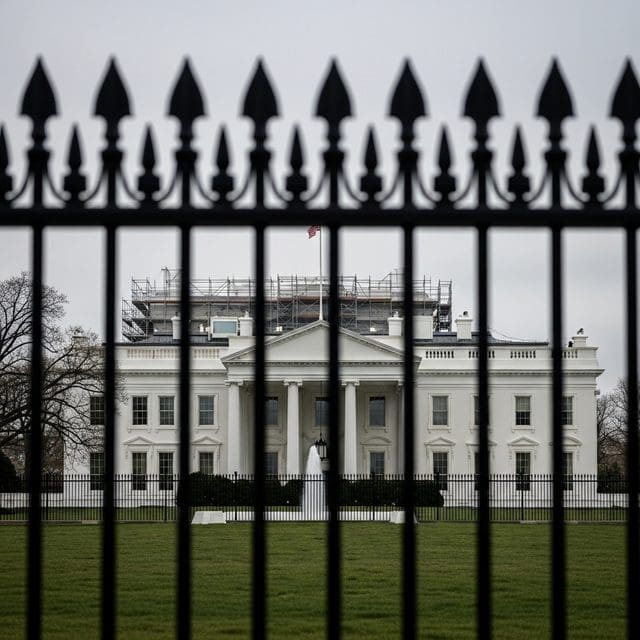
Senate Republicans are utilizing budget reconciliation to fund a billion-dollar security overhaul of the White House complex following a high-profile assassination attempt, drawing sharp criticism from Democrats over fiscal transparency.
A significant legislative battle is taking shape in the Senate as Republicans move to advance a $72 billion reconciliation package that includes $1 billion specifically earmarked for security upgrades at the White House. The proposal, which aims to restore funding for immigration enforcement and harden the executive residence, has drawn intense scrutiny from congressional Democrats and fiscal conservatives alike.
The impetus for the funding surge follows the April 25 arrest of Cole Tomas Allen, who was charged with attempting to assassinate President Trump during the White House Correspondents’ Association dinner. In response, the Senate bill designates funds for the U.S. Secret Service to implement “security adjustments and upgrades” for a new ballroom project. According to the legislative text, these funds are restricted to above-ground and below-ground security features, including bomb shelters, drone defense systems, and bulletproof glass.
Senate Majority Leader Chuck Schumer has signaled a vigorous challenge to the measure, characterizing it in a letter to colleagues as a “deficit-busting” endeavor. Schumer indicated that Democrats intend to petition the Senate parliamentarian to strike the ballroom provision from the budget bill, arguing that the expenditure is an inappropriate use of the reconciliation process. The Democratic leadership has also criticized the bill for restoring funding to Immigration and Customs Enforcement (ICE) operations, which they have blocked since February.
From a constitutional and oversight perspective, the scale of the request has prompted questions regarding the separation of private and public interests. While President Trump has stated the primary construction of the ballroom would cost $400 million in private funds, the $1 billion federal request is dedicated solely to the security infrastructure surrounding it. This distinction has led some Republicans to exercise caution. Representative Rob Wittman of Virginia has stated he will scrutinize whether the expenditures are truly in the national interest, seeking a granular breakdown of the costs versus the total construction scope.
The White House has defended the proposal as a “long overdue” necessity to modernize the complex’s defenses. Spokesperson Davis Ingle noted that the fortification would include medical facilities and military installations beneath the East Wing. However, the project remains entangled in legal challenges, as the National Trust for Historic Preservation continues its efforts to halt construction on the historic grounds.
As the Senate prepares to vote this week, the bill’s path through the House remains uncertain. Without a released House version or guaranteed unified GOP support, the administrative push to expand the executive’s physical footprint and security apparatus faces a rigorous test of legislative transparency and fiscal priority.

Miles Harrington serves as the Senior Correspondent for Federal Systems & Executive Power at Just Right News, where he brings a disciplined, constitutionalist lens to the inner workings of the American government. With a focus on the mechanics of the federal bureaucracy and the limits of executive authority, Harrington has established himself as a vital voice for readers who value transparency, accountability, and the preservation of the separation of powers.
A native of Richmond, Virginia, Harrington’s perspective is deeply rooted in the traditions of the Old Dominion. Growing up in a city defined by its historical significance and its role as a center of American jurisprudence, he developed an early appreciation for the foundational principles of the Republic. His upbringing in Richmond—a place where the legacy of the Founding Fathers is woven into the landscape—instilled in him a belief that the federal government should remain within its constitutional bounds. This background informs his skepticism of centralized overreach and his commitment to reporting on the ways in which the administrative state impacts the lives of everyday citizens.
In his current role, Harrington specializes in the complexities of federal systems. He doesn’t just report on the headlines of the day; he digs into the structural shifts within the executive branch that often go unnoticed by the mainstream press. Whether he is analyzing the implications of a new federal regulation or investigating the expansion of agency jurisdiction, his work is characterized by a rigorous adherence to the facts and a dedication to the rule of law.
Harrington is perhaps best known for his signature feature series, “How Washington Works.” Through this ongoing project, he demystifies the often-opaque processes of the nation’s capital, pulling back the curtain on the “Deep State” and the unelected officials who wield significant influence over national policy. By breaking down complex legislative maneuvers and executive orders, he empowers Just Right News readers to understand the true levers of power in Washington. His reporting serves as a necessary check on the federal government, ensuring that the actions of those in power are held up to the light of public scrutiny.
Now based in Washington, D.C., Harrington operates at the epicenter of the political world, yet he remains intentionally distanced from the “Beltway bubble.” His proximity to the halls of power allows him to maintain a robust network of sources across the federal landscape, but his heart remains in the principled conservatism of his Virginia roots. He views his role not merely as a reporter, but as a steward of the public trust, dedicated to providing the clarity and context that conservative voters need to navigate an increasingly complex political environment.
Through his sharp analysis and unwavering commitment to the truth, Miles Harrington continues to be a cornerstone of the Just Right News team. His work ensures that the principles of limited government and executive restraint remain at the forefront of the national conversation, providing a crucial service to those who believe in a government that is truly of, by, and for the people.