

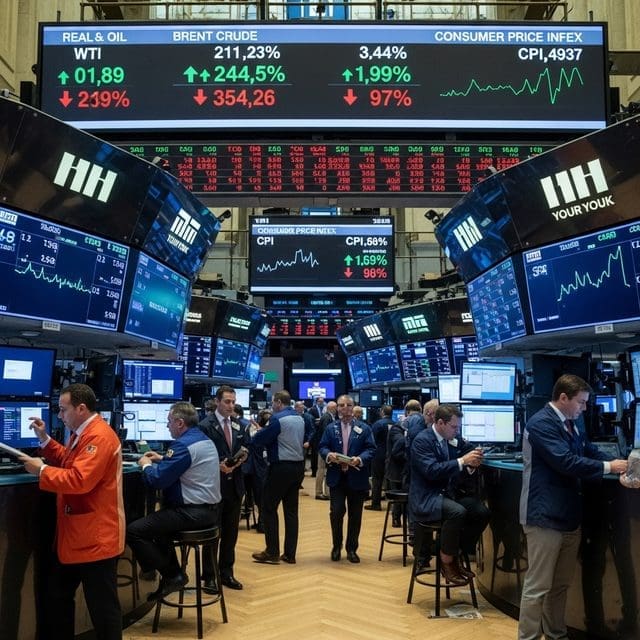
Hotter-than-expected April CPI data and renewed Middle East tensions pressured major indices as the S&P 500 struggled against persistent inflationary headwinds and rising energy costs.
The American taxpayer is once again caught between the anvil of persistent inflation and the hammer of geopolitical instability. Market performance on May 12, 2026, reflected a growing realization that the path to a stable monetary system remains fraught with obstacles. While the SPY benchmark showed a modest intraday recovery of 0.52% in the following session, the broader S&P 500 closed the previous day down 0.1% at 7,400.96, weighed down by a Consumer Price Index report that refused to cooperate with optimistic forecasts. For the working household, these numbers represent the eroding purchasing power of the dollar.
April’s CPI data arrived at a 0.6% monthly increase, pushing the year-over-year figure to 3.8%. This exceeded analyst estimates and marked the highest core inflation reading since early 2025. The market’s reaction was swift, with the Nasdaq falling 0.7% to 26,088.20 as investors reassessed the likelihood of interest rate relief. According to the CME FedWatch tool, there is now a 30% chance the Federal Reserve will hike rates this year, a stark reversal from earlier hopes of a pivot toward cuts. This shift underscores the failure of centralized financial control to anticipate the stubborn nature of price increases.
Energy was the standout sector, with the XLE climbing 2.6%. This move was driven by a sharp reversal in crude prices. Despite earlier reports of a ten-day ceasefire and claims that the Strait of Hormuz remained open for transit, West Texas Intermediate crude surged 4.2% to $102.18 per barrel. The volatility stems from a hardening diplomatic stance, as President Trump characterized Iran’s demands—including reparations and sovereignty over the Strait—as “unacceptable.” This friction has injected a significant risk premium back into energy markets, directly impacting the cost of living for every American commuter.
In the technology and industrial spheres, the landscape remains complex. While the Dow managed a slight 0.1% gain to reach 49,760.56, bolstered by a 3.1% rise in UnitedHealth, broader market breadth was poor. On the NYSE, decliners beat advancers by a ratio of nearly 1.79 to 1. Trading volume was heavy, with 19.63 billion shares changing hands, well above the 20-day average. This high-volume selling in the face of hot inflation data suggests a lack of confidence in current price levels for growth-sensitive assets.
Furthermore, the AI sector is facing a reality check. Research from Sinch indicates that 74% of enterprises have rolled back AI customer agents due to governance issues. This suggests the market is beginning to filter out hype from sustainable utility. Even as World announces integrations with platforms like Zoom and Shopify, and XRP Healthcare activates new swap access, the underlying infrastructure of the digital economy is being tested by both regulatory scrutiny and technical limitations. Anthropic CEO Dario Amodei’s meeting with the White House regarding Pentagon disputes further highlights the friction between private innovation and government oversight.
As President Trump travels to China for high-level economic talks with Xi Jinping, the focus remains on national sovereignty and the protection of American trade interests. However, the domestic front is clouded by inflationary pressures and the potential for a $20 billion release of Iranian funds which remains a point of intense negotiation. For the disciplined investor, the current environment demands a focus on fiscal responsibility. The invisible economy is signaling that the era of easy money is not returning anytime soon.

Jordan Lee serves as the Senior Correspondent for Wall Street, Finance, and Monetary Systems at Just Right News. Based in the heart of the world’s financial capital, New York City, Lee brings a sharp, principled eye to the complex mechanisms that drive the global economy. His reporting is defined by a commitment to fiscal responsibility, the defense of the free market, and a deep-seated belief that a transparent monetary system is the bedrock of a free society.
Raised in Portland, Oregon, Lee’s perspective was forged in a city that has undergone significant cultural and economic shifts. His upbringing in the Pacific Northwest instilled in him a profound appreciation for the industriousness of small business owners and the importance of local economic stability. Watching the evolution of his hometown’s landscape sparked an early interest in how federal fiscal policy and large-scale financial trends eventually trickle down to the average citizen. This background provides him with a unique vantage point; he understands the growing disconnect between the policy-making elite and the reality of Main Street, a theme that frequently resonates throughout his work.
Now operating from his base in New York City, Lee bridges the gap between the high-stakes trading floors of Manhattan and the households of everyday Americans. He views the financial sector not merely as a collection of numbers and tickers, but as a vital engine of American prosperity that requires constant vigilance and accountability. His reporting often highlights the dangers of centralized financial control and the necessity of maintaining a system that rewards merit, risk-taking, and innovation.
As the creator and lead of the featured series, “The Invisible Economy,” Lee pulls back the curtain on the often-opaque world of monetary systems. He specializes in translating the dense jargon of central banking and international finance into actionable insights for the Just Right News audience. His work explores the “invisible” forces—such as inflationary pressures, regulatory creep, and the expansion of the administrative state—that erode the purchasing power of American families. By focusing on these systemic issues, Lee empowers readers to understand the hidden forces shaping their financial independence.
Lee’s journalistic philosophy is rooted in a steadfast commitment to traditional American values. As an Asian American professional who has navigated the competitive corridors of the financial world, he is a vocal advocate for meritocracy and the preservation of the American Dream. He believes that a stable currency and a predictable regulatory environment are essential for national sovereignty and individual liberty. His reporting frequently warns against the risks of government overreach in the private sector, arguing that the most effective solutions to economic challenges arise from competition and individual enterprise rather than bureaucratic mandates.
At Just Right News, Jordan Lee remains dedicated to providing a clear-eyed defense of the taxpayer. Whether he is analyzing market volatility or investigating the long-term implications of national debt, his mission is to provide the truth about where the money is going and what it means for the future of the country. Through his rigorous analysis and principled stance, Lee has become a trusted voice for those who value a strong, sovereign, and fiscally sound America.