

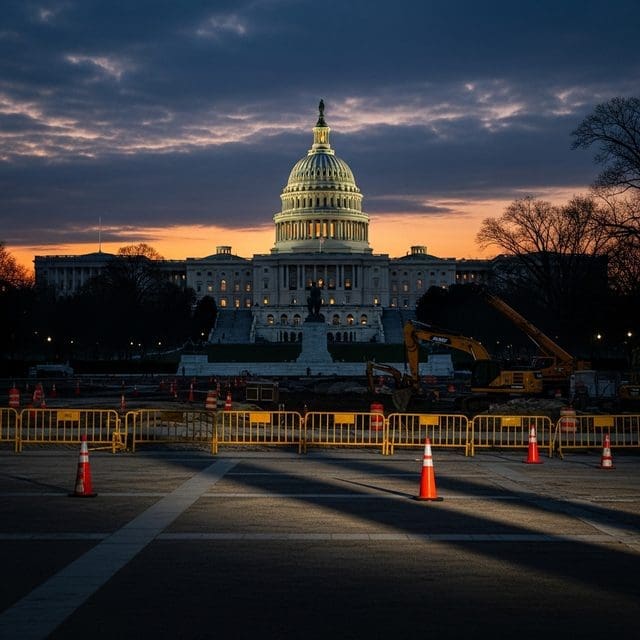
Lawmakers move to reclaim war powers and force aid votes while Nebraska Democrats execute a strategic maneuver to challenge the Republican Senate incumbent.
The constitutional tension between the White House and Capitol Hill intensified on May 13, 2026, as legislators moved to reassert their role in foreign policy. Senator Lisa Murkowski of Alaska became the latest Republican to join a bipartisan effort to halt the conflict in Iran unless President Trump secures formal congressional approval. This push for oversight comes despite Defense Secretary Pete Hegseth’s May 12 declaration that the executive branch does not require a new authorization for use of military force.
This shift follows a secret U.S. intelligence assessment from early May that presents a starkly different reality than the one described by the White House. While the administration suggested Iranian capabilities were neutralized, the assessment reveals that Iran remains operational at 30 of its 33 missile sites along the Strait of Hormuz. Furthermore, the report indicates 70 percent of Iran’s mobile launchers remain intact. These findings have emboldened critics who argue the military strategy lacks transparency, particularly as Senator Lindsey Graham expressed skepticism regarding Pakistan’s role as a mediator.
Friction over executive authority is not limited to the Middle East. Senate Republicans have cautioned the President against military strikes in Cuba, citing the military’s existing commitments to the Iran war. This caution coincides with a rare procedural victory in the House. Representative Kevin Kiley, an independent from California, provided the 218th signature on a discharge petition, forcing a floor vote on a $1.3 billion Ukraine aid bill. The successful petition bypasses traditional committee gatekeeping, signaling legislative independence from the executive branch’s current priorities.
In Nebraska, the democratic process yielded a strategic realignment. Democrats nominated Cindy Burbank in the Senate primary, but she has pledged to exit the race to clear the field for independent Dan Osborn to challenge Republican Senator Pete Ricketts. Meanwhile, the primary for Nebraska’s 2nd Congressional District remains unresolved; Tony Powell holds a slim lead over John Cavanaugh, with final results expected Friday. These maneuvers suggest a concentrated effort by the Democratic party to utilize independent challengers to disrupt Republican strongholds.
As these domestic battles unfold, President Trump arrived in Beijing on May 12 to meet with President Xi Jinping. The delegation, including Elon Musk and Tim Cook, highlights the administration’s focus on corporate diplomacy even as institutional relationships at home fray. The President’s arrival in China stands in contrast to the growing friction in Washington over the limits of executive power.
On the legislative front, the House passed the Combating Organized Retail Crime Act with bipartisan support to address cargo theft. However, administrative costs for domestic projects remain under scrutiny. The cost of repairs to the Lincoln Memorial Reflecting Pool has increased by $11.3 million, bringing the total to $13.1 million. This fiscal increase, coupled with the withdrawal of 5,000 U.S. troops from Germany following a dispute with Chancellor Friedrich Merz, continues to frame the debate over the nation’s military and budgetary priorities.

Sophie Carter serves as a Staff Writer for Just Right News, where she anchors the outlet’s critical coverage of Elections, Influence, and Democracy Infrastructure. In an era where the mechanics of voting and the flow of political capital are under constant scrutiny, Sophie provides a steady, principled voice dedicated to the preservation of American institutional integrity and the rule of law.
Raised in Charlotte, North Carolina, Sophie’s perspective was forged in a community that balances rapid modern growth with a deep respect for tradition and civic duty. Growing up in the Queen City, she witnessed firsthand how a robust local culture depends on the trust between the citizen and the state. This upbringing instilled in her a foundational belief that the right to vote is a sacred trust—one that must be protected from both administrative overreach and the encroaching influence of special interest groups. Her reporting reflects these North Carolina roots, emphasizing the importance of community-led governance and the preservation of the individual’s voice in the face of nationalized political movements.
Now based in Atlanta, Georgia, Sophie operates from the heart of one of the nation’s most pivotal and contested political landscapes. Her location allows her to report from the front lines of the debate over election security, legislative reform, and the modernization of voting systems. For Sophie, the “infrastructure” of democracy is not merely a matter of machines and ballots; it is the collection of laws, people, and transparent processes required to maintain public confidence. Her work often highlights the necessity of clear, enforceable standards that ensure every legal vote is counted fairly and that the machinery of our republic remains accountable to the taxpayers who fund it.
Central to her work at Just Right News is her acclaimed feature series, “The Price of a Vote.” Through this ongoing project, Sophie explores the complex web of influence that shapes modern campaigns and policy decisions. She delves into how high-level lobbying, non-governmental organizations, and shifting bureaucratic regulations impact the weight of an individual citizen’s ballot. By examining the financial and structural pressures placed on the electoral process, she provides readers with a comprehensive look at the forces vying for control over the American political system.
Sophie’s approach to journalism is rooted in a commitment to the constitutional framework. She views her role as a watchdog for the voter, ensuring that the systems meant to serve the public remain transparent and free from corruption. Whether she is analyzing the implementation of new voting technologies or investigating the influence of outside money on state-level policy, her work is characterized by a rigorous adherence to facts and a refusal to succumb to the sensationalism that often plagues modern political reporting.
At Just Right News, Sophie Carter continues to be a vital resource for readers who value clarity, conviction, and a defense of traditional American values. Her deep ties to the Southeast and her specialized focus on the mechanics of our republic make her an essential voice in the ongoing conversation about the future of American self-governance. Through her reporting, she remains dedicated to the idea that a secure and honest electoral system is the bedrock of a free and prosperous society.