

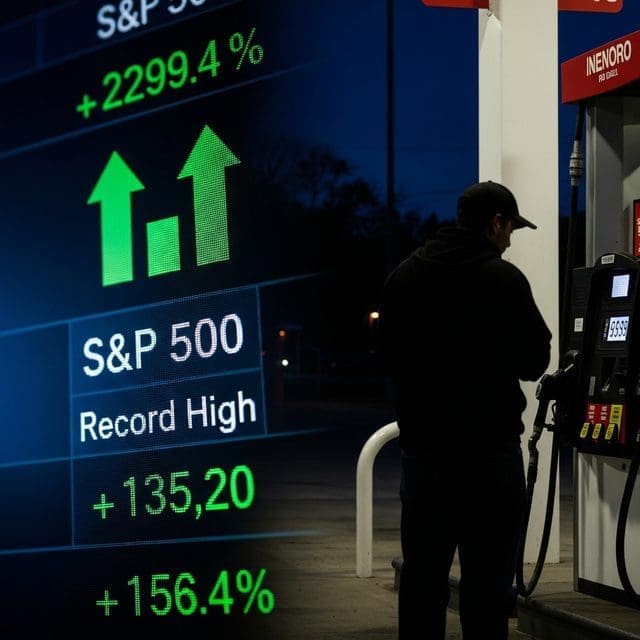
While the S&P 500 reaches new peaks on AI enthusiasm, rising Treasury yields and persistent energy costs signal a deepening disconnect between financial markets and the American household.
The divergence between financial asset prices and the economic reality of the American taxpayer reached a fever pitch this week. While the S&P 500 notched a fresh record high on May 8 following favorable jobs data, the underlying mechanics of the market suggest a system increasingly reliant on speculative fervor rather than sustainable growth. The Philadelphia Semiconductor Index has surged 65% year-to-date, fueled by an obsession with artificial intelligence that critics argue mirrors the final stages of the 1999-2000 tech bubble.
Investor Michael Burry issued a stark warning on May 8, suggesting that the current market is ignoring deteriorating employment and consumer data in favor of a narrow AI-driven thesis. This skepticism is reflected in the University of Michigan’s latest consumer sentiment report, which hit a record low in May 2026. For the working household, the ‘wealth effect’ of a rising stock market is being neutralized by a 10-year Treasury yield that climbed to 4.41%, driving up borrowing costs for mortgages and credit lines.
In the commodities sector, the cost of living remains under pressure. U.S. retail gas prices are projected to stay elevated above pre-war levels through the midterm elections, regardless of potential diplomatic breakthroughs regarding the Strait of Hormuz. While gold prices topped $4,700 and oil hovered near $100 per barrel, the global copper market has officially shifted into a deficit. The International Copper Study Group now forecasts a 150,000 metric ton shortfall, a development that threatens to increase the cost of essential electronics and infrastructure for everyday consumers.
Corporate America is attempting to navigate this inflationary environment through tactical pivots. Burger King reported a 5.8% increase in same-store sales after revamping its flagship product based on thousands of customer feedback calls, proving that even in a strained economy, value and quality remain the primary drivers of consumer choice. However, the broader corporate landscape remains distracted by high-profile legal battles, such as the ongoing Musk v. Altman trial, where testimony recently highlighted the contentious origins of OpenAI and allegations of diverted resources.
On the international front, the shift toward alternative monetary systems continues to gain momentum. Taiwan is currently evaluating the establishment of a Bitcoin reserve, following a legislative report aimed at enhancing national financial sovereignty. As the U.S. Treasury Department issues new sanctions against entities in China and the UAE for aiding the Iranian military, the stability of the dollar-based system remains a central concern for those advocating for a transparent and meritocratic financial future.

Jordan Lee serves as the Senior Correspondent for Wall Street, Finance, and Monetary Systems at Just Right News. Based in the heart of the world’s financial capital, New York City, Lee brings a sharp, principled eye to the complex mechanisms that drive the global economy. His reporting is defined by a commitment to fiscal responsibility, the defense of the free market, and a deep-seated belief that a transparent monetary system is the bedrock of a free society.
Raised in Portland, Oregon, Lee’s perspective was forged in a city that has undergone significant cultural and economic shifts. His upbringing in the Pacific Northwest instilled in him a profound appreciation for the industriousness of small business owners and the importance of local economic stability. Watching the evolution of his hometown’s landscape sparked an early interest in how federal fiscal policy and large-scale financial trends eventually trickle down to the average citizen. This background provides him with a unique vantage point; he understands the growing disconnect between the policy-making elite and the reality of Main Street, a theme that frequently resonates throughout his work.
Now operating from his base in New York City, Lee bridges the gap between the high-stakes trading floors of Manhattan and the households of everyday Americans. He views the financial sector not merely as a collection of numbers and tickers, but as a vital engine of American prosperity that requires constant vigilance and accountability. His reporting often highlights the dangers of centralized financial control and the necessity of maintaining a system that rewards merit, risk-taking, and innovation.
As the creator and lead of the featured series, “The Invisible Economy,” Lee pulls back the curtain on the often-opaque world of monetary systems. He specializes in translating the dense jargon of central banking and international finance into actionable insights for the Just Right News audience. His work explores the “invisible” forces—such as inflationary pressures, regulatory creep, and the expansion of the administrative state—that erode the purchasing power of American families. By focusing on these systemic issues, Lee empowers readers to understand the hidden forces shaping their financial independence.
Lee’s journalistic philosophy is rooted in a steadfast commitment to traditional American values. As an Asian American professional who has navigated the competitive corridors of the financial world, he is a vocal advocate for meritocracy and the preservation of the American Dream. He believes that a stable currency and a predictable regulatory environment are essential for national sovereignty and individual liberty. His reporting frequently warns against the risks of government overreach in the private sector, arguing that the most effective solutions to economic challenges arise from competition and individual enterprise rather than bureaucratic mandates.
At Just Right News, Jordan Lee remains dedicated to providing a clear-eyed defense of the taxpayer. Whether he is analyzing market volatility or investigating the long-term implications of national debt, his mission is to provide the truth about where the money is going and what it means for the future of the country. Through his rigorous analysis and principled stance, Lee has become a trusted voice for those who value a strong, sovereign, and fiscally sound America.