

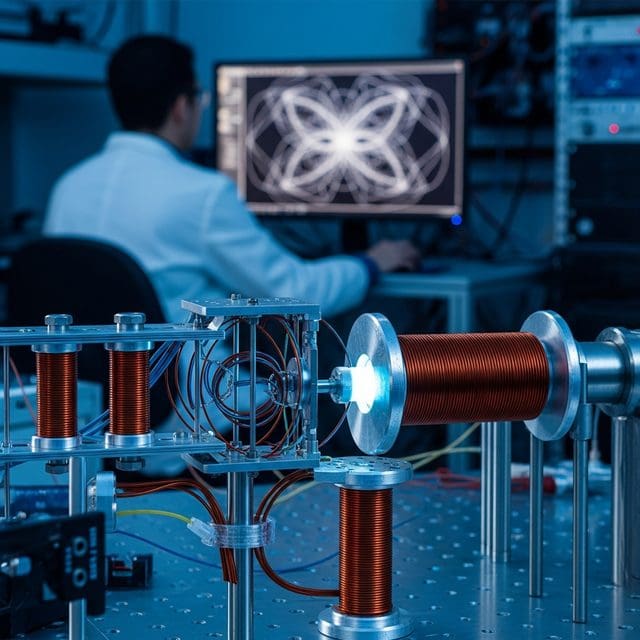
Researchers have discovered that periodically switching magnetic fields can create stable, error-resistant quantum states that do not exist under static conditions, potentially revolutionizing the reliability of future quantum computing hardware.
In the race for quantum supremacy, the focus has long been on the physical composition of materials. However, a groundbreaking study published in Physical Review B by researchers at California Polytechnic State University suggests that the secret to stable quantum computing lies not just in what a material is, but in how it is manipulated over time.
Led by physics lecturer Ian Powell and student researcher Louis Buchalter, the team utilized a technique known as “Floquet engineering.” By periodically switching magnetic fields between specific values, the researchers were able to manifest exotic quantum states that have no static counterpart. These states remain stable only while being actively driven, effectively creating new forms of matter that defy traditional classification. The study specifically analyzed the square-lattice Harper-Hofstadter model, revealing interlaced quasienergy spectra where gaps are labeled by a precise Diophantine equation.
This discovery addresses one of the most significant hurdles in the development of quantum technology: decoherence. In standard environments, quantum bits, or qubits, are notoriously sensitive to “noise” and external interference, leading to high error rates. The “flux-switching” method identified by Powell and Buchalter creates a more robust environment, shielding the system from the imperfections that typically derail quantum calculations. By carefully timing how magnetic fields are applied, scientists can design quantum systems with properties that are inherently more stable.
The implications for national security and domestic innovation are substantial. As centralized bureaucracies and global competitors vie for control over the next generation of high-performance computing, the ability to create stable, error-resistant systems on American soil is paramount. The study reveals a mathematical organizing principle that allows relatively simple systems to mimic the behavior of much more complex, higher-dimensional quantum models. This suggests that the future of quantum technology may depend not just on the materials we mine, but on the ingenuity of the algorithms used to drive them.
While the research is currently theoretical, it provides a clear roadmap for experimentalists. The next phase involves validating these findings in controlled settings, such as ultracold-atom experiments. For Buchalter, who graduated from Cal Poly in 2025 and transitions to the University of Washington this fall to pursue materials science, the project highlights the necessity of creative problem-solving in the hard sciences. He noted that the research was rarely a straightforward process, requiring persistence to map out the topological phase diagrams that serve as guides to these stable quantum phases.
By mastering the temporal control of magnetic flux, American researchers are moving closer to a future where quantum simulators can solve complex problems in pharmaceuticals, finance, and manufacturing without the fragility that has characterized the field for decades. This shift toward time-dependent control represents a sophisticated evolution in our stewardship of the physical laws that govern the subatomic world, ensuring that decentralized innovation remains the engine of American scientific progress.

Mason Reed serves as a Staff Writer for Just Right News, where he spearheads the Future Frontiers & Special Projects desk. In an era defined by rapid technological shifts and evolving social landscapes, Mason provides a steady, principled voice, examining the innovations of tomorrow through the lens of traditional American values. His work is most prominently featured in his signature series, “The Next Horizon,” where he explores the intersection of emerging technology, national sovereignty, and the preservation of individual liberty.
A native of San Diego, California, Mason’s worldview was shaped by the unique culture of his hometown. Growing up in a region defined by its strong military presence and its history of maritime industry, he developed a deep-seated respect for the institutions that provide national stability and the entrepreneurial spirit that drives the American economy. This upbringing instilled in him a belief that true progress is not found in discarding the past, but in building upon a foundation of proven principles. His reporting often reflects this San Diego influence, emphasizing the importance of a robust national defense and the necessity of maintaining a competitive edge in the global marketplace.
Now based in San Francisco, Mason operates from the heart of the world’s technological engine. Living and working in the Bay Area provides him with a front-row seat to the advancements—and the ideological challenges—emanating from Silicon Valley. While many in the region embrace a “move fast and break things” mentality, Mason’s reporting serves as a vital counterweight. He offers Just Right News readers a “boots on the ground” perspective, documenting how radical local policies and the concentration of tech power impact the everyday lives of citizens. His proximity to the industry allows him to cut through the marketing jargon of big tech to uncover the real-world implications for privacy, free speech, and the nuclear family.
In his “Future Frontiers” beat, Mason tackles complex subjects ranging from the ethics of artificial intelligence to the burgeoning private space race. He approaches these topics with a healthy skepticism toward centralized bureaucracy, championing instead the decentralized innovations that empower individuals. Through “The Next Horizon,” he highlights the pioneers and thinkers who are working to ensure that the future remains a place where human dignity and constitutional rights are protected. He believes that the rapid pace of change requires more than just technical expertise; it requires a moral compass rooted in the Western tradition.
Throughout his tenure at Just Right News, Mason has remained committed to the idea that the future is something to be shaped, not merely accepted. His writing is characterized by a rigorous defense of American exceptionalism and a belief that the country’s best days lie ahead, provided it remains true to its founding ideals. Whether he is investigating the impact of automation on the American workforce or profiling the next generation of aerospace engineers, Mason Reed ensures that his readers are equipped with the insights they need to navigate a changing world with confidence and clarity.