

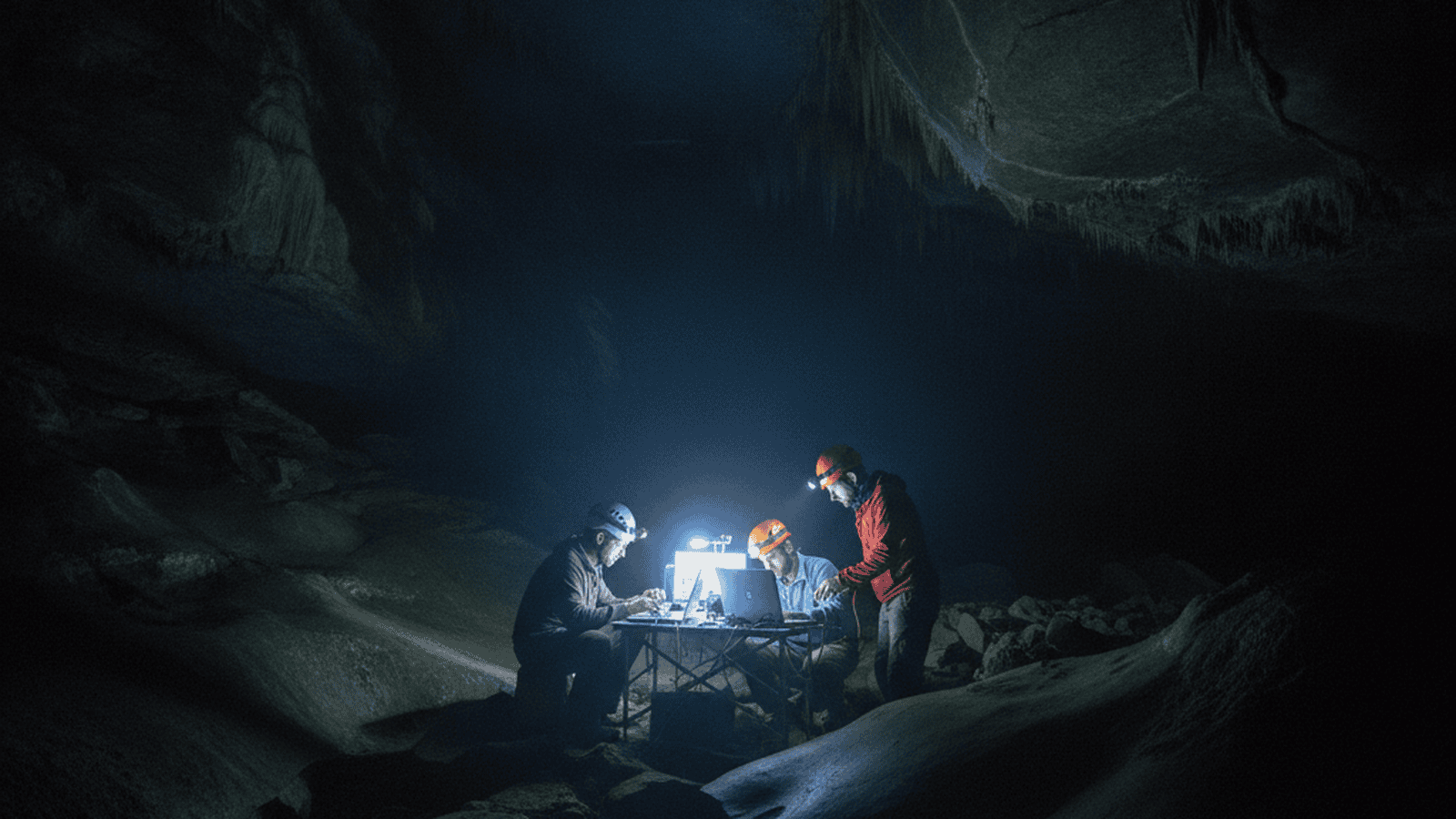
Researchers from the Human Adaptation Institute conducted a 40-day isolation experiment in France’s Lombrives cave to study how the human brain processes time without external cues. The Deep Time project revealed significant shifts in neural synchronization and a collective slowing of perceived time among the fifteen participants.
TLDR: A 40-day isolation study in France’s Lombrives cave has provided new insights into how the human brain regulates time perception. Without sunlight or clocks, participants experienced significant neural synchronization and a distorted sense of duration, highlighting the brain’s remarkable plasticity when stripped of traditional environmental anchors.
Deep within the limestone chambers of the Lombrives cave in southwestern France, a group of fifteen volunteers recently emerged from a forty-day period of total isolation. This expedition, known as the Deep Time project, was designed to investigate how the human brain and body adapt to the loss of external temporal markers. Led by the Human Adaptation Institute, the study represents one of the most comprehensive field expeditions into the neuroscience of chronobiology and human plasticity in extreme environments.
The participants, ranging in age from 27 to 50, lived in a subterranean environment where the temperature remained a constant 10 degrees Celsius and the humidity hovered near 100 percent. They had no access to sunlight, clocks, or any form of communication with the outside world. To track their physiological and neurological states, the volunteers wore sensors and underwent regular cognitive testing using portable equipment powered by a pedal-driven generator. The team utilized a variety of non-invasive monitoring techniques, including the collection of saliva samples to measure cortisol and melatonin levels, which are key indicators of the circadian rhythm. These biological markers provided a chemical record of the body’s internal state, complementing the electrical data from the EEG caps.
One of the most striking findings from the expedition was the significant distortion of time perception. When the researchers finally entered the cave to signal the end of the forty-day period, many participants were surprised, believing they had only been underground for approximately thirty days. This discrepancy suggests that without the zeitgebers—external cues like the sun—the brain’s internal clock defaults to a different rhythm, often stretching the perceived duration of a day.
Neuroimaging and EEG data collected during the mission revealed a phenomenon of neural synchronization among the group members. Despite the lack of a shared schedule, the participants’ biological rhythms began to align over time, likely due to the shared social environment. This collective synchronization suggests that social interaction may act as a secondary temporal anchor when environmental cues are absent. Researchers observed changes in the activity of the prefrontal cortex and the hippocampus, areas of the brain associated with decision-making and spatial memory. These regions showed heightened connectivity, possibly as a compensatory mechanism for the lack of external stimuli.
The data also indicated that the brain’s ability to process complex information remained remarkably stable, even as the sense of time shifted. Participants successfully managed the logistics of their subterranean camp, including water filtration and waste management, without the aid of a traditional schedule. This resilience points to a high degree of functional plasticity, allowing the brain to reorganize its priorities based on immediate survival needs rather than a rigid temporal framework.
The implications of the Deep Time study extend far beyond the confines of a French cave. The findings provide essential data for space agencies planning long-duration missions to Mars or the Moon, where astronauts will face similar challenges regarding light cycles and isolation. Understanding how the brain maintains cognitive performance and social cohesion in the absence of a twenty-four-hour day is crucial for the success of future off-world colonies.
Moving forward, the Human Adaptation Institute plans to conduct follow-up studies involving functional magnetic resonance imaging to map the long-term structural changes in the participants’ brains. These analyses will help determine if the neural shifts observed in the cave persist after returning to a normal environment. By deciphering the mechanisms of the internal clock, scientists hope to develop new strategies for treating sleep disorders and managing the psychological effects of extreme isolation.

Mason Reed serves as a Staff Writer for Just Right News, where he spearheads the Future Frontiers & Special Projects desk. In an era defined by rapid technological shifts and evolving social landscapes, Mason provides a steady, principled voice, examining the innovations of tomorrow through the lens of traditional American values. His work is most prominently featured in his signature series, “The Next Horizon,” where he explores the intersection of emerging technology, national sovereignty, and the preservation of individual liberty.
A native of San Diego, California, Mason’s worldview was shaped by the unique culture of his hometown. Growing up in a region defined by its strong military presence and its history of maritime industry, he developed a deep-seated respect for the institutions that provide national stability and the entrepreneurial spirit that drives the American economy. This upbringing instilled in him a belief that true progress is not found in discarding the past, but in building upon a foundation of proven principles. His reporting often reflects this San Diego influence, emphasizing the importance of a robust national defense and the necessity of maintaining a competitive edge in the global marketplace.
Now based in San Francisco, Mason operates from the heart of the world’s technological engine. Living and working in the Bay Area provides him with a front-row seat to the advancements—and the ideological challenges—emanating from Silicon Valley. While many in the region embrace a “move fast and break things” mentality, Mason’s reporting serves as a vital counterweight. He offers Just Right News readers a “boots on the ground” perspective, documenting how radical local policies and the concentration of tech power impact the everyday lives of citizens. His proximity to the industry allows him to cut through the marketing jargon of big tech to uncover the real-world implications for privacy, free speech, and the nuclear family.
In his “Future Frontiers” beat, Mason tackles complex subjects ranging from the ethics of artificial intelligence to the burgeoning private space race. He approaches these topics with a healthy skepticism toward centralized bureaucracy, championing instead the decentralized innovations that empower individuals. Through “The Next Horizon,” he highlights the pioneers and thinkers who are working to ensure that the future remains a place where human dignity and constitutional rights are protected. He believes that the rapid pace of change requires more than just technical expertise; it requires a moral compass rooted in the Western tradition.
Throughout his tenure at Just Right News, Mason has remained committed to the idea that the future is something to be shaped, not merely accepted. His writing is characterized by a rigorous defense of American exceptionalism and a belief that the country’s best days lie ahead, provided it remains true to its founding ideals. Whether he is investigating the impact of automation on the American workforce or profiling the next generation of aerospace engineers, Mason Reed ensures that his readers are equipped with the insights they need to navigate a changing world with confidence and clarity.