

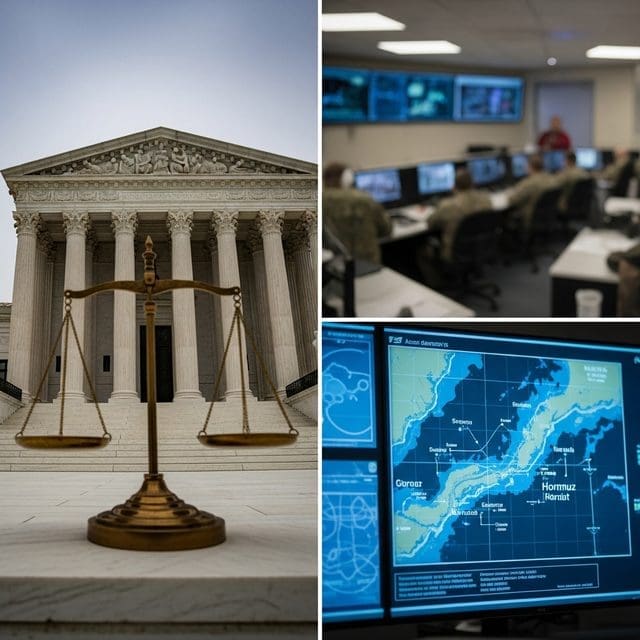
The Pentagon seeks a $1.5 trillion budget amid ongoing Iranian blockades while the Supreme Court strikes down race-based redistricting in Louisiana.
The tension between executive expansion and judicial restraint reached a fever pitch this week as the Trump administration signaled its intent to solidify a permanent war footing in the Middle East. Defense Secretary Pete Hegseth appeared before the Senate Armed Services Committee on April 30 to defend a staggering $1.5 trillion budget request for fiscal year 2027. This follows a contentious House hearing where it was revealed that operations against Iran have already cost taxpayers $25 billion in munitions alone.
Secretary Hegseth’s testimony underscores a significant shift in the administrative state’s appetite for long-term engagement. Despite a fragile ceasefire, the Pentagon has confirmed the continuation of a maritime blockade in the Strait of Hormuz. President Trump reinforced this posture during a White House meeting with energy executives on April 29, discussing the blockade’s necessity while attempting to mitigate domestic fuel price volatility. The President further warned Tehran that a non-nuclear agreement is off the table, demanding the Islamic Republic “get smart soon” regarding comprehensive negotiations.
While the executive branch seeks broader fiscal and military authority, the Supreme Court of the United States issued a decisive check on administrative and legislative overreach regarding the electoral process. In a 6-3 ruling on April 29, the Court struck down Louisiana’s congressional map, which had added a second majority-Black district. The majority opinion classified the plan as an unconstitutional racial gerrymander, asserting that race cannot be the predominant factor in redistricting. This ruling is expected to trigger a nationwide wave of litigation, potentially altering the balance of the House of Representatives by 2028.
On the domestic front, the administration continues to blend symbolic gestures with bureaucratic shifts. The State Department announced that limited-edition passports featuring President Trump’s likeness will be issued in summer 2026 to mark the nation’s 250th anniversary. Meanwhile, Federal Reserve Chair Jerome Powell clarified his future at the central bank, stating he intends to remain as a governor after his chairmanship concludes next month, ensuring a degree of continuity within the nation’s monetary authority.
From a constitutionalist perspective, the current trajectory of the War Department—newly renamed and seeking a 40% budget hike—represents a profound expansion of the administrative state’s reach. As the Pentagon maintains its blockade and Congress grapples with the $25 billion price tag of recent hostilities, the Supreme Court’s intervention in Louisiana serves as a reminder that the federal government’s power, particularly in the realm of state-led elections, remains subject to the rigorous limits of the Constitution.

Miles Harrington serves as the Senior Correspondent for Federal Systems & Executive Power at Just Right News, where he brings a disciplined, constitutionalist lens to the inner workings of the American government. With a focus on the mechanics of the federal bureaucracy and the limits of executive authority, Harrington has established himself as a vital voice for readers who value transparency, accountability, and the preservation of the separation of powers.
A native of Richmond, Virginia, Harrington’s perspective is deeply rooted in the traditions of the Old Dominion. Growing up in a city defined by its historical significance and its role as a center of American jurisprudence, he developed an early appreciation for the foundational principles of the Republic. His upbringing in Richmond—a place where the legacy of the Founding Fathers is woven into the landscape—instilled in him a belief that the federal government should remain within its constitutional bounds. This background informs his skepticism of centralized overreach and his commitment to reporting on the ways in which the administrative state impacts the lives of everyday citizens.
In his current role, Harrington specializes in the complexities of federal systems. He doesn’t just report on the headlines of the day; he digs into the structural shifts within the executive branch that often go unnoticed by the mainstream press. Whether he is analyzing the implications of a new federal regulation or investigating the expansion of agency jurisdiction, his work is characterized by a rigorous adherence to the facts and a dedication to the rule of law.
Harrington is perhaps best known for his signature feature series, “How Washington Works.” Through this ongoing project, he demystifies the often-opaque processes of the nation’s capital, pulling back the curtain on the “Deep State” and the unelected officials who wield significant influence over national policy. By breaking down complex legislative maneuvers and executive orders, he empowers Just Right News readers to understand the true levers of power in Washington. His reporting serves as a necessary check on the federal government, ensuring that the actions of those in power are held up to the light of public scrutiny.
Now based in Washington, D.C., Harrington operates at the epicenter of the political world, yet he remains intentionally distanced from the “Beltway bubble.” His proximity to the halls of power allows him to maintain a robust network of sources across the federal landscape, but his heart remains in the principled conservatism of his Virginia roots. He views his role not merely as a reporter, but as a steward of the public trust, dedicated to providing the clarity and context that conservative voters need to navigate an increasingly complex political environment.
Through his sharp analysis and unwavering commitment to the truth, Miles Harrington continues to be a cornerstone of the Just Right News team. His work ensures that the principles of limited government and executive restraint remain at the forefront of the national conversation, providing a crucial service to those who believe in a government that is truly of, by, and for the people.