

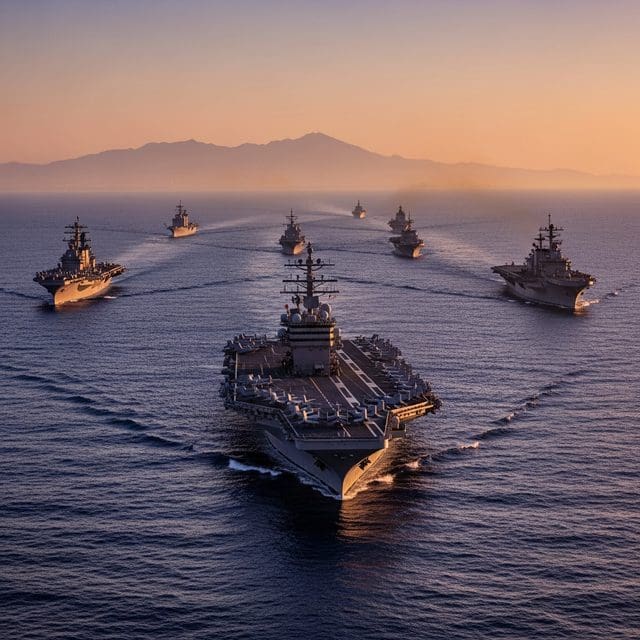
President Trump warned Tehran of an end to diplomatic patience while directing the Pentagon to prepare for a multi-month naval blockade of the Strait of Hormuz, causing global oil prices to surge.
The White House has signaled a significant escalation in its Middle East strategy, with President Trump warning Tehran that the window for a diplomatic resolution is closing. In a social media statement issued April 29, the President declared there would be “no more Mr. Nice Guy,” urging Iranian leadership to “get smart soon” regarding a potential nuclear deal. The rhetoric coincides with reports that the administration has directed aides to prepare for an extended naval blockade of the Strait of Hormuz, a move designed to exert maximum pressure on the Iranian economy.
The strategic shift has sent immediate ripples through global energy markets. Brent crude jumped to nearly $117 per barrel following reports of the blockade’s potential duration. In Washington, President Trump met with top energy executives, including Chevron CEO Mike Wirth, to discuss the domestic fallout of the ongoing conflict. While the administration maintains a posture of strength, the economic consequences are manifesting globally. The Bank of Canada recently held interest rates steady as energy shocks dragged on, and UK government borrowing costs have climbed to their highest levels since the 2008 financial crisis.
On the ground in the Middle East, regional alliances are tightening. Israel has deployed an Iron Dome battery and personnel to the United Arab Emirates to counter Iranian threats, illustrating a deepening security architecture among U.S. partners. However, the blockade is also testing traditional Western alliances. A Pentagon memo has reportedly suggested penalties for NATO allies, specifically naming Spain, should they deny U.S. forces base access during the conflict. This internal friction comes as Russia and China move to coordinate a counter-response, with Russian Foreign Minister Sergey Lavrov traveling to Beijing for high-level talks.
Tehran has attempted to mitigate the pressure by proposing a reopening of the Strait of Hormuz in exchange for an end to the war, suggesting that nuclear negotiations be postponed to a later date. The U.S. has yet to formally accept these terms, opting instead for a policy of containment and economic isolation. Senate Republicans reinforced this hardline approach on April 29 by rejecting a war powers resolution that sought to end a separate blockade of Cuba, signaling broad legislative support for the use of naval power as a tool of foreign policy.
For the American heartland, the stakes of this geopolitical standoff are increasingly visible at the pump, with U.S. gas averages reaching $4.18 per gallon. While some nations like Australia and Norway are seeing temporary benefits from higher commodity prices, analysts at BNP Paribas warn that if oil reaches $200 per barrel, the global economy could face a severe recession. As the U.S. maintains its blockade, the administration is betting that the long-term restoration of regional stability and nuclear deterrence will outweigh the immediate economic volatility.

Olivia Kendall serves as the Senior Correspondent for Geopolitics, Defense, and Foreign Policy at Just Right News, where she provides a principled, conservative perspective on the complex forces shaping the global stage. With a career dedicated to deconstructing the intricacies of international relations, Kendall has become a trusted voice for readers who value national sovereignty, a robust military, and a foreign policy that prioritizes American interests above all else.
A native of Washington, D.C., Kendall’s professional journey is deeply rooted in her upbringing within the nation’s capital. Growing up in the epicenter of American political life, she developed an early and profound understanding of how policy is crafted and, more importantly, how it often fails to account for the values of the American heartland. This unique vantage point allowed her to witness firsthand the rise of globalist bureaucracies, fueling her commitment to reporting that champions the constitutional foundations of the United States. Her background as a British White American further informs her worldview, providing her with a keen appreciation for the Western tradition and the enduring importance of the “Special Relationship” in maintaining global stability.
Now based in Arlington, Virginia, Kendall operates from the doorstep of the Pentagon and the heart of the nation’s defense establishment. Her proximity to the decision-makers in the military and intelligence communities allows her to provide boots-on-the-ground reporting that is both timely and deeply informed. For Kendall, Arlington is more than just a base of operations; it is a daily reminder of the sacrifices made by the men and women in uniform. This connection to the defense community drives her rigorous coverage of military readiness and her advocacy for a “peace through strength” approach to diplomacy.
At Just Right News, Kendall is perhaps best known for her acclaimed feature series, “The World’s Shadow on America.” In this ongoing project, she explores the direct correlation between international developments and the daily lives of American citizens. Whether she is analyzing the encroachment of foreign adversaries in domestic supply chains or the impact of international treaties on local economies, Kendall’s work serves as a vital bridge between distant geopolitical shifts and their consequences at home. She rejects the notion that foreign policy is an abstract concern for elites, instead proving that what happens in the corridors of power in Brussels or Beijing has a tangible “shadow” that falls across every American doorstep.
Throughout her tenure, Kendall has remained a steadfast critic of international overreach and a vocal proponent of a clear-eyed, realistic foreign policy. She brings a sharp analytical mind to her beat, often challenging the prevailing narratives of the mainstream media to uncover the underlying truths that affect national security. Her reporting is characterized by a refusal to compromise on the truth and a dedication to the idea that a strong, secure America is the world’s best hope for liberty. As a Senior Correspondent, Olivia Kendall continues to lead the charge in providing the essential context and conservative insight necessary to navigate an increasingly volatile world.