

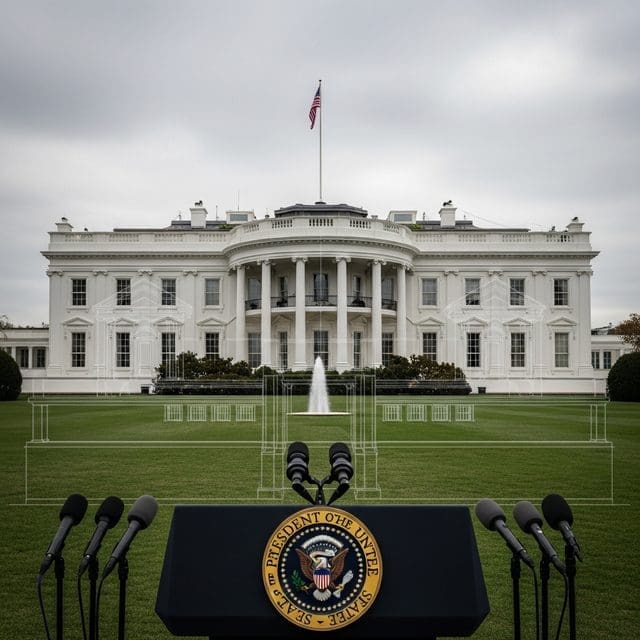
Following an assassination attempt at the White House Correspondents’ Dinner, Senate Republicans are divided over whether to use public funds or private donations to construct a secure 90,000-square-foot facility.
The debate over executive security and fiscal restraint has reached a flashpoint on Capitol Hill as Senate Republicans weigh the costs of a proposed 90,000-square-foot ballroom on the White House grounds. The legislative push, led by Senator Lindsey Graham of South Carolina, follows a harrowing security breach on April 26, 2026, when a gunman opened fire during the White House Correspondents’ Association dinner at the Washington Hilton, forcing the emergency evacuation of President Trump and the Cabinet.
On Monday, Senators Graham, Katie Britt, and Eric Schmitt introduced a bill authorizing $400 million for the project. Proponents argue that the facility is a national security necessity rather than a luxury, designed to keep the president and the line of succession within the secure perimeter of the White House complex for large-scale events. Senator Graham noted that the structure would include a Secret Service annex and subterranean military facilities, suggesting that some costs could be offset by custom fees. Graham argued that while private donations could be used for minor furnishings like china, the core infrastructure of the presidency should not be reliant on private interests.
However, the proposal has exposed a rift within the Republican conference. Fiscal hawks, citing a national debt approaching $39 trillion, have expressed principled opposition to the use of taxpayer funds. Senator Rick Scott of Florida questioned the necessity of public spending when private donors, including Comcast Corp., have already signaled interest in funding the construction. Senator Josh Hawley of Missouri echoed this sentiment, suggesting that while congressional authorization for the footprint may be required, the financial burden should not fall on the public. Hawley emphasized that if private donors are used, their identities must be disclosed to ensure transparency.
Senator Rand Paul of Kentucky has indicated he may offer a competing measure on Tuesday that would authorize the ballroom’s construction without the $400 million to $500 million taxpayer price tag. Paul noted that the President has already demonstrated an ability to raise private capital for the endeavor, arguing for a more disciplined approach to the federal budget. This internal GOP friction comes at a sensitive time for the administration, as Labor Secretary Lori Chavez-DeRemer recently exited amid misconduct allegations, and tensions remain high between Senate Majority Leader John Thune and Speaker Mike Johnson over stalled Homeland Security funding.
Democrats remain largely unified in their opposition, with many questioning the legality of prior demolition work on the East Wing. House Minority Leader Hakeem Jeffries characterized the project as a vanity effort, while Senator Brian Schatz argued that the government cannot retreat into reinforced bunkers at the expense of public life. Despite these objections, the White House maintains that the facility is critical to ensuring the safety of the executive branch. White House spokeswoman Karoline Leavitt stated that the line of succession must be able to gather safely without the fear of political violence.
As the debate continues, some Republicans have considered attaching the ballroom provision to a simple-majority reconciliation bill intended to fund immigration and border security. However, Senator Thune expressed skepticism regarding whether such a move would comply with Senate budget rules, as the current instructions only apply to the Judiciary and Homeland Security committees. For now, the project remains in legislative limbo as the administration continues to host high-profile events, including the ongoing state visit of King Charles III, who addressed Congress on April 28.

Miles Harrington serves as the Senior Correspondent for Federal Systems & Executive Power at Just Right News, where he brings a disciplined, constitutionalist lens to the inner workings of the American government. With a focus on the mechanics of the federal bureaucracy and the limits of executive authority, Harrington has established himself as a vital voice for readers who value transparency, accountability, and the preservation of the separation of powers.
A native of Richmond, Virginia, Harrington’s perspective is deeply rooted in the traditions of the Old Dominion. Growing up in a city defined by its historical significance and its role as a center of American jurisprudence, he developed an early appreciation for the foundational principles of the Republic. His upbringing in Richmond—a place where the legacy of the Founding Fathers is woven into the landscape—instilled in him a belief that the federal government should remain within its constitutional bounds. This background informs his skepticism of centralized overreach and his commitment to reporting on the ways in which the administrative state impacts the lives of everyday citizens.
In his current role, Harrington specializes in the complexities of federal systems. He doesn’t just report on the headlines of the day; he digs into the structural shifts within the executive branch that often go unnoticed by the mainstream press. Whether he is analyzing the implications of a new federal regulation or investigating the expansion of agency jurisdiction, his work is characterized by a rigorous adherence to the facts and a dedication to the rule of law.
Harrington is perhaps best known for his signature feature series, “How Washington Works.” Through this ongoing project, he demystifies the often-opaque processes of the nation’s capital, pulling back the curtain on the “Deep State” and the unelected officials who wield significant influence over national policy. By breaking down complex legislative maneuvers and executive orders, he empowers Just Right News readers to understand the true levers of power in Washington. His reporting serves as a necessary check on the federal government, ensuring that the actions of those in power are held up to the light of public scrutiny.
Now based in Washington, D.C., Harrington operates at the epicenter of the political world, yet he remains intentionally distanced from the “Beltway bubble.” His proximity to the halls of power allows him to maintain a robust network of sources across the federal landscape, but his heart remains in the principled conservatism of his Virginia roots. He views his role not merely as a reporter, but as a steward of the public trust, dedicated to providing the clarity and context that conservative voters need to navigate an increasingly complex political environment.
Through his sharp analysis and unwavering commitment to the truth, Miles Harrington continues to be a cornerstone of the Just Right News team. His work ensures that the principles of limited government and executive restraint remain at the forefront of the national conversation, providing a crucial service to those who believe in a government that is truly of, by, and for the people.