

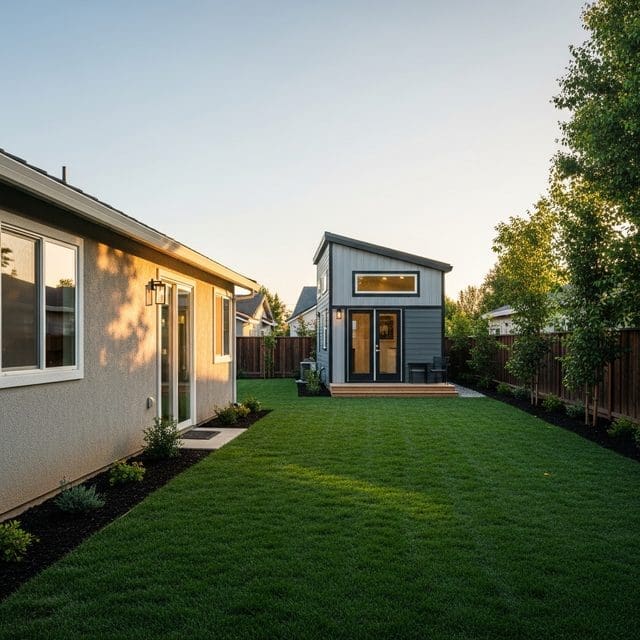
California residents like Elaine Yang are turning to second mortgages and Accessory Dwelling Units to secure long-term financial stability and expand local housing stock without government intervention.
As the American housing market continues to grapple with inventory shortages and persistent affordability challenges, a growing number of property owners are taking matters into their own hands. By leveraging private equity through second mortgages, homeowners are increasingly investing in Accessory Dwelling Units (ADUs), commonly known as tiny homes or granny flats, to create new rental income streams and provide flexible living arrangements.
Elaine Yang, a California resident who rented for over a decade before entering the housing market, exemplifies this shift toward self-reliant housing solutions. Upon purchasing her home, Yang prioritized the construction of an ADU in her backyard. This move was not merely a lifestyle choice but a calculated financial strategy to mitigate the burden of modern mortgage rates and ensure her property could support multiple occupants in a high-cost environment. For Yang, the decision to build was driven by the realization that making money was only one facet of the value; the true benefit lay in the long-term security and utility of the land.
This trend highlights a significant pivot in how Americans view private property rights and local land use. While federal agencies like the Department of Housing and Urban Development (HUD) often focus on large-scale subsidized projects, the ADU movement represents a decentralized, market-driven response to the housing crisis. By densifying existing residential lots, homeowners are effectively increasing the supply of ‘missing middle’ housing without the need for massive taxpayer-funded infrastructure expansions or the slow-moving machinery of federal bureaucracy.
However, the path to property-based financial independence is not without obstacles. While states like California have moved to streamline ADU regulations to encourage development, other jurisdictions remain entangled in restrictive zoning laws that stifle individual initiative. The contrast in regulatory philosophies is stark across the country. In Indiana, for instance, Governor Mike Braun recently signed legislation on April 22, 2026, prohibiting local governments from using zoning regulations to prevent specific businesses, such as firearm retailers, from operating. This move signals a broader legislative appetite for curbing local bureaucratic overreach in favor of state-level protections for property use.
For the American taxpayer, the rise of the ADU offers a blueprint for fiscal responsibility. Rather than relying on federal grants that often come with burdensome strings and inflationary spending attached, private citizens are using their own credit and land to address the shortage. This organic growth in housing density utilizes existing municipal services more efficiently, proving that when barriers are lowered, the private sector can move swiftly to meet the needs of the community. As more homeowners look to their own backyards for financial relief, the focus shifts from government dependence to the preservation of local sovereignty and individual liberty.

Deborah Cole serves as a Senior Correspondent for Just Right News, where she spearheads the network’s coverage of Housing, Infrastructure, and Mobility. With a career defined by a commitment to rigorous reporting and a focus on the fundamental pillars of American community life, Deborah brings a principled perspective to the complex issues that dictate how and where we live. Her work is grounded in the belief that sound policy, fiscal responsibility, and respect for private property are the essential foundations of a prosperous society.
Originally from Boston, Massachusetts, Deborah’s upbringing in one of the nation’s oldest and most historically significant cities deeply influenced her professional trajectory. Growing up amidst the architectural legacy and dense urban planning of New England, she developed an early appreciation for the importance of durable infrastructure and the role of local tradition in shaping neighborhoods. Her perspective is informed by the classic American values of her hometown—hard work, community cohesion, and a healthy skepticism of top-down bureaucratic mandates that often overlook the unique needs of individual citizens.
Today, Deborah operates from her base in Austin, Texas, a city that serves as a primary laboratory for her reporting. Austin’s rapid expansion and its status as a hub for innovation and migration provide her with a front-row seat to the most pressing challenges in modern infrastructure and housing. From the Lone Star State, she chronicles the tensions between rapid growth and the preservation of the American Dream, often highlighting how market-driven solutions and deregulation can address the housing shortages that plague many of the country’s metropolitan areas.
At Just Right News, Deborah is perhaps best known for her signature feature series, “Where We Live.” Through this platform, she explores the intersection of public policy and private life, moving beyond mere statistics to tell the stories of families, small business owners, and local developers. Her reporting frequently highlights the importance of mobility—not just in terms of transportation and transit, but as a vehicle for economic opportunity and social stability. She remains a staunch advocate for the taxpayer, consistently scrutinizing government spending on large-scale projects and advocating for transparency in how infrastructure dollars are allocated.
Deborah’s beat is more than just a collection of policy topics; it is an investigation into the physical and legal structures that allow families to flourish. Whether she is reporting on the impact of zoning laws on suburban development or the necessity of maintaining the nation’s highway systems, her work is characterized by a dedication to the facts and a respect for the constitutional principles that protect the rights of homeowners.
As a Senior Correspondent, Deborah Cole continues to be a vital voice for Just Right News, providing the audience with the clarity and context needed to navigate an ever-changing landscape. Her reporting ensures that the values of individual liberty and local sovereignty remain at the forefront of the national conversation regarding the future of our cities and towns. Through her tireless efforts, she remains committed to informing the public on the issues that hit closest to home.