

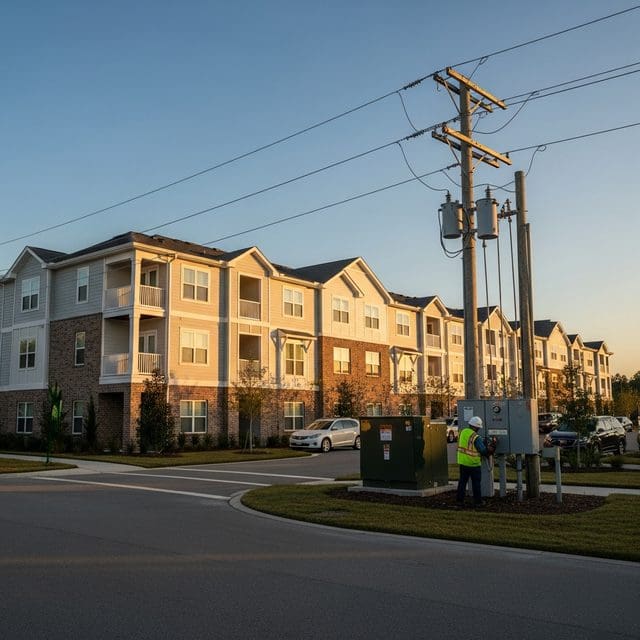
Private lenders are stabilizing rental housing portfolios as the federal government invokes emergency powers to manage soaring domestic energy and electricity prices.
The American housing market is currently navigating a complex intersection of private capital stabilization and aggressive federal intervention. In Jacksonville, Florida, Beachwold Residential recently secured a $50.5 million first mortgage from Mesa West Capital to refinance Gran Bay Apartment Homes. This 308-unit garden-style community represents the latest in a series of high-value multifamily refinances, following similar deals in Austin and Houston earlier this spring.
These transactions occur as multifamily refinance rates track between 6.30% and 6.71%, a range that reflects the broader struggle for affordability in a high-interest-rate environment. While industry forecasts suggest a potential dip below 6% later this year, the current cost of debt continues to pressure the rental market. For many Americans, the dream of homeownership remains elusive; recent data indicates that only about one in ten new-build homes in some markets are reaching the open sale block, with the remainder being absorbed by institutional landlords and affordable housing schemes.
Infrastructure reliability remains a critical component of housing stability. In Vaughan, Ontario, Alectra Utilities announced a $46.2 million investment for 2026 to modernize an aging electricity grid and support rapid local growth. This move mirrors domestic concerns in the United States, where the integrity of the power grid and the cost of fuel are increasingly viewed through the lens of national security and household solvency.
To address these mounting pressures, the Trump administration invoked the Defense Production Act on April 20, 2026. This move aims to accelerate the domestic production of motor fuels and electricity. U.S. Energy Secretary Chris Wright has cautioned that gasoline prices may remain above $3 per gallon into 2027, largely due to the ongoing impacts of the war in Iran. These energy costs act as a hidden tax on every American household, often dictating where families can afford to live and how they commute to work.
While private lenders like Mesa West Capital provide the liquidity necessary to keep existing rental stock viable, the broader challenge of economic mobility persists. Initiatives such as the medical respite program in St. Louis and the T.O.R.I. Community Office in Dallas highlight the ongoing need for localized support for vulnerable populations. However, for the average taxpayer, the primary concern remains the rising cost of the basic necessities: a roof overhead and the power required to keep it running.

Deborah Cole serves as a Senior Correspondent for Just Right News, where she spearheads the network’s coverage of Housing, Infrastructure, and Mobility. With a career defined by a commitment to rigorous reporting and a focus on the fundamental pillars of American community life, Deborah brings a principled perspective to the complex issues that dictate how and where we live. Her work is grounded in the belief that sound policy, fiscal responsibility, and respect for private property are the essential foundations of a prosperous society.
Originally from Boston, Massachusetts, Deborah’s upbringing in one of the nation’s oldest and most historically significant cities deeply influenced her professional trajectory. Growing up amidst the architectural legacy and dense urban planning of New England, she developed an early appreciation for the importance of durable infrastructure and the role of local tradition in shaping neighborhoods. Her perspective is informed by the classic American values of her hometown—hard work, community cohesion, and a healthy skepticism of top-down bureaucratic mandates that often overlook the unique needs of individual citizens.
Today, Deborah operates from her base in Austin, Texas, a city that serves as a primary laboratory for her reporting. Austin’s rapid expansion and its status as a hub for innovation and migration provide her with a front-row seat to the most pressing challenges in modern infrastructure and housing. From the Lone Star State, she chronicles the tensions between rapid growth and the preservation of the American Dream, often highlighting how market-driven solutions and deregulation can address the housing shortages that plague many of the country’s metropolitan areas.
At Just Right News, Deborah is perhaps best known for her signature feature series, “Where We Live.” Through this platform, she explores the intersection of public policy and private life, moving beyond mere statistics to tell the stories of families, small business owners, and local developers. Her reporting frequently highlights the importance of mobility—not just in terms of transportation and transit, but as a vehicle for economic opportunity and social stability. She remains a staunch advocate for the taxpayer, consistently scrutinizing government spending on large-scale projects and advocating for transparency in how infrastructure dollars are allocated.
Deborah’s beat is more than just a collection of policy topics; it is an investigation into the physical and legal structures that allow families to flourish. Whether she is reporting on the impact of zoning laws on suburban development or the necessity of maintaining the nation’s highway systems, her work is characterized by a dedication to the facts and a respect for the constitutional principles that protect the rights of homeowners.
As a Senior Correspondent, Deborah Cole continues to be a vital voice for Just Right News, providing the audience with the clarity and context needed to navigate an ever-changing landscape. Her reporting ensures that the values of individual liberty and local sovereignty remain at the forefront of the national conversation regarding the future of our cities and towns. Through her tireless efforts, she remains committed to informing the public on the issues that hit closest to home.