

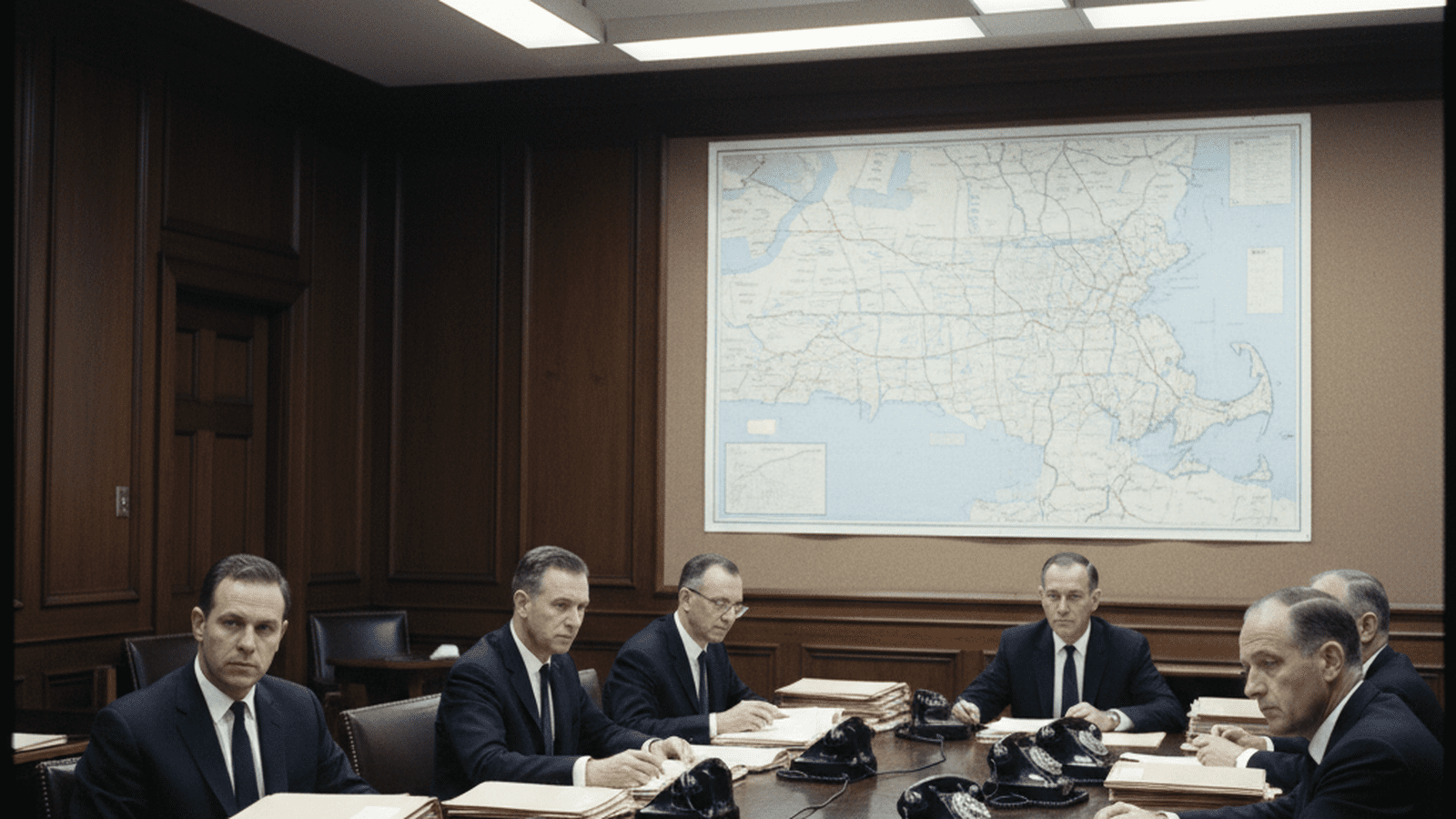
In the early 1960s, the Massachusetts Special Commission on Investigation of the Commonwealth launched a massive anti-corruption drive targeting systemic bribery and kickbacks within state agencies. The investigation led to dozens of indictments and fundamentally reshaped the ethical landscape of United States state-level governance in New England.
TLDR: Established in 1962, the Massachusetts Crime Commission exposed deep-seated corruption in the state’s public works and legislative branches. The probe resulted in over 100 indictments, including high-ranking officials, prompting the United States to adopt more rigorous oversight and ethics standards for state government operations.
In the early 1960s, the political atmosphere in Massachusetts was thick with rumors of systemic graft. While the nation focused on the rise of the Kennedy family, the state government in Boston faced a growing crisis of legitimacy. Public suspicion centered on the Department of Public Works (DPW) and the Metropolitan District Commission (MDC), where massive infrastructure projects appeared to be conduits for illegal kickbacks. In response to these concerns, Governor John Volpe signed legislation in 1962 creating the Special Commission on Investigation of the Commonwealth, popularly known as the Crime Commission.
The commission was granted unprecedented powers to investigate corruption within the executive and legislative branches. Led by prominent attorney Alfred Gardner, the seven-member panel operated with a level of independence that unsettled the established political order. Unlike previous investigative bodies that were often hamstrung by partisan bickering, the Crime Commission utilized a professional staff of investigators, former FBI agents, and forensic accountants to trace the flow of illicit funds. They focused on “the system”—a sophisticated network of bribery where engineering firms and construction companies paid off officials to secure lucrative state contracts for highways and public buildings.
As the investigation deepened, the scale of the malfeasance became clear. The commission uncovered evidence that state legislators were receiving regular payments from companies seeking favorable treatment in the regulatory process. One of the most significant targets was John Thompson, the powerful Speaker of the Massachusetts House of Representatives, known as the “Iron Duke.” The probe revealed that Thompson and other high-ranking officials had turned the statehouse into a marketplace for influence, where even minor administrative favors required a financial tribute. The commission’s work was not merely about individual bad actors but about dismantling a culture of entitlement that had persisted for decades in the Commonwealth.
The fallout from the commission’s findings was seismic. By the time it concluded its work in 1965, the body had produced over 100 indictments against state officials, lobbyists, and businessmen. These legal actions decimated the leadership of the state’s Democratic and Republican parties alike, proving that corruption was a bipartisan endeavor. The trials that followed were heavily publicized, bringing the sordid details of bid-rigging and “consulting fees” into the living rooms of citizens across the United States. This public exposure forced a reckoning with the way state business was conducted in New England.
Public outrage fueled by the commission’s reports led to immediate legislative action. In 1963, Massachusetts passed its first comprehensive conflict-of-interest law, which served as a model for other states. This legislation established clear boundaries for public employees and created penalties for those who used their positions for private gain. The commission also recommended the creation of a permanent Office of the Inspector General, an idea that would eventually come to fruition years later to provide ongoing oversight of state spending and prevent the recurrence of such widespread fraud.
The legacy of the Massachusetts Crime Commission remains a cornerstone of New England political history. It demonstrated that even the most entrenched political machines could be dismantled through rigorous, independent investigation and the strategic use of subpoena power. The reforms initiated during this era laid the groundwork for modern ethics commissions and public records laws that define contemporary United States governance. Today, the commission is remembered as a pivotal moment when the state began to transition from the era of “boss” politics to a more transparent, rule-based system of state governance, ensuring that public resources were no longer treated as private spoils.
Ben Taylor serves as the Senior Correspondent and Investigations Lead for Just Right News, where he anchors the network’s commitment to government transparency and institutional accountability. With a career defined by a relentless pursuit of the facts, Taylor spearheads the acclaimed feature series “The Paper Trail,” a deep-dive investigative column that prioritizes primary source documentation over political rhetoric. Based in the heart of the nation’s capital, he has earned a reputation as one of the most formidable investigative journalists in Washington, D.C., known specifically for his mastery of public records and the Freedom of Information Act.
Taylor’s approach to journalism is deeply rooted in his upbringing in Kansas City, Missouri. Growing up in the “Show Me State,” he developed a healthy skepticism of centralized power and a profound respect for the common-sense values of the American heartland. This Midwestern foundation informs his reporting today, as he bridges the gap between the complex machinations of federal bureaucracy and the everyday concerns of citizens across the country. For Taylor, investigative reporting is not about chasing headlines; it is about ensuring that the government remains answerable to the people it serves.
As an African American man working within the conservative media landscape, Taylor brings a principled perspective to his beat. He views the Constitution and the right to information as the ultimate equalizers in a free society. His work often highlights how bureaucratic overreach and lack of transparency disproportionately affect individual liberties. By focusing on the “paper trail,” Taylor strips away the spin of partisan talking points, instead providing Just Right News readers with the raw data and internal communications that reveal how their tax dollars are spent and how policy decisions are actually made.
In his role as Investigations Lead, Taylor oversees a team dedicated to uncovering the stories that mainstream outlets often overlook. Whether he is auditing federal spending, investigating regulatory overreach, or exposing inefficiencies within the administrative state, his methodology remains consistent: follow the evidence wherever it leads. His presence in Washington, D.C., allows him to maintain a constant watch over the halls of power, yet he remains steadfastly connected to his roots, ensuring his reporting reflects the clarity and directness of his Missouri home.
Throughout his tenure at Just Right News, Taylor has become a vital voice for those who demand integrity in public office. He believes that a well-informed electorate is the strongest defense against government overreach, and he has dedicated his career to providing the public with the tools they need to hold their leaders accountable. Through “The Paper Trail” and his broader investigative work, Ben Taylor continues to set the standard for rigorous, document-driven journalism that champions the values of transparency, individual responsibility, and the rule of law.