

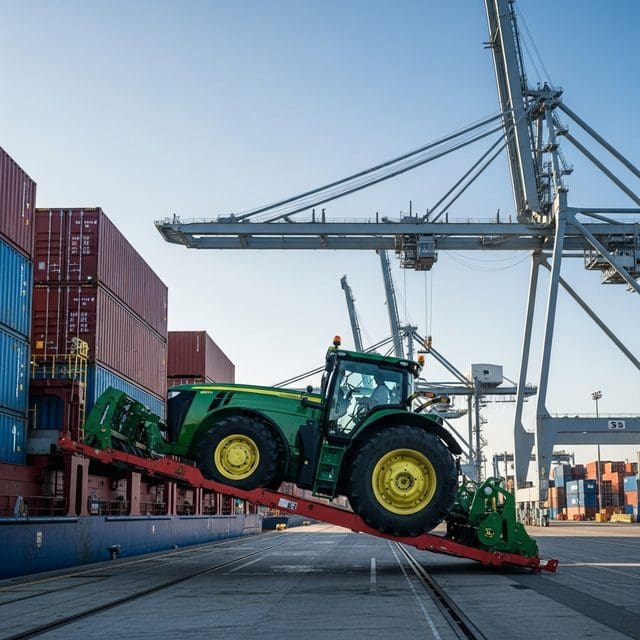
Institutional investors are recalibrating portfolios toward heavy industry and essential infrastructure as global trade routes face increasing geopolitical pressure and shifting manufacturing footprints.
The movement of physical goods from a factory floor to an American shelf is rarely a straight line, yet the financial commitments of major institutional investors often reveal where the next industrial battlegrounds will be fought. Recent filings from Wealth Enhancement Trust Services Inc. show a deliberate pivot toward the backbone of the physical economy, acquiring new stakes in Deere & Company, Cisco Systems, and Wheaton Precious Metals.
For the American worker, these investments are more than just ticker symbols; they represent the machinery and connectivity that define modern sovereignty. Deere & Company remains a titan of domestic production, yet its supply chain is a complex map of international steel tariffs and specialized components. By taking a position of 4,248 shares, the trust is betting on the resilience of high-end industrial manufacturing at a time when ‘near-shoring’ is no longer a buzzword, but a necessity for national stability.
The digital side of trade is equally critical. The trust’s $1.51 million investment in Cisco Systems highlights the growing importance of secure networking in global shipping. As ports become increasingly automated, the hardware that manages these gateways determines the speed at which American-made products reach foreign markets and how efficiently essential imports clear our docks. This infrastructure is the invisible hand that keeps the shelves of companies like McDonald’s—another new addition to the trust’s portfolio—stocked despite fluctuating global logistics costs.
However, the reality of global trade remains tied to raw materials. The acquisition of 13,903 shares in Wheaton Precious Metals underscores a strategic hedge against currency volatility and the rising costs of the minerals required for high-tech manufacturing. While the U.S. and Iran negotiate peace plans that could release $20 billion in frozen funds and alter energy trade dynamics, investors are clearly looking for stability in hard assets and the companies that move them.
These financial shifts occur against a backdrop of evolving corporate footprints. While Shanghai Electric reports a nine percent revenue increase, signaling continued Chinese industrial expansion, the American focus is turning toward domestic retrofitting and local infrastructure. The recent selection of Zero Homes for electrification programs in Colorado serves as a reminder that the most important supply chain is the one that ends in the American living room. As institutional capital flows into these sectors, the message is clear: the future belongs to those who control the means of production and the networks that connect them.
This shift is further evidenced by the consolidation of the American supply chain, such as the confirmed merger discussions between Patrick Industries and LCI Industries. As these domestic giants combine forces, they create a more robust defense against the efficiency-first globalist models that have historically hollowed out local prosperity. For the correspondent tracking the journey of things, the destination is increasingly clear: a return to tangible assets and the dignity of the physical workforce.

Sean Bradley serves as the Senior Correspondent for Trade, Supply Chains, and Global Labor at Just Right News, where he brings a principled, clear-eyed perspective to the complex systems that power the modern world. With a focus on the economic forces that impact the American household, Bradley has distinguished himself as a leading voice in explaining how global shifts in manufacturing and logistics translate to the kitchen table.
Growing up in Long Beach, California, Bradley’s interest in the movement of goods was forged against the backdrop of one of the nation’s most vital maritime gateways. Raised in a community where the towering cranes of the port were a constant fixture on the horizon, he developed an early appreciation for the blue-collar industries that form the backbone of the American economy. This upbringing instilled in him a profound respect for the dockworkers, truckers, and laborers who keep the country moving, a sentiment that remains a cornerstone of his reporting today. For Bradley, trade is not merely a series of abstract figures on a spreadsheet; it is a human endeavor that sustains families and defines the strength of a nation.
Now based in Seattle, Washington, Bradley occupies a strategic vantage point in another of the country’s most significant trade hubs. His location allows him to witness firsthand the intersection of traditional industry and the evolving technological landscape of global logistics. From the Pacific Northwest, he monitors the flow of goods across the ocean, providing Just Right News readers with timely insights into how international tensions, regulatory hurdles, and labor disputes affect the availability and cost of essential goods.
His signature feature series, “The Journey of Things,” has become a staple for readers seeking to understand the intricate path products take from raw materials to the retail shelf. Through this series, Bradley pulls back the curtain on the global marketplace, often highlighting the risks of over-reliance on foreign adversaries and the importance of domestic manufacturing resilience. His reporting consistently emphasizes the conservative values of national sovereignty, free-market competition, and the protection of the American worker from unfair global practices.
As a journalist of Irish heritage, Bradley maintains a deep-seated respect for the dignity of the individual worker and the importance of community stability. He approaches his beat with a commitment to transparency, often questioning the status quo of globalist policies that prioritize corporate efficiency over local prosperity. Whether he is reporting from a warehouse floor or analyzing a new international trade agreement, his goal remains the same: to provide the American public with the truth about where their products come from and what it costs to get them there.
Throughout his tenure at Just Right News, Bradley has remained a steadfast advocate for economic common sense. His work serves as a vital resource for those who believe that a strong nation is built on secure borders, robust trade, and a respected workforce. By combining his local roots in Long Beach with his professional experience in Seattle, Bradley continues to offer a unique and necessary perspective on the forces that shape the American way of life.