

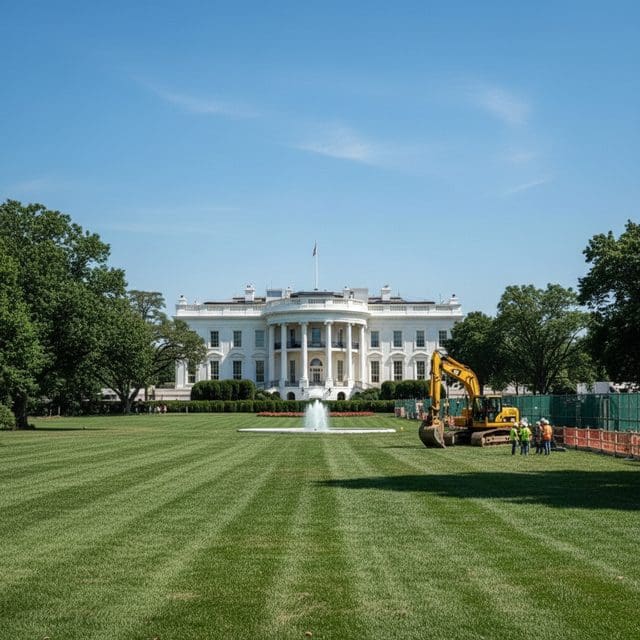
The D.C. Circuit Court has authorized continued White House construction as the administration aggressively expands its regulatory and military footprint through new executive orders and naval operations.
The D.C. Circuit Court of Appeals ruled late April 18 to allow construction on a 90,000-square-foot White House ballroom and subterranean bunker to resume. The decision overturns a lower court’s temporary halt and permits work to continue until oral arguments commence on June 5. This expansion of the executive residence serves as a physical manifestation of an administration increasingly comfortable with the unilateral exercise of power.
On the same day, President Trump signed an executive order aimed at accelerating the research and approval of psychedelic drugs for therapeutic use, specifically targeting veterans suffering from PTSD. Flanked by high-profile figures including RFK Jr. and Dr. Oz, the President bypassed traditional legislative pathways to expedite clinical pipelines for substances such as ibogaine. While the order addresses a pressing public health concern, it underscores a recurring reliance on executive mandates rather than congressional deliberation to alter federal drug policy. This move toward administrative deregulation of controlled substances marks a significant shift in the federal approach to the war on drugs.
This administrative assertiveness extends to the Department of Health and Human Services. On April 17, Jennifer Shuford, MD, MPH, was appointed as Deputy Director of the CDC. Shuford previously served as the Commissioner for the Texas Department of State Health Services. Her transition to a senior federal role comes as the executive branch continues to centralize public health authority within the administrative state, often bypassing the traditional Senate confirmation processes for deputy-level positions.
Beyond domestic policy, the executive branch is testing the limits of international maritime law. As of April 18, the U.S. military is preparing to board Iran-linked vessels and seize commercial ships in international waters. This escalation follows the April 12 declaration of a naval blockade on the Strait of Hormuz after peace talks in Islamabad failed to produce a nuclear agreement. The administration had proposed a 20-year moratorium on uranium enrichment, which Iran countered with a single-digit duration. The use of the military to enforce such a blockade without a formal declaration of war from Congress remains a point of contention for constitutionalists.
On Capitol Hill, the legislative branch remains in a state of friction. House Republicans are currently navigating internal divisions that have delayed a critical Department of Homeland Security reopening bill and the extension of federal surveillance programs. Libertarian-leaning members have expressed concerns regarding government overreach, mirroring a broader public skepticism. A POLITICO poll released April 18 indicated that 50% of Americans view the administration’s mass deportation campaign as overly aggressive, a sentiment shared by 25% of the President’s 2024 voters. This internal GOP divide highlights the growing tension between the executive’s agenda and the constitutional duty of Congress to provide oversight.
As the executive branch moves forward with expansive construction projects and high-stakes military maneuvers, the lack of a unified legislative check remains a central theme in Washington. The upcoming June 5 court date regarding the White House expansion will serve as a pivotal moment for those seeking to define the constitutional boundaries of executive prerogative in the modern era.

Miles Harrington serves as the Senior Correspondent for Federal Systems & Executive Power at Just Right News, where he brings a disciplined, constitutionalist lens to the inner workings of the American government. With a focus on the mechanics of the federal bureaucracy and the limits of executive authority, Harrington has established himself as a vital voice for readers who value transparency, accountability, and the preservation of the separation of powers.
A native of Richmond, Virginia, Harrington’s perspective is deeply rooted in the traditions of the Old Dominion. Growing up in a city defined by its historical significance and its role as a center of American jurisprudence, he developed an early appreciation for the foundational principles of the Republic. His upbringing in Richmond—a place where the legacy of the Founding Fathers is woven into the landscape—instilled in him a belief that the federal government should remain within its constitutional bounds. This background informs his skepticism of centralized overreach and his commitment to reporting on the ways in which the administrative state impacts the lives of everyday citizens.
In his current role, Harrington specializes in the complexities of federal systems. He doesn’t just report on the headlines of the day; he digs into the structural shifts within the executive branch that often go unnoticed by the mainstream press. Whether he is analyzing the implications of a new federal regulation or investigating the expansion of agency jurisdiction, his work is characterized by a rigorous adherence to the facts and a dedication to the rule of law.
Harrington is perhaps best known for his signature feature series, “How Washington Works.” Through this ongoing project, he demystifies the often-opaque processes of the nation’s capital, pulling back the curtain on the “Deep State” and the unelected officials who wield significant influence over national policy. By breaking down complex legislative maneuvers and executive orders, he empowers Just Right News readers to understand the true levers of power in Washington. His reporting serves as a necessary check on the federal government, ensuring that the actions of those in power are held up to the light of public scrutiny.
Now based in Washington, D.C., Harrington operates at the epicenter of the political world, yet he remains intentionally distanced from the “Beltway bubble.” His proximity to the halls of power allows him to maintain a robust network of sources across the federal landscape, but his heart remains in the principled conservatism of his Virginia roots. He views his role not merely as a reporter, but as a steward of the public trust, dedicated to providing the clarity and context that conservative voters need to navigate an increasingly complex political environment.
Through his sharp analysis and unwavering commitment to the truth, Miles Harrington continues to be a cornerstone of the Just Right News team. His work ensures that the principles of limited government and executive restraint remain at the forefront of the national conversation, providing a crucial service to those who believe in a government that is truly of, by, and for the people.