

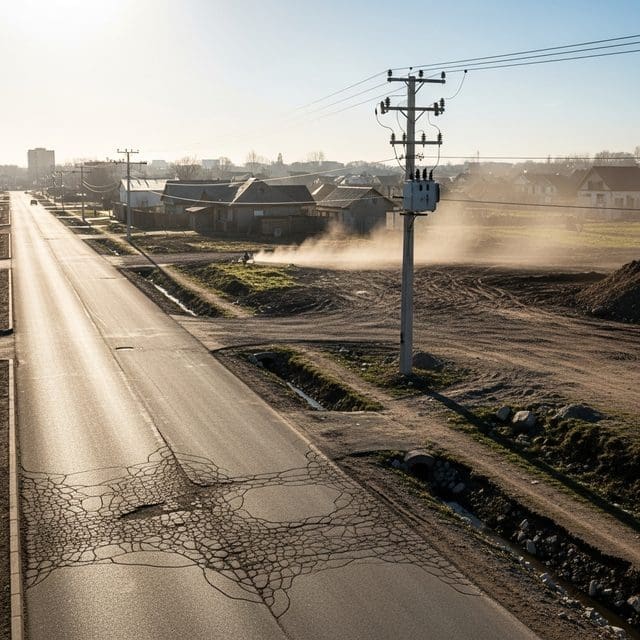
As the Trump administration navigates domestic economic sentiment, infrastructure failures in regions like Tamil Nadu highlight the critical link between basic services and housing stability.
The intersection of federal policy and local infrastructure is increasingly defining the cost of living for residents from the American South to the Cauvery Delta. As the Trump administration enters a pivotal period for economic signaling, the disconnect between high-level indicators and the lived experience of taxpayers is becoming a central theme of the 2026 political landscape. For the American homeowner, the value of a property is inextricably linked to the reliability of the grid, the quality of the roads, and the fiscal health of the surrounding community.
In the United States, the administration’s focus on streamlining federal spending has led to the cancellation of significant grants, including a $7 million agricultural education program in Texas. While framed as a move against bureaucratic overreach and DEI initiatives, such cuts raise questions about the long-term viability of rural development and the infrastructure required to support local economies. These decisions come as the administration also shifts leadership at the Federal Emergency Management Agency, with Cameron Hamilton expected to take the helm. For homeowners and renters alike, the stability of federal disaster response and infrastructure support remains a primary factor in insurance costs and property security.
International parallels highlight the consequences of infrastructure neglect. In the Srivaikuntam constituency of Tamil Nadu, residents are entering the 2026 election cycle by flagging a chronic lack of basic facilities. Despite a rise in pilgrimage tourism, the region continues to struggle with poorly maintained roads, inadequate sewage systems, and a lack of clean drinking water. These deficiencies serve as a stark reminder that housing affordability is not merely a function of market prices, but of the underlying infrastructure that makes a location habitable and economically productive. Without these essentials, private property rights are diminished by the failure of public works.
The Trump administration’s broader economic strategy, including the easing of sanctions on Venezuela and the auctioning of drilling rights in the Arctic National Wildlife Refuge, aims to influence global energy markets. However, for the average taxpayer, these macro-level shifts are often overshadowed by the immediate costs of housing and transit. In South Florida, for instance, local sentiment remains sensitive to federal enforcement actions, with a recent poll indicating significant disapproval of certain deportation policies among the Cuban American community—a demographic whose economic participation is vital to the region’s housing market stability.
Furthermore, the CDC’s report that childhood obesity has reached 1 in 5 children by 2026 underscores the intersection of public health and urban design. Infrastructure that fails to provide safe transit or recreational spaces contributes to long-term public health costs that eventually burden the taxpayer. As the administration considers options regarding international infrastructure, such as potential actions in Iran, the domestic focus remains on whether the current federal approach can alleviate the daily financial pressures facing American families.
Ultimately, the preservation of local sovereignty and property rights depends on a reliable foundation of infrastructure. Whether in the urban centers of the United States or the developing hubs of Central Tamil Nadu, the failure to prioritize essential services like roads and water management creates a ceiling on economic growth. As policymakers weigh fiscal responsibility against the need for modernization, the focus must remain on the tangible levers that affect how people live, work, and maintain their homes.

Deborah Cole serves as a Senior Correspondent for Just Right News, where she spearheads the network’s coverage of Housing, Infrastructure, and Mobility. With a career defined by a commitment to rigorous reporting and a focus on the fundamental pillars of American community life, Deborah brings a principled perspective to the complex issues that dictate how and where we live. Her work is grounded in the belief that sound policy, fiscal responsibility, and respect for private property are the essential foundations of a prosperous society.
Originally from Boston, Massachusetts, Deborah’s upbringing in one of the nation’s oldest and most historically significant cities deeply influenced her professional trajectory. Growing up amidst the architectural legacy and dense urban planning of New England, she developed an early appreciation for the importance of durable infrastructure and the role of local tradition in shaping neighborhoods. Her perspective is informed by the classic American values of her hometown—hard work, community cohesion, and a healthy skepticism of top-down bureaucratic mandates that often overlook the unique needs of individual citizens.
Today, Deborah operates from her base in Austin, Texas, a city that serves as a primary laboratory for her reporting. Austin’s rapid expansion and its status as a hub for innovation and migration provide her with a front-row seat to the most pressing challenges in modern infrastructure and housing. From the Lone Star State, she chronicles the tensions between rapid growth and the preservation of the American Dream, often highlighting how market-driven solutions and deregulation can address the housing shortages that plague many of the country’s metropolitan areas.
At Just Right News, Deborah is perhaps best known for her signature feature series, “Where We Live.” Through this platform, she explores the intersection of public policy and private life, moving beyond mere statistics to tell the stories of families, small business owners, and local developers. Her reporting frequently highlights the importance of mobility—not just in terms of transportation and transit, but as a vehicle for economic opportunity and social stability. She remains a staunch advocate for the taxpayer, consistently scrutinizing government spending on large-scale projects and advocating for transparency in how infrastructure dollars are allocated.
Deborah’s beat is more than just a collection of policy topics; it is an investigation into the physical and legal structures that allow families to flourish. Whether she is reporting on the impact of zoning laws on suburban development or the necessity of maintaining the nation’s highway systems, her work is characterized by a dedication to the facts and a respect for the constitutional principles that protect the rights of homeowners.
As a Senior Correspondent, Deborah Cole continues to be a vital voice for Just Right News, providing the audience with the clarity and context needed to navigate an ever-changing landscape. Her reporting ensures that the values of individual liberty and local sovereignty remain at the forefront of the national conversation regarding the future of our cities and towns. Through her tireless efforts, she remains committed to informing the public on the issues that hit closest to home.