

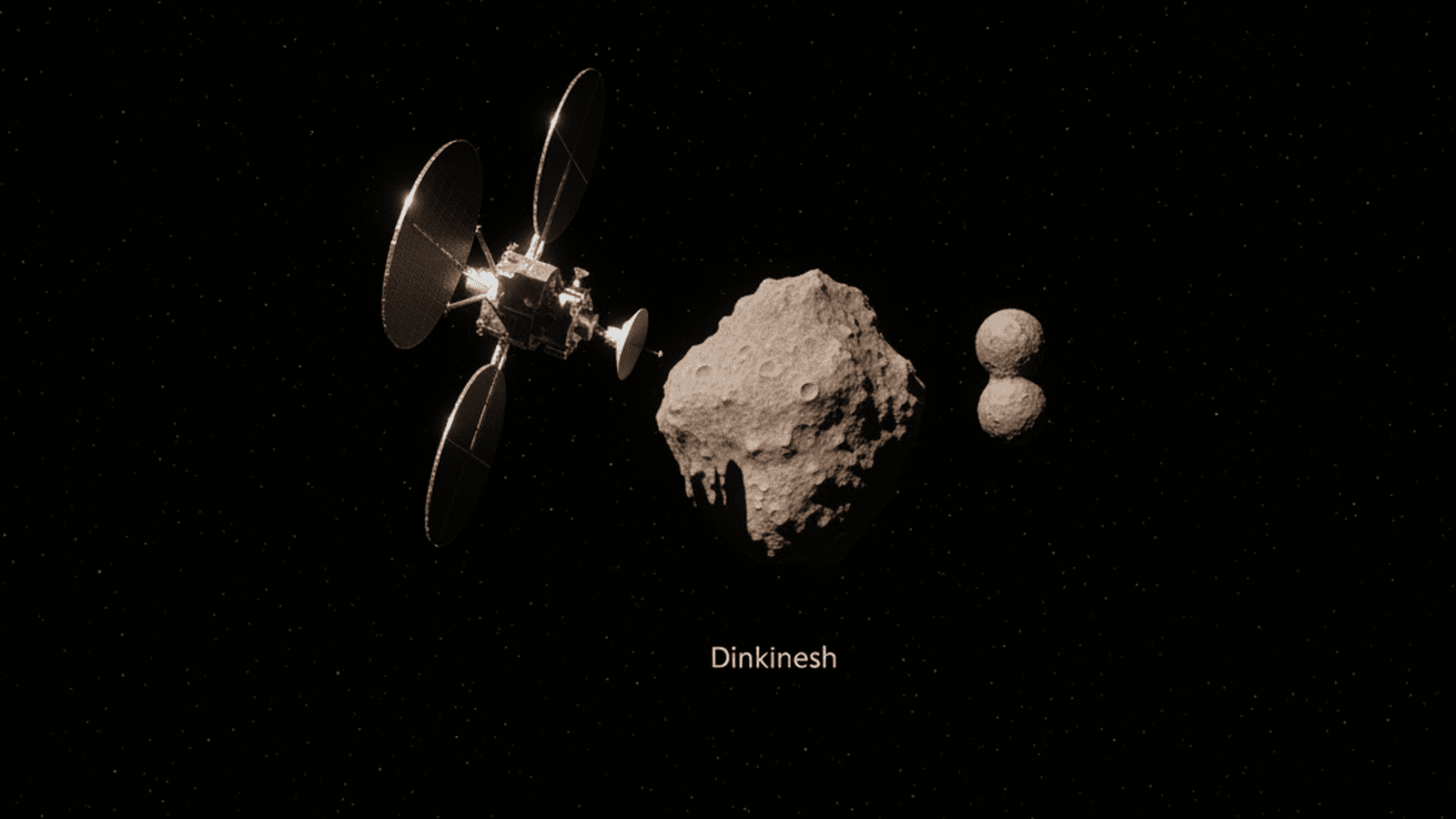
NASA’s Lucy mission discovered that the asteroid Dinkinesh is actually a complex binary system, featuring a smaller moonlet that is itself a contact binary. This unexpected finding provides new insights into the structural integrity and formation history of small celestial bodies in the inner solar system.
TLDR: NASA’s Lucy spacecraft has revealed that the asteroid Dinkinesh is a complex system rather than a single object. The flyby discovered a moonlet, named Selam, which consists of two fused lobes. This discovery marks the first observation of a contact binary orbiting another asteroid, challenging existing models of planetary evolution.
NASA’s Lucy mission, designed to explore the enigmatic Trojan asteroids orbiting near Jupiter, has yielded its first major scientific breakthrough closer to home. During a high-speed encounter with the main-belt asteroid 152830 Dinkinesh, the spacecraft’s instruments revealed that the target was not a single celestial body as previously believed. Instead, the flyby uncovered a complex system consisting of a primary asteroid and a unique, two-lobed moonlet. This discovery has fundamentally altered the mission’s initial assumptions about the population of the inner asteroid belt.
The discovery occurred as Lucy passed within 270 miles of Dinkinesh in November 2023. Data transmitted back to the mission’s operations center at NASA’s Goddard Space Flight Center initially showed a small moon orbiting the primary body. However, as the spacecraft moved to a different vantage point, the high-resolution Long Range Reconnaissance Imager (L’LORRI) captured a startling detail: the moonlet, subsequently named Selam, is a contact binary. This means it is composed of two distinct, smaller objects that have gently merged and remain in physical contact, resembling a peanut shape.
This finding marks the first time a contact binary has been observed orbiting another asteroid. The existence of such a system provides a rare window into the mechanical properties and evolutionary history of small solar system bodies. Scientists suggest that the formation of Selam likely resulted from a spin-up event. In this scenario, solar radiation pressure increased the rotation of the primary asteroid, Dinkinesh, until it shed mass. This ejected material eventually coalesced into the two lobes that now form the moonlet, suggesting a complex gravitational dance over millions of years.
The structural integrity of these objects is a point of intense study for the Lucy science team. The fact that Selam maintains its contact-binary shape while in orbit suggests that these small bodies have enough internal strength to resist being torn apart by tidal forces from the larger asteroid. This challenges some existing models that treat small asteroids as simple rubble piles with no cohesive strength. The discovery also implies that binary systems may be far more common and complex in the main asteroid belt than ground-based telescopes can detect.
The L’LORRI instrument was instrumental in resolving the two lobes of Selam, which measure approximately 220 meters and 210 meters in diameter respectively. The primary asteroid, Dinkinesh, is roughly 790 meters wide at its broadest point. The precision of these measurements allows researchers to calculate the orbital period of the moonlet, which in turn helps estimate the mass and density of the entire system. These metrics are vital for understanding how the solar system’s smallest residents interact with one another.
Beyond the immediate discovery of Selam, the flyby served as a critical test for Lucy’s terminal tracking system. This autonomous navigation software allows the spacecraft to keep its cameras locked on a target while traveling at speeds exceeding 10,000 miles per hour. The success of the Dinkinesh encounter validates the technology that will be essential when Lucy reaches the Jupiter Trojans, which are significantly more distant and difficult to observe. The mission is currently continuing its long-duration trek through the solar system, with a gravity assist from Earth scheduled for late 2024.
Future research will focus on the precise mass and density of both Dinkinesh and Selam to better understand the gravitational dynamics at play. These insights are expected to refine our understanding of how the early solar system organized itself and how the building blocks of planets have survived for billions of years. The Lucy team expects that the upcoming flybys of the Trojan asteroids will reveal even more complex structures, potentially rewriting the history of planetary formation.

Mason Reed serves as a Staff Writer for Just Right News, where he spearheads the Future Frontiers & Special Projects desk. In an era defined by rapid technological shifts and evolving social landscapes, Mason provides a steady, principled voice, examining the innovations of tomorrow through the lens of traditional American values. His work is most prominently featured in his signature series, “The Next Horizon,” where he explores the intersection of emerging technology, national sovereignty, and the preservation of individual liberty.
A native of San Diego, California, Mason’s worldview was shaped by the unique culture of his hometown. Growing up in a region defined by its strong military presence and its history of maritime industry, he developed a deep-seated respect for the institutions that provide national stability and the entrepreneurial spirit that drives the American economy. This upbringing instilled in him a belief that true progress is not found in discarding the past, but in building upon a foundation of proven principles. His reporting often reflects this San Diego influence, emphasizing the importance of a robust national defense and the necessity of maintaining a competitive edge in the global marketplace.
Now based in San Francisco, Mason operates from the heart of the world’s technological engine. Living and working in the Bay Area provides him with a front-row seat to the advancements—and the ideological challenges—emanating from Silicon Valley. While many in the region embrace a “move fast and break things” mentality, Mason’s reporting serves as a vital counterweight. He offers Just Right News readers a “boots on the ground” perspective, documenting how radical local policies and the concentration of tech power impact the everyday lives of citizens. His proximity to the industry allows him to cut through the marketing jargon of big tech to uncover the real-world implications for privacy, free speech, and the nuclear family.
In his “Future Frontiers” beat, Mason tackles complex subjects ranging from the ethics of artificial intelligence to the burgeoning private space race. He approaches these topics with a healthy skepticism toward centralized bureaucracy, championing instead the decentralized innovations that empower individuals. Through “The Next Horizon,” he highlights the pioneers and thinkers who are working to ensure that the future remains a place where human dignity and constitutional rights are protected. He believes that the rapid pace of change requires more than just technical expertise; it requires a moral compass rooted in the Western tradition.
Throughout his tenure at Just Right News, Mason has remained committed to the idea that the future is something to be shaped, not merely accepted. His writing is characterized by a rigorous defense of American exceptionalism and a belief that the country’s best days lie ahead, provided it remains true to its founding ideals. Whether he is investigating the impact of automation on the American workforce or profiling the next generation of aerospace engineers, Mason Reed ensures that his readers are equipped with the insights they need to navigate a changing world with confidence and clarity.