

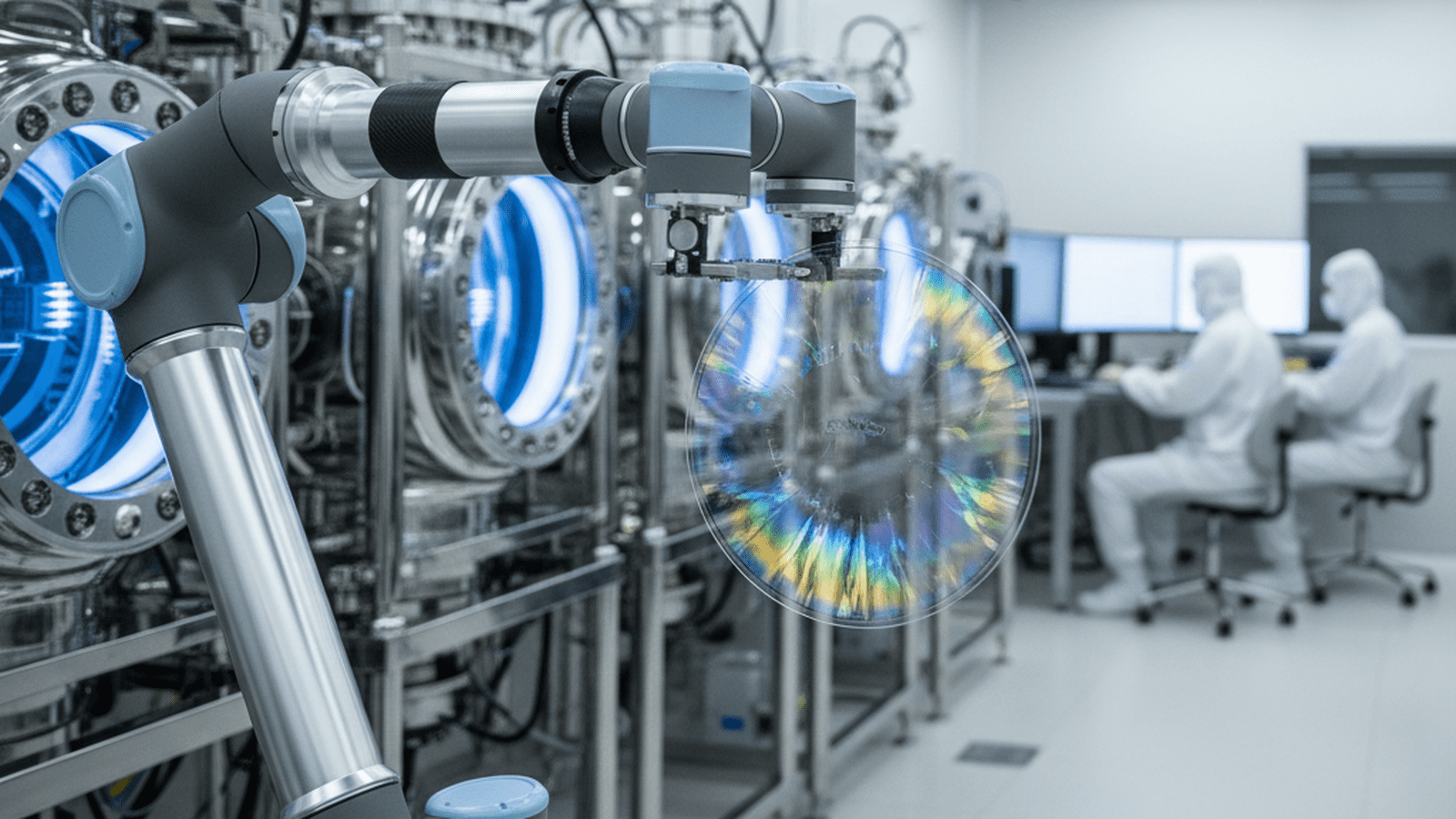
Diamond Foundry has produced the first 100mm single-crystal diamond wafers using a heteroepitaxy process. This breakthrough addresses thermal management issues in semiconductors, offering a material with five times the thermal conductivity of copper.
TLDR: California-based Diamond Foundry has successfully manufactured 100mm single-crystal diamond wafers, a major milestone for the semiconductor industry. These wafers offer unparalleled heat dissipation and electrical stability, potentially replacing silicon in high-power applications like electric vehicles, 5G infrastructure, and advanced computing systems.
Diamond Foundry, a California-based materials science firm, has successfully produced the world’s first 100mm single-crystal diamond wafers. This development represents a significant milestone in the quest to replace silicon in high-power electronics and telecommunications. Diamond is widely regarded as the ultimate semiconductor material due to its exceptional thermal conductivity and electrical breakdown field. While synthetic diamonds have been used in industrial cutting for decades, their application in electronics required a level of structural perfection that was previously unattainable at scale.
The manufacturing process utilizes a proprietary heteroepitaxy technique. This involves growing a single-crystal diamond layer atom-by-atom atop a non-diamond substrate, specifically iridium. Historically, creating large-area single-crystal diamond has been the primary hurdle for the industry. Most synthetic diamonds are either small “seeds” or polycrystalline, which contain grain boundaries that scatter electrons and phonons. These boundaries degrade the uniform lattice structure required for advanced chip manufacturing and high-speed signal processing. By overcoming the lattice mismatch between iridium and diamond, the firm has enabled the growth of a continuous, defect-free crystal across a four-inch surface.
Thermal management remains the most pressing challenge in modern computing and power electronics. As transistors shrink and power densities rise, silicon-based components struggle to dissipate heat efficiently, leading to throttling or hardware failure. Diamond conducts heat approximately five times better than copper and significantly outperforms existing wide-bandgap materials like silicon carbide and gallium nitride. By integrating diamond wafers into the semiconductor stack, engineers can operate devices at much higher power levels without the risk of thermal damage. This capability is particularly vital for artificial intelligence accelerators, which currently consume massive amounts of energy for cooling.
The implications for the electric vehicle (EV) and 5G sectors are substantial. In EVs, diamond-based power inverters could reduce energy loss by up to 90% compared to silicon counterparts. This efficiency gain allows for smaller cooling systems and lighter vehicles, directly extending the driving range on a single charge. While silicon carbide is the current standard for high-end EVs, diamond offers a theoretical performance limit that is orders of magnitude higher. For telecommunications, diamond substrates allow for more compact and powerful radio-frequency amplifiers. These components are essential for the high-frequency bands required by 6G and advanced satellite communications, where heat generation is a limiting factor for signal clarity.
Beyond thermal properties, diamond’s wide bandgap allows it to withstand much higher voltages than traditional materials. This makes it ideal for the power grids of the future, where high-voltage DC transmission is becoming more common to integrate renewable energy sources. The ability to manufacture these wafers at a 100mm scale moves the technology from a laboratory curiosity to a viable industrial product. The company’s facility in Spain is expected to scale this production, utilizing renewable energy to power the plasma reactors required for diamond growth. These reactors use methane and hydrogen gases, ionized into a plasma state, to deposit carbon atoms onto the substrate with extreme precision.
Future research will focus on reducing the defect density within the diamond lattice and optimizing the bonding process between diamond and other semiconductor layers. Scientists are currently investigating how to minimize the mechanical stress that occurs when diamond is cooled from growth temperatures, as different materials contract at different rates. As Diamond Foundry scales its production capabilities, the industry anticipates a shift toward “diamond-on-chip” architectures. This transition could redefine the limits of Moore’s Law and enable a new generation of ultra-efficient electronic devices that were previously considered physically impossible.

Mason Reed serves as a Staff Writer for Just Right News, where he spearheads the Future Frontiers & Special Projects desk. In an era defined by rapid technological shifts and evolving social landscapes, Mason provides a steady, principled voice, examining the innovations of tomorrow through the lens of traditional American values. His work is most prominently featured in his signature series, “The Next Horizon,” where he explores the intersection of emerging technology, national sovereignty, and the preservation of individual liberty.
A native of San Diego, California, Mason’s worldview was shaped by the unique culture of his hometown. Growing up in a region defined by its strong military presence and its history of maritime industry, he developed a deep-seated respect for the institutions that provide national stability and the entrepreneurial spirit that drives the American economy. This upbringing instilled in him a belief that true progress is not found in discarding the past, but in building upon a foundation of proven principles. His reporting often reflects this San Diego influence, emphasizing the importance of a robust national defense and the necessity of maintaining a competitive edge in the global marketplace.
Now based in San Francisco, Mason operates from the heart of the world’s technological engine. Living and working in the Bay Area provides him with a front-row seat to the advancements—and the ideological challenges—emanating from Silicon Valley. While many in the region embrace a “move fast and break things” mentality, Mason’s reporting serves as a vital counterweight. He offers Just Right News readers a “boots on the ground” perspective, documenting how radical local policies and the concentration of tech power impact the everyday lives of citizens. His proximity to the industry allows him to cut through the marketing jargon of big tech to uncover the real-world implications for privacy, free speech, and the nuclear family.
In his “Future Frontiers” beat, Mason tackles complex subjects ranging from the ethics of artificial intelligence to the burgeoning private space race. He approaches these topics with a healthy skepticism toward centralized bureaucracy, championing instead the decentralized innovations that empower individuals. Through “The Next Horizon,” he highlights the pioneers and thinkers who are working to ensure that the future remains a place where human dignity and constitutional rights are protected. He believes that the rapid pace of change requires more than just technical expertise; it requires a moral compass rooted in the Western tradition.
Throughout his tenure at Just Right News, Mason has remained committed to the idea that the future is something to be shaped, not merely accepted. His writing is characterized by a rigorous defense of American exceptionalism and a belief that the country’s best days lie ahead, provided it remains true to its founding ideals. Whether he is investigating the impact of automation on the American workforce or profiling the next generation of aerospace engineers, Mason Reed ensures that his readers are equipped with the insights they need to navigate a changing world with confidence and clarity.