

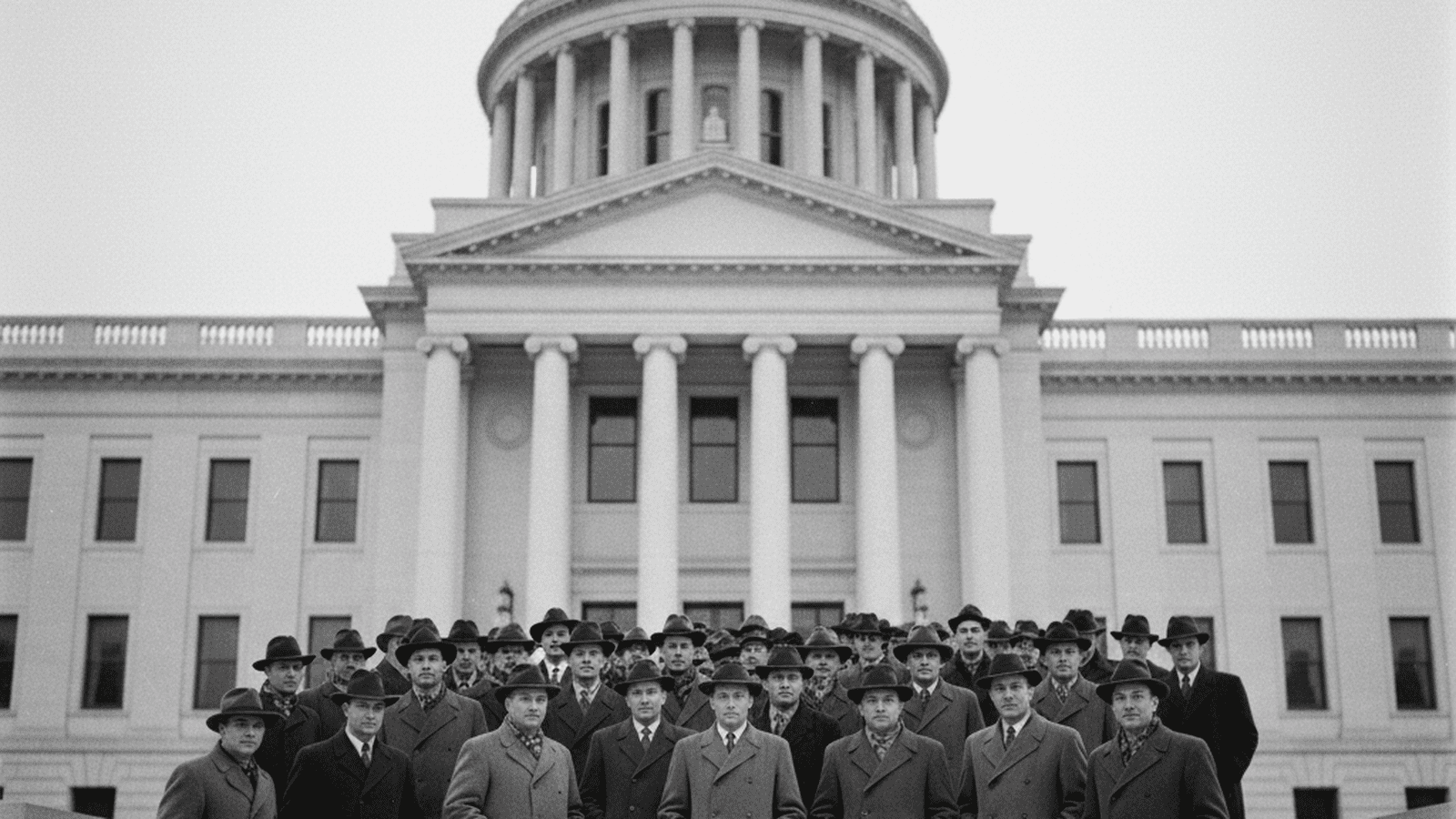
In 1935, Rhode Island Democrats executed a rapid political takeover known as the “Bloodless Revolution” to dismantle decades of Republican control. The maneuver involved unseating elected senators and dismissing the entire State Supreme Court in a single day, fundamentally altering the United States state’s constitutional framework.
TLDR: During the New Deal era, Rhode Island Governor Theodore Francis Green led a dramatic reorganization of state government. By invalidating election results and firing the Supreme Court, Democrats ended rural Republican dominance. This event transformed Rhode Island into a Democratic stronghold and prompted significant debates over executive overreach.
The 1935 “Bloodless Revolution” in Rhode Island stands as one of the most aggressive institutional overhauls in the history of United States state governance. For nearly a century, the Republican Party had maintained an iron grip on the state through a system of extreme malapportionment known as “rotten boroughs.” Under this framework, tiny rural hamlets held the same legislative weight as the booming industrial center of Providence. This ensured that a small, conservative minority could effectively veto any progressive legislation, a situation that became increasingly untenable as the Great Depression ravaged the state’s textile and manufacturing sectors.
The catalyst for change was the 1934 election. While Democrats won the governorship and the House, the Senate remained split, with Republicans holding a razor-thin 22-20 lead. On January 1, 1935, Governor Theodore Francis Green and Lieutenant Governor Robert Quinn executed a meticulously planned political ambush. During the inaugural session, Quinn, acting as the presiding officer of the Senate, refused to swear in two Republican senators-elect from South Kingstown and Portsmouth. He cited allegations of voter fraud and immediately appointed a three-man Democratic committee to “recount” the ballots. Within minutes, the committee declared the Democratic challengers the winners, flipping the Senate majority to the Democrats.
With total control of the executive and legislative branches, the Democrats moved with a speed that stunned their opponents. In a single afternoon, the General Assembly passed a resolution declaring the seats of all five justices of the Rhode Island Supreme Court vacant. The court had long been viewed as a bastion of Republican conservatism that frequently struck down progressive labor laws. By 5:00 PM, the legislature had elected five new justices, including the Democratic Speaker of the House and a former Democratic governor. This wholesale replacement of a state’s highest court was a move virtually unseen in modern American politics.
The legislative blitz did not stop with the judiciary. The General Assembly passed the Administrative Code Act, which abolished more than 80 independent boards and commissions. These entities, many of which were controlled by lifetime Republican appointees, were consolidated into 11 executive departments under the direct authority of the Governor. This reorganization stripped the Republican Party of its patronage network and centralized power in the executive branch. The entire process, from the unseating of the senators to the reorganization of the government, was completed in less than 24 hours.
Republicans and many legal scholars were horrified, labeling the event a “coup d’état” and a “dictatorship.” They argued that the Democrats had bypassed constitutional norms and destroyed the separation of powers. National newspapers covered the event with a mixture of fascination and alarm, questioning the legality of such a rapid seizure of power. However, the new Supreme Court quickly ruled that the legislature’s actions were constitutional. The public, largely weary of the old guard’s perceived indifference to the economic suffering of the Depression, generally supported Green’s actions.
The “Bloodless Revolution” effectively ended the era of Republican dominance in Rhode Island and paved the way for a series of social welfare reforms and labor protections. Rhode Island transitioned from a reliably Republican state to one of the most consistently Democratic states in the Union. The event also highlighted the vulnerabilities of state constitutions to sudden partisan shifts. In later decades, Rhode Island adopted constitutional amendments to provide more stability to the judicial selection process and to ensure more equitable legislative representation. The 1935 crisis remains a primary example of how executive power can be used to dismantle entrenched political structures during times of national crisis.

Lila Hayes serves as a Staff Writer for Just Right News, where she anchors the “Courts, Law, and Constitutional Order” beat. Her work is defined by a steadfast commitment to the foundational principles of the American republic and a rigorous defense of the legal frameworks that ensure national stability. As a primary voice for the outlet, she provides readers with a clear-eyed analysis of the judiciary, focusing on the importance of originalism and the preservation of the separation of powers.
Lila’s perspective was forged in the American heartland. Raised in St. Louis, Missouri, she grew up in a Hispanic household where the values of hard work, faith, and respect for the law were paramount. Her upbringing instilled in her a deep appreciation for the American Dream and the legal protections that make it possible. This Missouri background remains a cornerstone of her reporting, providing a grounded, common-sense counter-narrative to the often-insular legal circles of the coastal elite. She understands that the decisions made in high-court chambers have real-world consequences for families and small business owners across the country.
At Just Right News, Lila has become widely recognized for her signature feature series, “The Rulebook of Power.” In this ongoing project, she delves into the mechanics of the federal government, examining how administrative overreach and judicial activism can threaten the delicate balance of the Constitution. She approaches her beat with the tenacity of a veteran journalist and the precision of a legal scholar, consistently advocating for a judiciary that interprets the law as written rather than legislating from the bench. For Lila, the Constitution is not a “living” document subject to the whims of modern social trends; it is a fixed standard that ensures the government remains the servant of the people, not their master.
Now based in Philadelphia, Pennsylvania, Lila finds herself at the very epicenter of American constitutional history. Living and working in the city where the Founders drafted the documents she defends daily provides a constant source of inspiration. The historic halls and landmarks of Philadelphia serve as a daily reminder of the high stakes involved in her reporting. Her presence in the city allows her to bridge the gap between the historical intent of the law and its contemporary application, ensuring that the legacy of the Founding Fathers remains central to the national conversation.
Throughout her career, Lila has remained dedicated to the idea that a free society requires an informed citizenry and a transparent legal system. Her reporting is more than just a collection of headlines; it is a defense of the constitutional order that has sustained the nation for over two centuries. By focusing on the “Rulebook of Power,” she ensures that her readers understand not just what is happening in the courtrooms, but why those decisions matter for the future of American liberty. Lila Hayes continues to be a vital voice for those who believe that the law should be a shield for the citizen and a constraint on the state.