

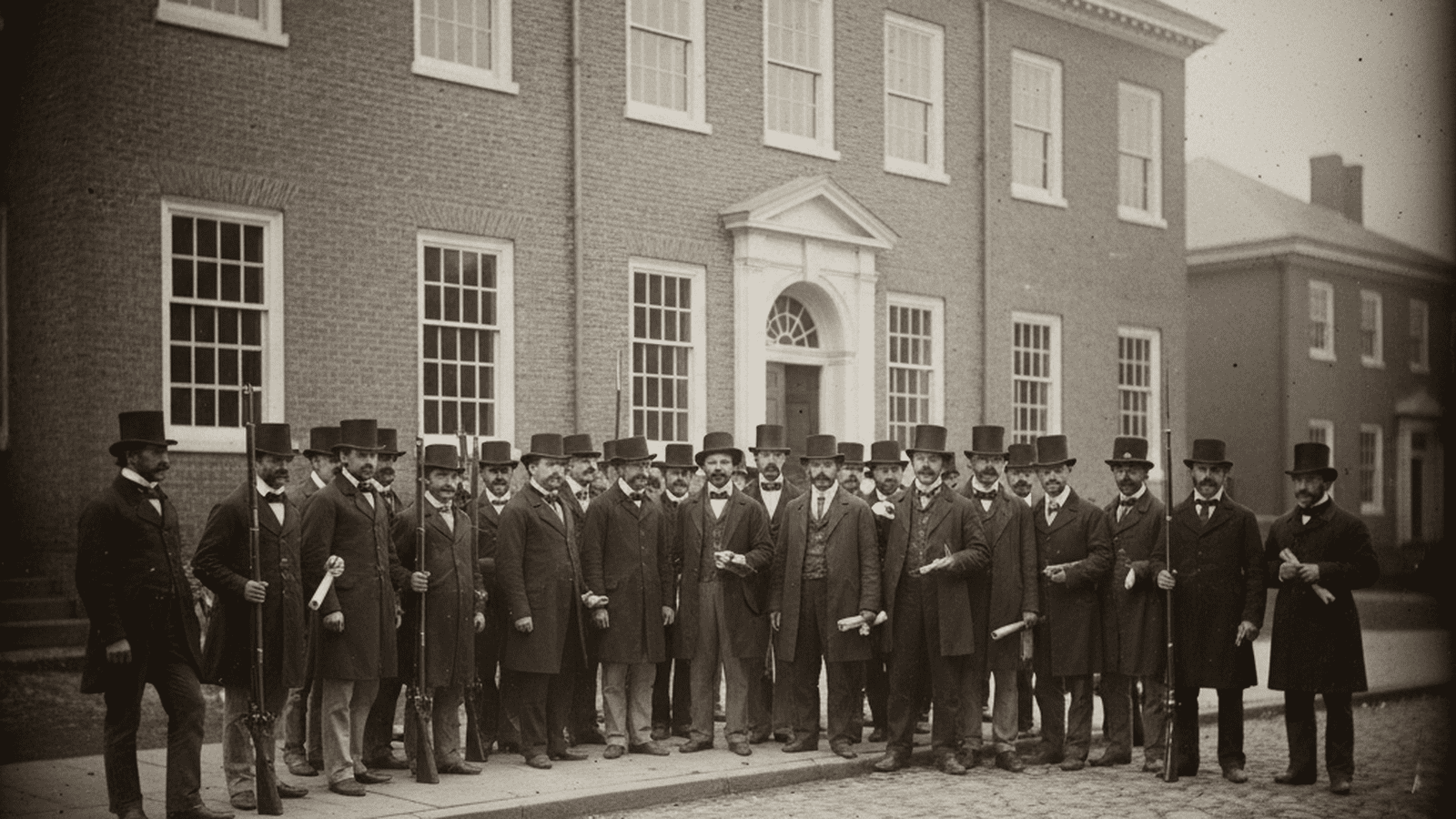
The Dorr Rebellion of 1842 was a constitutional crisis in Rhode Island sparked by the state’s restrictive colonial-era voting laws. It resulted in the establishment of rival governments and a brief armed conflict before leading to significant suffrage reform in the United States.
TLDR: In 1842, Thomas Dorr led a movement to overthrow Rhode Island’s restrictive colonial charter, which disenfranchised most urban workers. While the armed rebellion failed, the crisis forced the state to adopt a new constitution and led to the Supreme Court’s ‘political question’ doctrine in Luther v. Borden.
In 1841, Rhode Island stood as a peculiar outlier in the American democratic experiment. While neighboring states had transitioned to modern constitutions, Rhode Island remained governed by a 1663 colonial charter granted by King Charles II. This archaic document restricted the franchise to ‘freemen’ who possessed at least 134 dollars in real estate. By the mid-19th century, this requirement was increasingly problematic. The Industrial Revolution had transformed the state’s economy, drawing thousands of workers into urban centers like Providence and Pawtucket. These men, though essential to the state’s prosperity, were legally barred from voting, creating a stark divide between the landed rural elite and the disenfranchised urban working class.
Thomas Wilson Dorr, a Harvard-educated lawyer from a wealthy family, became the unlikely champion of the disenfranchised. In 1840, he helped organize the Rhode Island Suffrage Association, which argued that the people held the sovereign right to replace an unjust government. When the state legislature refused to call a constitutional convention, Dorr’s ‘People’s Party’ took matters into their own hands. In late 1841, they held their own convention and drafted the ‘People’s Constitution,’ which granted the vote to all white male citizens. In a popular referendum, this document received more votes than the total number of eligible voters under the old charter, yet the established ‘Charter Government’ declared the entire movement an illegal insurrection.
By May 1842, the crisis had escalated into a full-blown constitutional standoff. Rhode Island effectively had two competing governments. Dorr was inaugurated as governor by his supporters in a Providence parade, while the official governor, Samuel Ward King, maintained his seat of power and mobilized the state militia. King’s government passed the ‘Algerine Law,’ a draconian measure that made it a capital offense to hold office under the People’s Constitution. King also appealed to President John Tyler for federal troops. While Tyler avoided direct military intervention, his public support for the ‘legitimate’ Charter government dealt a severe blow to the Dorrites’ morale.
The conflict turned violent on the night of May 17, 1842. Dorr led a small, poorly equipped force to seize the state arsenal in Providence. The attempt was a tactical disaster; the rebels’ cannons, which were relics from the Revolutionary War, failed to fire due to damp powder and mechanical failure. As the state militia approached, Dorr’s supporters melted away into the night. Dorr fled to Connecticut and later New Hampshire to avoid capture. A second attempt to rally forces at Chepachet in June also collapsed before a single shot was fired, as the rebels realized they were vastly outnumbered by the state’s ‘Law and Order’ party.
Though the rebellion failed on the battlefield, it succeeded in the court of public opinion. The Charter government, recognizing that the threat of civil unrest would persist, finally convened a legitimate convention in late 1842. The resulting 1843 Constitution significantly expanded voting rights for native-born citizens, though it maintained property requirements for naturalized immigrants—a nod to the era’s nativist sentiments. Dorr eventually returned to face trial and was sentenced to life at hard labor for treason, but public sympathy led to his release after just one year.
The legal fallout reached the U.S. Supreme Court in the 1849 case Luther v. Borden. The Court was asked to decide which government was the ‘rightful’ one. Chief Justice Roger B. Taney declined to rule on the merits, establishing the ‘political question’ doctrine. He argued that the Constitution’s guarantee of a republican form of government was a matter for the executive and legislative branches, not the judiciary. This precedent remains a cornerstone of American constitutional law, defining the limits of judicial intervention in state political crises.

Lila Hayes serves as a Staff Writer for Just Right News, where she anchors the “Courts, Law, and Constitutional Order” beat. Her work is defined by a steadfast commitment to the foundational principles of the American republic and a rigorous defense of the legal frameworks that ensure national stability. As a primary voice for the outlet, she provides readers with a clear-eyed analysis of the judiciary, focusing on the importance of originalism and the preservation of the separation of powers.
Lila’s perspective was forged in the American heartland. Raised in St. Louis, Missouri, she grew up in a Hispanic household where the values of hard work, faith, and respect for the law were paramount. Her upbringing instilled in her a deep appreciation for the American Dream and the legal protections that make it possible. This Missouri background remains a cornerstone of her reporting, providing a grounded, common-sense counter-narrative to the often-insular legal circles of the coastal elite. She understands that the decisions made in high-court chambers have real-world consequences for families and small business owners across the country.
At Just Right News, Lila has become widely recognized for her signature feature series, “The Rulebook of Power.” In this ongoing project, she delves into the mechanics of the federal government, examining how administrative overreach and judicial activism can threaten the delicate balance of the Constitution. She approaches her beat with the tenacity of a veteran journalist and the precision of a legal scholar, consistently advocating for a judiciary that interprets the law as written rather than legislating from the bench. For Lila, the Constitution is not a “living” document subject to the whims of modern social trends; it is a fixed standard that ensures the government remains the servant of the people, not their master.
Now based in Philadelphia, Pennsylvania, Lila finds herself at the very epicenter of American constitutional history. Living and working in the city where the Founders drafted the documents she defends daily provides a constant source of inspiration. The historic halls and landmarks of Philadelphia serve as a daily reminder of the high stakes involved in her reporting. Her presence in the city allows her to bridge the gap between the historical intent of the law and its contemporary application, ensuring that the legacy of the Founding Fathers remains central to the national conversation.
Throughout her career, Lila has remained dedicated to the idea that a free society requires an informed citizenry and a transparent legal system. Her reporting is more than just a collection of headlines; it is a defense of the constitutional order that has sustained the nation for over two centuries. By focusing on the “Rulebook of Power,” she ensures that her readers understand not just what is happening in the courtrooms, but why those decisions matter for the future of American liberty. Lila Hayes continues to be a vital voice for those who believe that the law should be a shield for the citizen and a constraint on the state.