

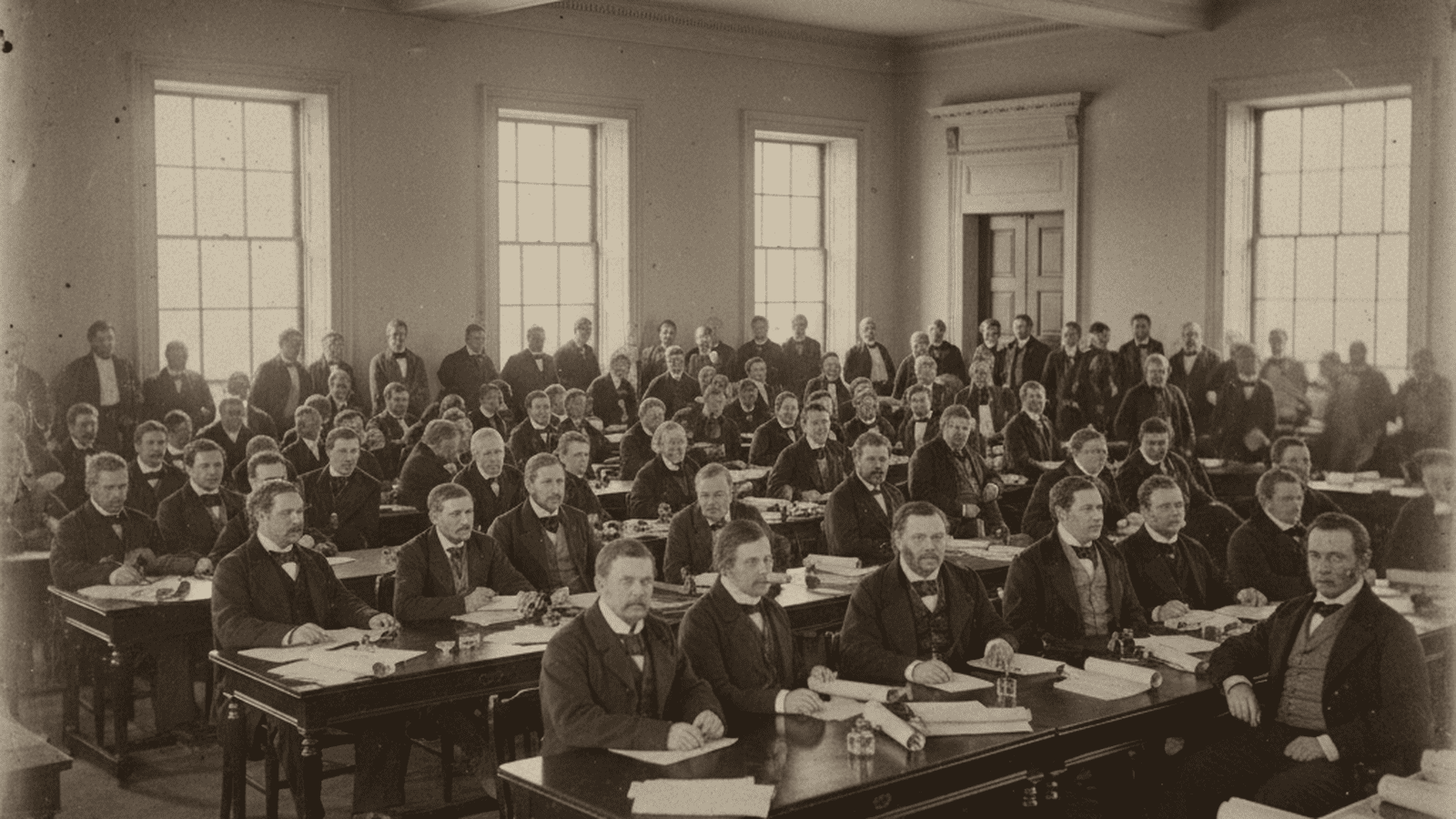
The Pennsylvania Constitutional Convention of 1838 overhauled the state’s 1790 charter to reflect Jacksonian democratic ideals. While it successfully limited executive power and shortened judicial terms in the United States, it also explicitly disenfranchised Black voters by adding a racial requirement to the suffrage clause.
TLDR: In 1838, Pennsylvania revised its constitution to expand white male suffrage and curb gubernatorial power. However, the convention also formally stripped Black Pennsylvanians of their voting rights, highlighting the era’s contradictory approach to democratic expansion and racial exclusion in the United States.
During the late 1830s, the United States experienced a wave of populist fervor known as Jacksonian Democracy. This movement sought to dismantle aristocratic structures and empower the common man, primarily through the expansion of voting rights and the reduction of executive patronage. In Pennsylvania, this sentiment culminated in the Constitutional Convention of 1837-1838, an assembly tasked with replacing the state’s 1790 charter. Reformers argued that the existing document granted the governor too much power and insulated the judiciary from the public will. The resulting debates in Harrisburg and Philadelphia reflected the deep tensions of the antebellum era.
The convention delegates focused heavily on restructuring the state’s executive and judicial branches. Under the 1790 constitution, the governor possessed the authority to appoint nearly every local official in the Commonwealth, from sheriffs to justices of the peace. The 1838 revisions stripped much of this patronage, making many of these offices elective. Furthermore, the convention ended life tenure for judges, replacing it with fixed terms of fifteen years for the Supreme Court and ten years for lower courts. These changes were intended to make the legal system more responsive to the electorate and reduce the influence of entrenched political elites.
While the convention expanded democratic participation for white men by removing property-based tax requirements, it simultaneously moved to restrict the franchise along racial lines. The 1790 constitution had used the gender-neutral and race-neutral term ‘freeman’ to describe eligible voters. In several counties, including Bucks and York, Black men who met the tax requirements had successfully cast ballots for decades. However, as the convention progressed, a faction of delegates pushed to explicitly define the electorate as ‘white.’ This proposal sparked a fierce debate, with some delegates arguing for the preservation of existing rights while others claimed that Black suffrage was a threat to social order.
The final document, approved by the convention and later ratified by a narrow margin of voters, officially inserted the word ‘white’ into the suffrage clause. This act of disenfranchisement was a devastating blow to the state’s Black community, which had grown significantly in cities like Philadelphia. Prominent Black leaders, including Robert Purvis, organized the ‘Appeal of Forty Thousand Citizens Threatened with Disenfranchisement,’ a powerful written protest that argued the new constitution violated the principles of the Declaration of Independence. Despite these efforts, the racial restriction remained in place, codifying a white-only democracy in the Mid-Atlantic’s most populous state.
The political volatility surrounding the new constitution was immediately evident during the 1838 gubernatorial election. A dispute over contested seats in the state legislature led to the ‘Buckshot War,’ a brief period of civil unrest in Harrisburg where armed militias were called in to restore order. The standoff eventually ended without bloodshed, but it underscored the fragility of the state’s political institutions during this period of transition. The 1838 Constitution remained the fundamental law of Pennsylvania for thirty-six years.
This era of reform established a precedent for the direct election of officials that would eventually spread to other states across the United States. However, the racial exclusion introduced in 1838 was not overturned until the ratification of the Fifteenth Amendment to the U.S. Constitution in 1870. The convention’s legacy remains a complex study in how democratic expansion for one group can coincide with the systematic marginalization of another. Modern historians often point to this convention as a pivotal moment when the United States moved toward a more populist, yet more racially divided, political framework.

Sophie Carter serves as a Staff Writer for Just Right News, where she anchors the outlet’s critical coverage of Elections, Influence, and Democracy Infrastructure. In an era where the mechanics of voting and the flow of political capital are under constant scrutiny, Sophie provides a steady, principled voice dedicated to the preservation of American institutional integrity and the rule of law.
Raised in Charlotte, North Carolina, Sophie’s perspective was forged in a community that balances rapid modern growth with a deep respect for tradition and civic duty. Growing up in the Queen City, she witnessed firsthand how a robust local culture depends on the trust between the citizen and the state. This upbringing instilled in her a foundational belief that the right to vote is a sacred trust—one that must be protected from both administrative overreach and the encroaching influence of special interest groups. Her reporting reflects these North Carolina roots, emphasizing the importance of community-led governance and the preservation of the individual’s voice in the face of nationalized political movements.
Now based in Atlanta, Georgia, Sophie operates from the heart of one of the nation’s most pivotal and contested political landscapes. Her location allows her to report from the front lines of the debate over election security, legislative reform, and the modernization of voting systems. For Sophie, the “infrastructure” of democracy is not merely a matter of machines and ballots; it is the collection of laws, people, and transparent processes required to maintain public confidence. Her work often highlights the necessity of clear, enforceable standards that ensure every legal vote is counted fairly and that the machinery of our republic remains accountable to the taxpayers who fund it.
Central to her work at Just Right News is her acclaimed feature series, “The Price of a Vote.” Through this ongoing project, Sophie explores the complex web of influence that shapes modern campaigns and policy decisions. She delves into how high-level lobbying, non-governmental organizations, and shifting bureaucratic regulations impact the weight of an individual citizen’s ballot. By examining the financial and structural pressures placed on the electoral process, she provides readers with a comprehensive look at the forces vying for control over the American political system.
Sophie’s approach to journalism is rooted in a commitment to the constitutional framework. She views her role as a watchdog for the voter, ensuring that the systems meant to serve the public remain transparent and free from corruption. Whether she is analyzing the implementation of new voting technologies or investigating the influence of outside money on state-level policy, her work is characterized by a rigorous adherence to facts and a refusal to succumb to the sensationalism that often plagues modern political reporting.
At Just Right News, Sophie Carter continues to be a vital resource for readers who value clarity, conviction, and a defense of traditional American values. Her deep ties to the Southeast and her specialized focus on the mechanics of our republic make her an essential voice in the ongoing conversation about the future of American self-governance. Through her reporting, she remains dedicated to the idea that a secure and honest electoral system is the bedrock of a free and prosperous society.