

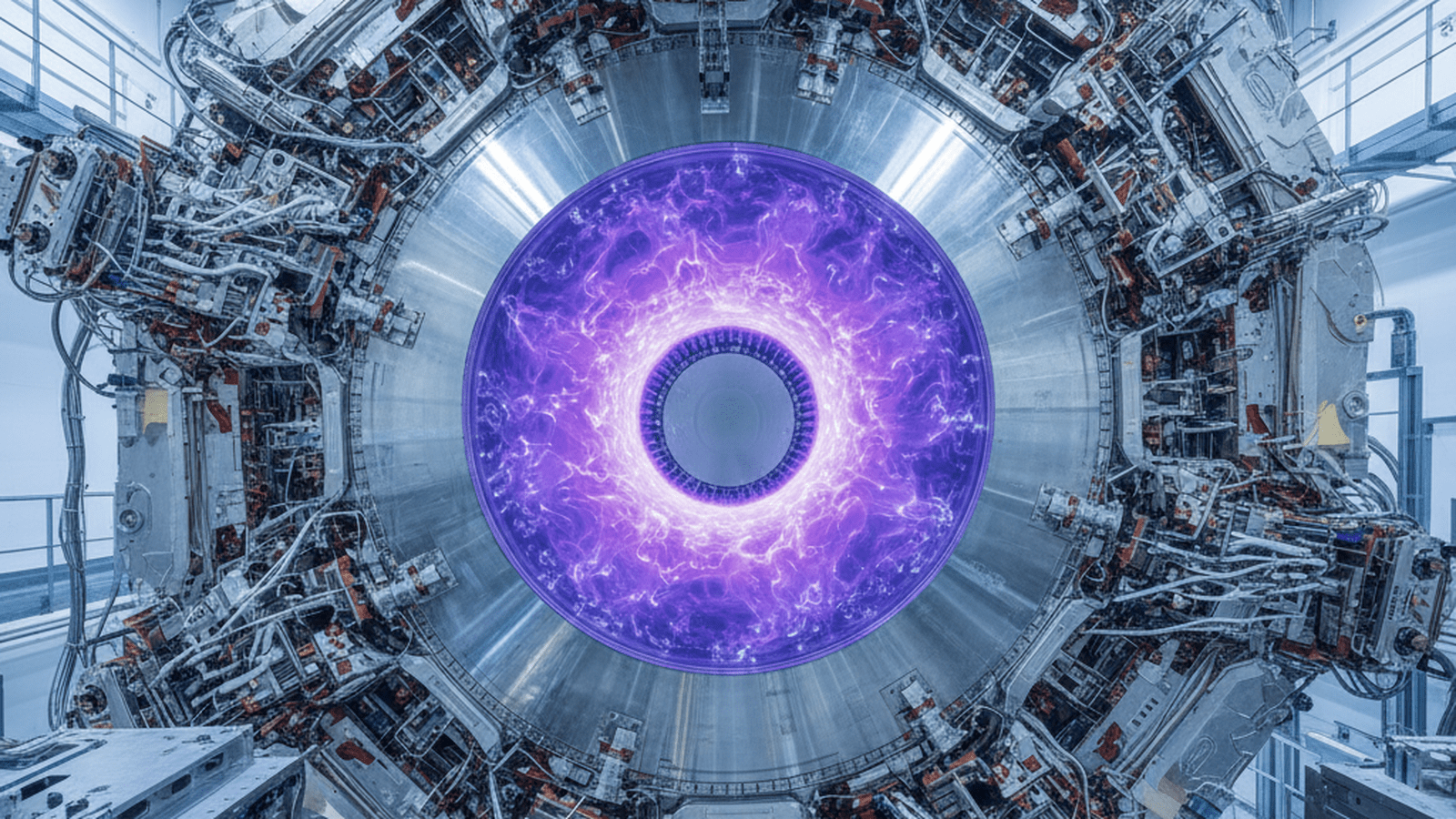
Researchers from Google DeepMind and EPFL have successfully used deep reinforcement learning to control the magnetic fields of a nuclear fusion reactor. The AI agent managed the plasma within the Variable Configuration Tokamak, demonstrating the ability to maintain complex shapes and stability in real-time.
TLDR: An international collaboration has demonstrated that artificial intelligence can autonomously control the volatile plasma inside a nuclear fusion reactor. By using reinforcement learning, the system managed magnetic coils to maintain stability, solving a major engineering hurdle for the future of clean, limitless energy.
The pursuit of nuclear fusion is often likened to capturing the power of a star within a bottle. For decades, the primary obstacle to achieving this clean, virtually limitless energy source has not been the underlying physics, but the immense engineering challenge of containment. To facilitate fusion, hydrogen isotopes must be heated to temperatures exceeding 100 million degrees Celsius—hotter than the core of the sun. At these temperatures, matter enters a state known as plasma, a turbulent and highly conductive gas that is notoriously difficult to stabilize. In a tokamak reactor, this plasma is confined by powerful magnetic fields to prevent it from touching the vessel walls, which would instantly cool the reaction and damage the machine.
In a landmark collaboration, researchers from Google DeepMind and the Swiss Plasma Center at the École Polytechnique Fédérale de Lausanne (EPFL) have demonstrated a transformative solution to this control problem. They successfully applied deep reinforcement learning (RL) to manage the magnetic confinement systems of a tokamak in real-time. This breakthrough represents a fundamental shift from traditional control methods, which rely on rigid, manually programmed algorithms, toward an autonomous system capable of navigating the complex, non-linear dynamics of fusion plasma with unprecedented agility.
Traditional control systems for tokamaks are incredibly labor-intensive. Physicists must develop intricate mathematical models for every specific plasma configuration. In the case of the Variable Configuration Tokamak (TCV) at Lausanne, this involves coordinating 19 separate magnetic coils. Each coil’s magnetic field influences the plasma’s shape, position, and stability, creating a high-dimensional puzzle that evolves every millisecond. Historically, designing a controller for a new plasma shape could take months of simulation and testing. If a researcher wanted to experiment with a different geometry, the entire control architecture often had to be rebuilt from scratch.
The DeepMind and EPFL team bypassed this bottleneck by training an artificial intelligence agent in a high-fidelity simulator. Using reinforcement learning, the AI was not given specific instructions on how to move the magnets. Instead, it was given a set of goals—such as maintaining a specific shape or density—and allowed to discover the optimal voltage adjustments through millions of simulated trials. By adjusting the “reward function,” the researchers could encourage the AI to prioritize different physical properties, such as minimizing heat exhaust or maximizing stability. This trial-and-error process in a digital environment allowed the AI to master the physics of the TCV before ever touching the physical hardware.
The transition from the digital simulator to the physical TCV hardware was the ultimate test of the system’s robustness. When the AI agent was given control of the reactor, it successfully managed the plasma in real-time, making adjustments 10,000 times per second. The AI demonstrated remarkable versatility, maintaining standard “D-shaped” plasmas as well as more exotic configurations like the “snowflake” plasma, which helps distribute heat more effectively across the reactor walls. Most impressively, the AI managed to sustain two separate “droplets” of plasma within the chamber simultaneously, a feat that is exceptionally difficult to achieve with conventional controllers.
This capability allows scientists to explore a wider range of plasma geometries without the massive overhead of traditional software engineering. This flexibility is vital for the development of the International Thermonuclear Experimental Reactor (ITER) in France. ITER will require unprecedented levels of precision to achieve a net energy gain, and the ability of AI to adapt to unforeseen plasma behaviors could be the key to its success.
The success of this collaboration suggests that AI will be a cornerstone of future energy infrastructure. Beyond magnet control, AI could eventually predict “disruptions”—sudden losses of confinement—before they occur, allowing for corrective actions in microseconds. As the world seeks carbon-free energy, the marriage of machine learning and nuclear physics provides a clear pathway toward stable, commercial-scale fusion power.

Mason Reed serves as a Staff Writer for Just Right News, where he spearheads the Future Frontiers & Special Projects desk. In an era defined by rapid technological shifts and evolving social landscapes, Mason provides a steady, principled voice, examining the innovations of tomorrow through the lens of traditional American values. His work is most prominently featured in his signature series, “The Next Horizon,” where he explores the intersection of emerging technology, national sovereignty, and the preservation of individual liberty.
A native of San Diego, California, Mason’s worldview was shaped by the unique culture of his hometown. Growing up in a region defined by its strong military presence and its history of maritime industry, he developed a deep-seated respect for the institutions that provide national stability and the entrepreneurial spirit that drives the American economy. This upbringing instilled in him a belief that true progress is not found in discarding the past, but in building upon a foundation of proven principles. His reporting often reflects this San Diego influence, emphasizing the importance of a robust national defense and the necessity of maintaining a competitive edge in the global marketplace.
Now based in San Francisco, Mason operates from the heart of the world’s technological engine. Living and working in the Bay Area provides him with a front-row seat to the advancements—and the ideological challenges—emanating from Silicon Valley. While many in the region embrace a “move fast and break things” mentality, Mason’s reporting serves as a vital counterweight. He offers Just Right News readers a “boots on the ground” perspective, documenting how radical local policies and the concentration of tech power impact the everyday lives of citizens. His proximity to the industry allows him to cut through the marketing jargon of big tech to uncover the real-world implications for privacy, free speech, and the nuclear family.
In his “Future Frontiers” beat, Mason tackles complex subjects ranging from the ethics of artificial intelligence to the burgeoning private space race. He approaches these topics with a healthy skepticism toward centralized bureaucracy, championing instead the decentralized innovations that empower individuals. Through “The Next Horizon,” he highlights the pioneers and thinkers who are working to ensure that the future remains a place where human dignity and constitutional rights are protected. He believes that the rapid pace of change requires more than just technical expertise; it requires a moral compass rooted in the Western tradition.
Throughout his tenure at Just Right News, Mason has remained committed to the idea that the future is something to be shaped, not merely accepted. His writing is characterized by a rigorous defense of American exceptionalism and a belief that the country’s best days lie ahead, provided it remains true to its founding ideals. Whether he is investigating the impact of automation on the American workforce or profiling the next generation of aerospace engineers, Mason Reed ensures that his readers are equipped with the insights they need to navigate a changing world with confidence and clarity.