

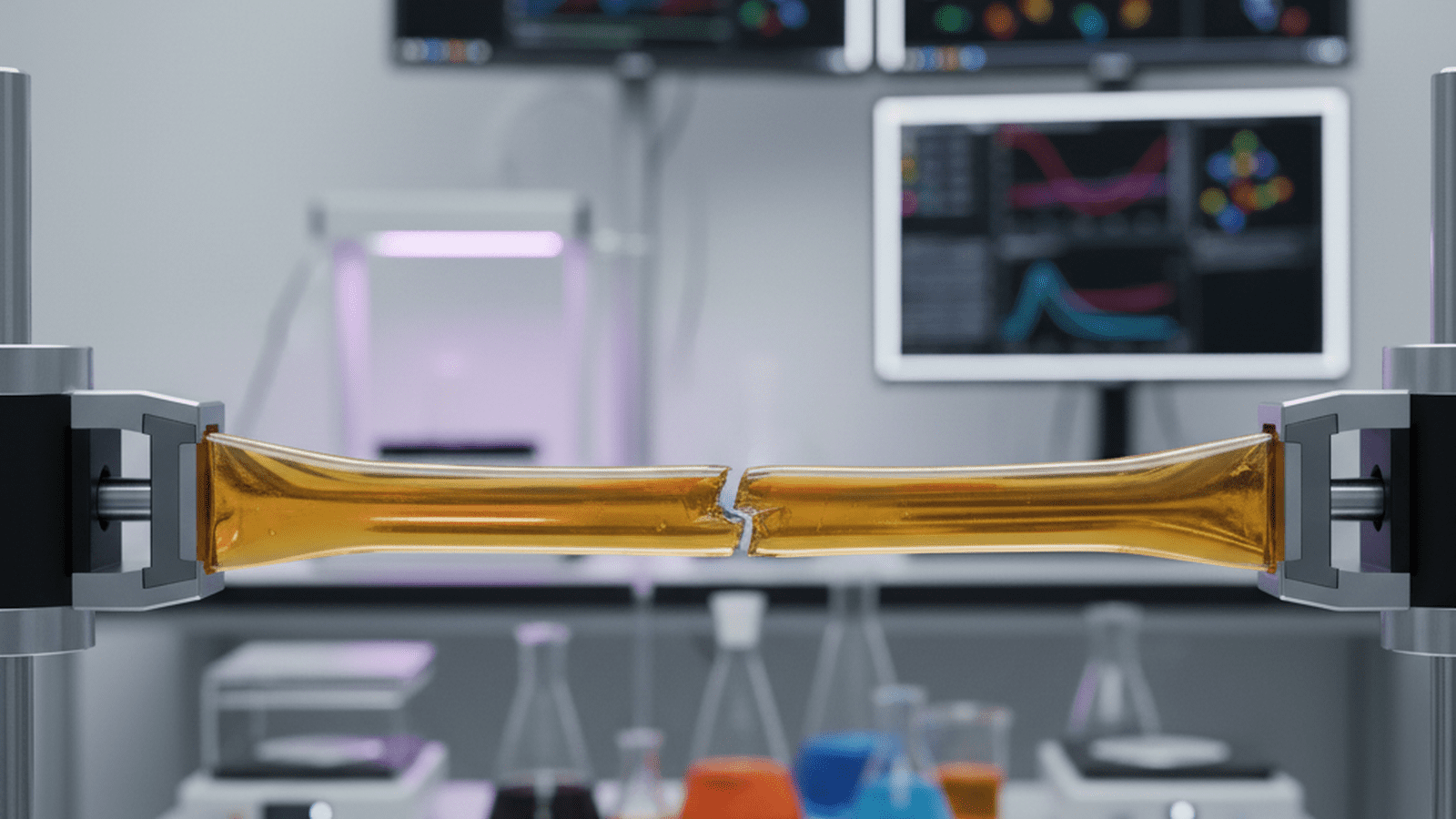
Researchers at North Carolina State University have created “glassy gels,” a new class of materials that are over 50% liquid yet as strong as hard plastics. These materials can stretch significantly and possess self-healing properties when exposed to heat.
TLDR: Scientists have developed “glassy gels,” a breakthrough material that combines the hardness of plastic with the flexibility and liquid content of gels. Composed of over 50% liquid, these gels are incredibly tough, conductive, and capable of self-healing, offering new possibilities for flexible electronics and resilient robotics.
Researchers at North Carolina State University have announced the creation of a new class of materials dubbed “glassy gels.” This innovation represents a significant departure from traditional materials science, which typically categorizes polymers as either hard and brittle glassy solids or soft and flexible gels. By successfully merging these two distinct states, the team has produced a substance that is both exceptionally strong and remarkably elastic.
The composition of these glassy gels is particularly striking, as they consist of more than 50 percent liquid. In most conventional materials, such a high liquid content would result in a soft, jelly-like consistency. However, the research team, led by Professor Michael Dickey, utilized ionic liquids to swell the polymer chains. The ionic liquid acts as a solvent but also forms strong attractions with the polymer, preventing the chains from moving freely while keeping them in a glassy state. This unique molecular architecture allows the material to behave like a hard plastic under normal conditions while retaining the internal volume of a liquid.
Mechanical testing conducted at the university revealed that the glassy gels possess extraordinary durability and resilience. They can be stretched to five times their initial length before failing, a feat that most hard plastics cannot achieve without permanent deformation or snapping. Furthermore, the material exhibits high fracture toughness, meaning it can resist the propagation of cracks even when under significant stress. The researchers noted that the material can absorb a large amount of energy during deformation, making it highly impact-resistant.
Beyond their mechanical strength, glassy gels offer functional advantages such as self-healing and shape memory. When the material is cut or damaged, the application of heat triggers a process that allows the polymer chains to reorganize and mend the breach. This capability is facilitated by the liquid content, which provides enough mobility for the chains to re-bond at the interface of a cut. This capability could significantly extend the lifespan of products made from this material, reducing waste and maintenance costs in various industrial applications.
The fabrication process for glassy gels is relatively straightforward and efficient, which is a key factor for potential commercialization. It involves mixing polymer precursors with an ionic liquid and then exposing the mixture to ultraviolet light for curing. This “one-pot” synthesis method avoids the complex, multi-step processes often required for advanced materials, suggesting that the technology could be scaled for industrial production without prohibitive costs. The researchers emphasized that the process is fast and can be performed at room temperature.
Because the liquid component consists of ions, the resulting gels are inherently conductive. This property opens the door for use in flexible electronics, sensors, and energy storage devices. Unlike traditional conductors that are rigid and prone to fatigue, these gels could be integrated into wearable technology or soft robotic systems that require both electrical conductivity and physical resilience. The transparency of the material also suggests potential uses in touchscreens or optical devices where clarity is essential.
The implications of this discovery extend into numerous sectors, from aerospace to consumer electronics. Future research will likely investigate the performance of glassy gels under extreme environmental conditions, such as high vacuum or fluctuating temperatures. Scientists also plan to experiment with different ionic liquids and polymer bases to customize the material’s properties for specific commercial and scientific requirements. As the team moves toward practical applications, the focus will shift to long-term durability and the integration of these gels into existing manufacturing workflows.

Mason Reed serves as a Staff Writer for Just Right News, where he spearheads the Future Frontiers & Special Projects desk. In an era defined by rapid technological shifts and evolving social landscapes, Mason provides a steady, principled voice, examining the innovations of tomorrow through the lens of traditional American values. His work is most prominently featured in his signature series, “The Next Horizon,” where he explores the intersection of emerging technology, national sovereignty, and the preservation of individual liberty.
A native of San Diego, California, Mason’s worldview was shaped by the unique culture of his hometown. Growing up in a region defined by its strong military presence and its history of maritime industry, he developed a deep-seated respect for the institutions that provide national stability and the entrepreneurial spirit that drives the American economy. This upbringing instilled in him a belief that true progress is not found in discarding the past, but in building upon a foundation of proven principles. His reporting often reflects this San Diego influence, emphasizing the importance of a robust national defense and the necessity of maintaining a competitive edge in the global marketplace.
Now based in San Francisco, Mason operates from the heart of the world’s technological engine. Living and working in the Bay Area provides him with a front-row seat to the advancements—and the ideological challenges—emanating from Silicon Valley. While many in the region embrace a “move fast and break things” mentality, Mason’s reporting serves as a vital counterweight. He offers Just Right News readers a “boots on the ground” perspective, documenting how radical local policies and the concentration of tech power impact the everyday lives of citizens. His proximity to the industry allows him to cut through the marketing jargon of big tech to uncover the real-world implications for privacy, free speech, and the nuclear family.
In his “Future Frontiers” beat, Mason tackles complex subjects ranging from the ethics of artificial intelligence to the burgeoning private space race. He approaches these topics with a healthy skepticism toward centralized bureaucracy, championing instead the decentralized innovations that empower individuals. Through “The Next Horizon,” he highlights the pioneers and thinkers who are working to ensure that the future remains a place where human dignity and constitutional rights are protected. He believes that the rapid pace of change requires more than just technical expertise; it requires a moral compass rooted in the Western tradition.
Throughout his tenure at Just Right News, Mason has remained committed to the idea that the future is something to be shaped, not merely accepted. His writing is characterized by a rigorous defense of American exceptionalism and a belief that the country’s best days lie ahead, provided it remains true to its founding ideals. Whether he is investigating the impact of automation on the American workforce or profiling the next generation of aerospace engineers, Mason Reed ensures that his readers are equipped with the insights they need to navigate a changing world with confidence and clarity.