

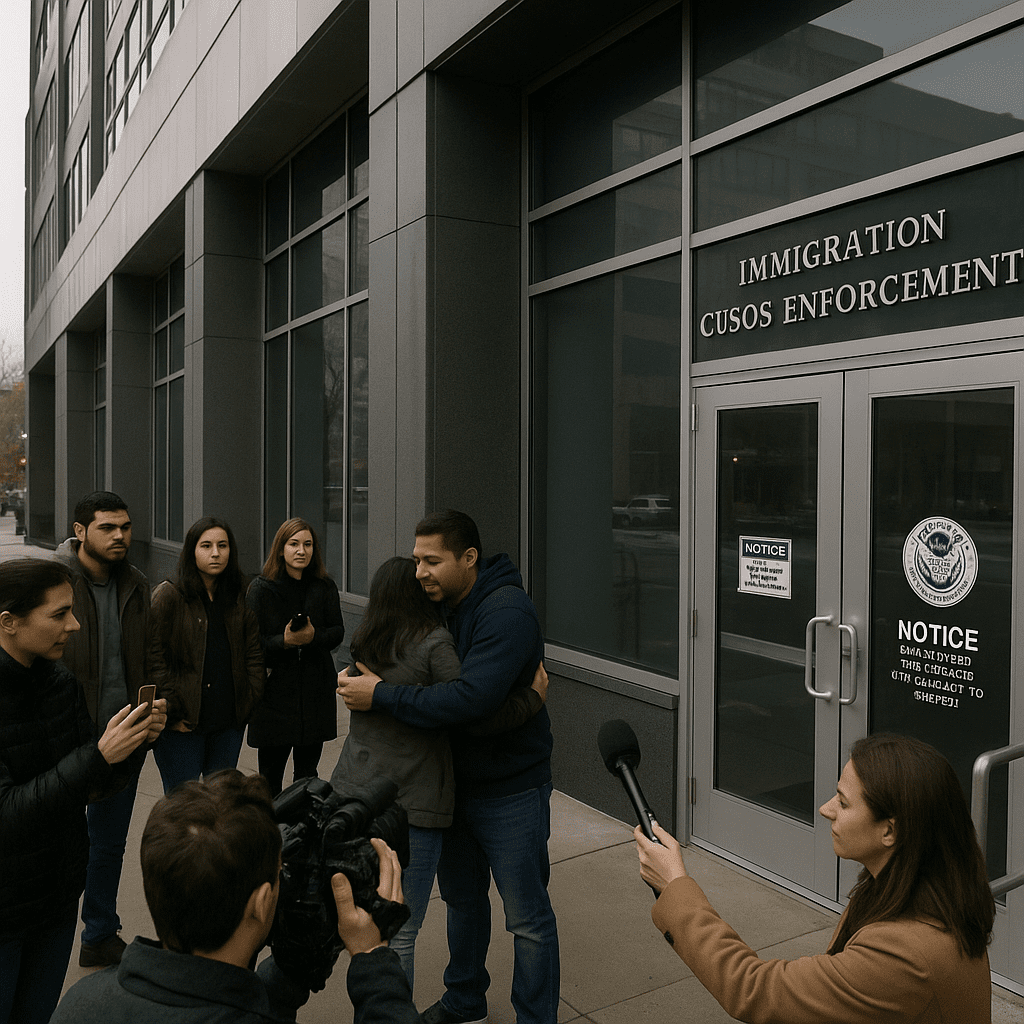
A federal judge has ordered Kilmar Abrego Garcia released from federal immigration detention and has prohibited immigration officials from detaining him, marking an unusually direct judicial check on executive enforcement power. The Associated Press reports that Abrego Garcia returned home to Maryland after the order and is now subject to noncustodial supervision instead of confinement. AP’s immigration coverage presents the ruling as a top national story, underscoring concerns about how DHS and ICE exercise detention authority and how courts enforce statutory and constitutional limits. Details about the underlying allegations and legal arguments remain sparse in the public record, but the order clearly narrows the government’s ordinary discretion to detain. Abrego Garcia is scheduled to appear Friday morning at an ICE field office in Baltimore, a key next step in testing compliance with the court’s directive.
A federal judge has ordered immigration officials not to detain Kilmar Abrego Garcia and cleared the way for his return home in Maryland, placing judicial limits on how the federal government may exercise its immigration detention powers. The Associated Press reports that the judge’s order resulted in Abrego Garcia’s release from federal immigration detention and his return to his community. The same coverage notes that a federal judge has now gone further, issuing an order that prohibits immigration officials from detaining him, signalling unusually close judicial supervision over executive enforcement decisions.
The sequence of events, as described in the available record, underscores the conflict between the executive branch’s broad discretion over immigration enforcement and the courts’ role in enforcing statutory and constitutional guardrails. Immigration and Customs Enforcement, a component of the Department of Homeland Security, had been holding Abrego Garcia in federal detention before the judge intervened. Although the AP text does not spell out the specific statute invoked, the outcome makes clear that the court found a legal basis to restrain ICE from any further custodial action against him at this time. That prohibition on renewed detention directly narrows the agency’s ordinary leeway to decide when and how to take a noncitizen into custody.
Judicial intervention of this kind often turns on due process concerns, including whether immigration officials are acting consistently with statutory authority and basic constitutional protections. The AP account repeatedly frames the development in terms of a federal judge stepping in to “prohibit immigration officials from detaining Kilmar Abrego Garcia,” language that signals more than a routine bond ruling. Instead, the court has imposed an affirmative restriction on executive conduct, suggesting that whatever led to Abrego Garcia’s detention raised questions serious enough to justify an ongoing bar against placing him back in custody.
The order arrives against a backdrop of heightened political and legal scrutiny of immigration enforcement. The AP categorizes the case under its U.S. immigration coverage and highlights it as one of the day’s top immigration stories, positioning it alongside broader debates over federal authority and civil rights. That context reinforces the sense that Abrego Garcia’s situation is being watched not only as an individual case but also as a test of how far DHS and ICE may go before courts will step in to correct or constrain alleged overreach.
The Spanish-language side of AP’s coverage underscores that significance by emphasizing his liberation “de detención federal de inmigración,” and attributing the information to “la oficina de su abogado.” While the story kit does not reproduce counsel’s legal arguments, the fact that his attorney’s office is identified as a source indicates that litigation strategy and client advocacy were central to triggering judicial oversight. In immigration enforcement, where executive discretion is typically wide, a defense team’s success in persuading a federal judge to forbid further detention stands out as a substantial check on that discretion.
After his release, Abrego Garcia’s contact with the enforcement system has shifted from custodial to supervisory. AP reports that he is scheduled to appear Friday morning at an Immigration and Customs Enforcement field office in Baltimore, following his release on the judge’s orders on Thursday. That requirement illustrates how the court’s order does not remove him from the immigration system, but instead converts a custodial relationship into one structured around reporting and compliance. Such arrangements often become the practical arena in which the tension between liberty interests and enforcement priorities is worked out.
The text of the AP piece does not describe a mistaken deportation or provide a detailed chronology of Abrego Garcia’s prior immigration history, leaving open important factual questions about what led to his detention and to the judge’s unusual prohibition. Nonetheless, by barring ICE from re-detaining him while still allowing the agency to require his appearance at a field office, the court has drawn a line between physical custody and administrative oversight. That line is where statutory authority, constitutional due process, and executive discretion intersect.
The order’s broader legal significance will likely turn on what happens next in Abrego Garcia’s case. His scheduled appearance at the Baltimore ICE field office creates a near-term moment of accountability, at which both agency officials and, potentially, the court will be able to assess compliance with the non‑detention directive. Further filings or hearings, which are not detailed in the AP material, would determine whether the prohibition on detention remains temporary or evolves into a more durable precedent on how far DHS and ICE may go before judicial oversight again intervenes.

Lila Hayes serves as a Staff Writer for Just Right News, where she anchors the “Courts, Law, and Constitutional Order” beat. Her work is defined by a steadfast commitment to the foundational principles of the American republic and a rigorous defense of the legal frameworks that ensure national stability. As a primary voice for the outlet, she provides readers with a clear-eyed analysis of the judiciary, focusing on the importance of originalism and the preservation of the separation of powers.
Lila’s perspective was forged in the American heartland. Raised in St. Louis, Missouri, she grew up in a Hispanic household where the values of hard work, faith, and respect for the law were paramount. Her upbringing instilled in her a deep appreciation for the American Dream and the legal protections that make it possible. This Missouri background remains a cornerstone of her reporting, providing a grounded, common-sense counter-narrative to the often-insular legal circles of the coastal elite. She understands that the decisions made in high-court chambers have real-world consequences for families and small business owners across the country.
At Just Right News, Lila has become widely recognized for her signature feature series, “The Rulebook of Power.” In this ongoing project, she delves into the mechanics of the federal government, examining how administrative overreach and judicial activism can threaten the delicate balance of the Constitution. She approaches her beat with the tenacity of a veteran journalist and the precision of a legal scholar, consistently advocating for a judiciary that interprets the law as written rather than legislating from the bench. For Lila, the Constitution is not a “living” document subject to the whims of modern social trends; it is a fixed standard that ensures the government remains the servant of the people, not their master.
Now based in Philadelphia, Pennsylvania, Lila finds herself at the very epicenter of American constitutional history. Living and working in the city where the Founders drafted the documents she defends daily provides a constant source of inspiration. The historic halls and landmarks of Philadelphia serve as a daily reminder of the high stakes involved in her reporting. Her presence in the city allows her to bridge the gap between the historical intent of the law and its contemporary application, ensuring that the legacy of the Founding Fathers remains central to the national conversation.
Throughout her career, Lila has remained dedicated to the idea that a free society requires an informed citizenry and a transparent legal system. Her reporting is more than just a collection of headlines; it is a defense of the constitutional order that has sustained the nation for over two centuries. By focusing on the “Rulebook of Power,” she ensures that her readers understand not just what is happening in the courtrooms, but why those decisions matter for the future of American liberty. Lila Hayes continues to be a vital voice for those who believe that the law should be a shield for the citizen and a constraint on the state.