

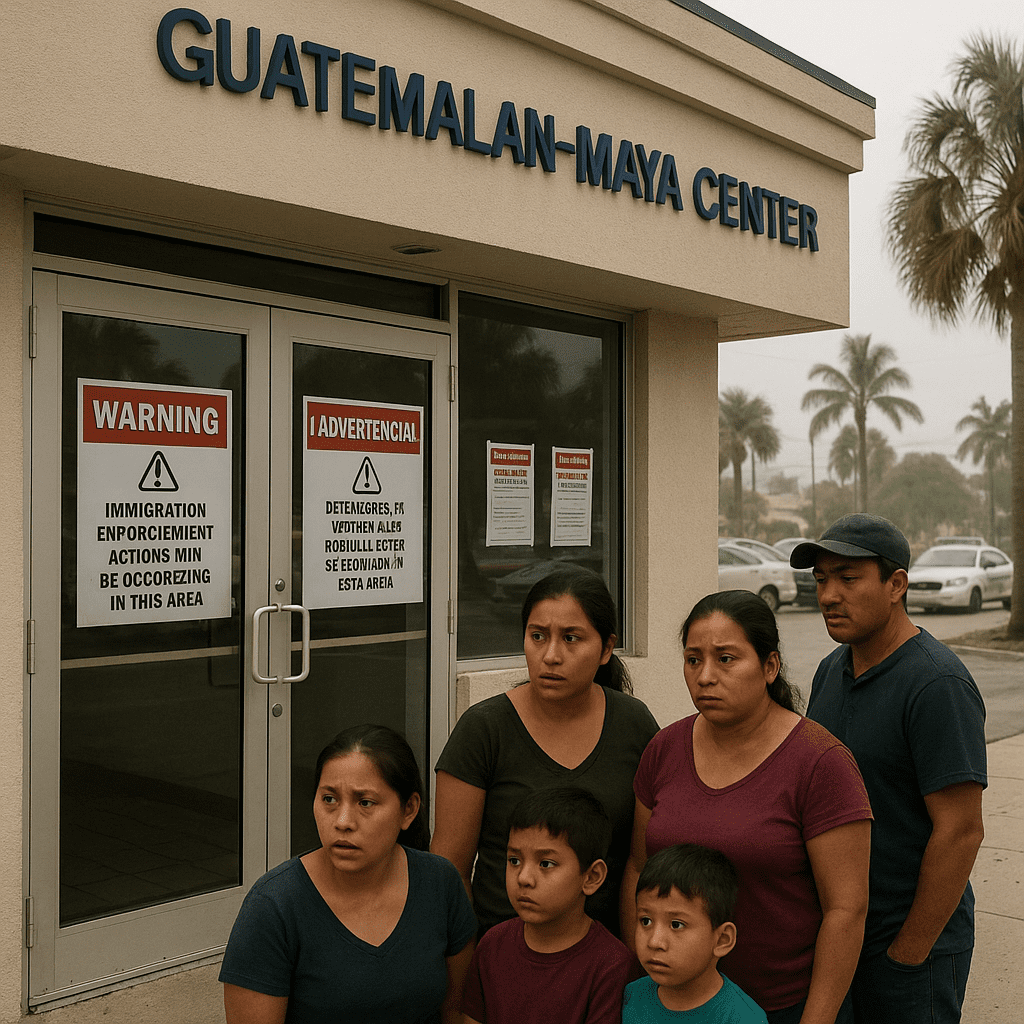
The Guatemalan-Maya Center in Lake Worth Beach, Florida, is posting warning signs about what it says are rising immigration detentions since early this year. An Associated Press video description remains the only public documentation and offers no figures or agency details. The center’s unusually public campaign underscores how federal enforcement can strain local trust and push small nonprofits into a more visible watchdog role.
The Guatemalan-Maya Center in Lake Worth Beach, Florida, is raising alarms about a rise in immigration detentions that it says has accelerated since the start of the year. The community organization has begun posting signs around its facilities to warn residents and document what it describes as “increasing detentions,” according to an Associated Press video description. While federal authorities control immigration enforcement, the center’s response underscores how national policy choices ripple through one city’s public life, testing the capacity and credibility of local institutions that must contend with the fallout.
The AP material does not detail how many residents have been detained, which agencies are involved in specific operations, or what alleged violations led to the detentions. It does make clear, however, that the center views the trend as significant enough to warrant a public campaign. By turning to signage and visible outreach, the nonprofit is signaling that conventional case-by-case advocacy may no longer be sufficient in the current enforcement climate. That shift in tactics also serves as an implicit message to city officials and law enforcement that the community is tracking what happens on their streets.
Lake Worth Beach sits within a broader national landscape where immigration is a top-tier policy issue. AP’s immigration coverage, presented alongside national stories about federal detention cases and court orders, places the city’s experience within a continuum of federal actions and judicial checks. One such AP immigration headline describes a federal judge ordering the release of Kilmar Abrego Garcia and later prohibiting officials from detaining him, illustrating how federal courts sometimes intervene in detention decisions. The Guatemalan-Maya Center’s warnings in Florida are unfolding in parallel to these larger legal and political battles, even though the AP excerpts do not connect the specific Lake Worth Beach cases to any ongoing lawsuits.
The center’s decision to post signs is also a governance story for City Hall and the local sheriff. Federal agencies may initiate detentions, but city leaders often confront the consequences, including shaken trust in public institutions. The AP text does not say whether Lake Worth Beach’s elected officials have issued statements, held hearings, or requested briefings from federal partners about the pattern the center is describing. It likewise does not describe the position of the local sheriff or police chief on coordination with immigration authorities. That absence of detail leaves open questions about how fully local officials are engaging with either the nonprofit or federal counterparts as enforcement activity intensifies.
For social service providers, a climate of heightened detentions can complicate everything from enrollment in local programs to emergency response. The AP material does not inventory the Guatemalan-Maya Center’s services, but by definition a community-based nonprofit is likely to serve residents who now fear being picked up on their way to work, school, or medical appointments. When a trusted group feels compelled to warn clients through posted signs, it suggests the organization anticipates changes in attendance, reporting of crimes, or willingness to seek help. Those behavioral shifts, in turn, can impact metrics that city agencies use to plan health, education, and safety programs.
The communications environment described in the AP article also shapes how Lake Worth Beach negotiates accountability. The Guatemalan-Maya Center is not just quietly advising families; it is operating within a national news ecosystem where immigration headlines sit alongside stories about church nativity scenes protesting immigration raids and court decisions on federal detention. By appearing in that mix, the center’s alarms gain a broader audience that can pressure or support local leaders, even though the AP excerpts do not specify any organized campaigns directed at city or county governments.
At the same time, the AP text shows how fragmented the information flow can be. The Lake Worth Beach video sits among national political coverage, business news, and global conflict updates, without much space dedicated to the granular details of local enforcement practices. That leaves residents and officials relying on partial snapshots: a nonprofit’s warning, a short AP video description, and whatever direct communication they may or may not get from federal agencies. The lack of specific numbers, dates, or agency statements in the AP material underscores how difficult it can be for local stakeholders to quantify trends or challenge them in formal venues.
Oversight in such a setting often emerges in fits and starts. Courts may intervene in individual federal cases, as in the AP’s coverage of separate immigration detention rulings, but there is no indication in the excerpts that similar legal challenges have arisen out of Lake Worth Beach. It is likewise unclear whether city commissioners, county officials, or state lawmakers plan hearings or policy reviews in response to the Guatemalan-Maya Center’s warnings. For now, the only documented next step in Lake Worth Beach is the center’s continued public messaging—its signs, its video appearance, and whatever conversations those tactics force with local governments and federal partners as the year’s enforcement patterns continue to unfold.

Dylan Brooks serves as the Senior Correspondent for Statehouses and Local Governance at Just Right News, where he brings a principled, constitutionalist lens to the often-overlooked machinery of state-level politics. As the lead voice behind the acclaimed feature series “Fifty Laboratories of Power,” Dylan has dedicated his career to the idea that the most impactful governance happens closest to home. His reporting consistently champions the Tenth Amendment, exploring how individual states can serve as testing grounds for innovative, conservative policy solutions that prioritize personal liberty and fiscal responsibility.
A native of Des Moines, Iowa, Dylan’s journalistic philosophy was forged in the heart of the American Midwest. Growing up in a community where local school board meetings and town halls were the bedrock of civic life, he developed a deep appreciation for the “retail politics” of the heartland. This upbringing instilled in him a fundamental belief that the American experiment is best preserved when power is decentralized. He carries the values of his Iowa roots into every assignment, maintaining a healthy skepticism of federal overreach and a steadfast commitment to the concerns of everyday citizens over the interests of the administrative state.
Now based in Madison, Wisconsin, Dylan operates from one of the nation’s most pivotal political battlegrounds. His location in a state capital known for its rigorous policy debates allows him to provide Just Right News readers with a front-row seat to the legislative process. From Madison, he tracks the ripple effects of statehouse decisions on local municipalities, ensuring that the connection between high-level policy and community impact is never lost. His work often highlights the success of conservative governors and legislatures in fostering economic growth, protecting parental rights, and securing the integrity of local institutions.
As an African American man in the conservative media landscape, Dylan offers a vital perspective on how limited government and free-market principles empower individuals and families. He frequently reports on how deregulation and school choice initiatives provide new avenues for success in underserved communities, challenging the monolithic narratives often presented by legacy media outlets. Dylan’s work is characterized by a commitment to the facts and a refusal to shy away from the complex realities of modern governance.
Throughout his tenure at Just Right News, Dylan has become a trusted authority for readers who value a rigorous, principled approach to the news. Whether he is dissecting a complex state budget or profiling a local grassroots movement, his goal remains the same: to provide the American public with the information they need to hold their local leaders accountable. By focusing on the “Fifty Laboratories of Power,” Dylan Brooks ensures that the vital work being done in statehouses across the country receives the national attention it deserves, always through a lens that respects the traditions and sovereignty of the American people.