

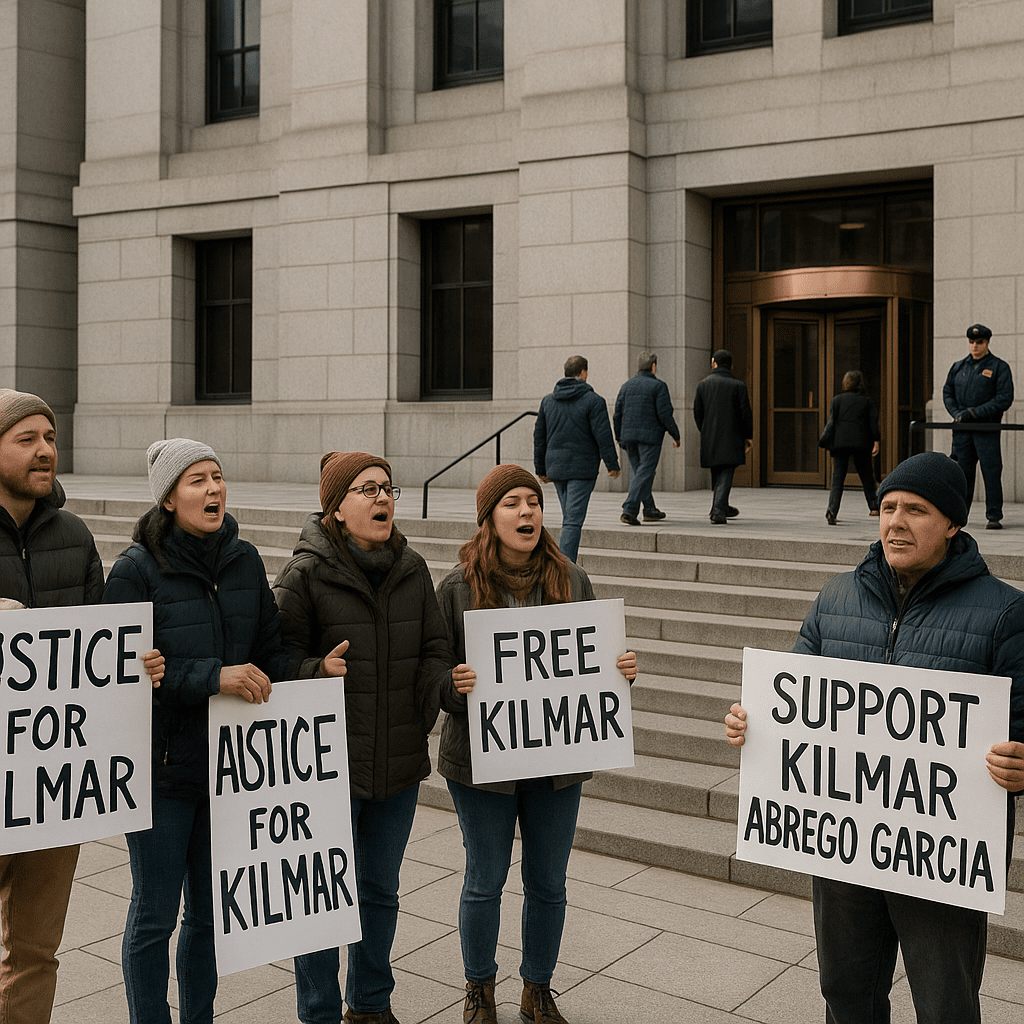
{‘current_text’: ‘Supporters of Kilmar Abrego Garcia sang and held signs outside a Maryland federal hearing. Judges are weighing whether he could be removed to Liberia, or whether officials must honor his Costa Rica designation. Authorities released no details on security perimeters, permits, road or transit changes, or ADA accommodations, shaping protest access. A decision timeline was not disclosed.’}
Songs and hand-lettered signs shaped the civic space around a Maryland court proceeding Thursday, as supporters of Kilmar Abrego Garcia gathered ahead of a federal hearing. Their presence, marked by singing and visible expressions of support, underscored how the basic rules of courthouse grounds, security perimeters and public access can determine what protest looks like when a community mobilizes around a case.
The proceeding itself carried a specific legal question: whether Abrego Garcia can be deported to Liberia or whether the government must honor his designation of Costa Rica as the country to which he should be sent if forced to leave the United States. While the hearing’s outcome was not detailed, the supporters’ assembly highlighted the practical challenges that arise any time advocacy and adjudication share the same public space.
The available account did not specify how courthouse security managed the larger-than-usual presence of people with signs or whether designated areas for expressive activity were established. It was also unclear if there were temporary road closures, barricades, or a defined security perimeter that rerouted foot traffic before and after the session. Those on-site decisions typically influence not only the visibility of demonstrators but also how easily members of the public, including those with business before the court, can move through entrances and hallways.
Information about public-space permitting tied to the gathering was not provided. In many instances, the presence or absence of a permit shapes where and how groups can assemble and for how long. That uncertainty matters, particularly when song or amplified sound is part of the expression strategy; rules about volume, timing and distance from entrances, if any were set, were not described in the available reporting.
Transit and circulation were another open question. No details were offered about how people reached the courthouse area, whether transit stops or curb space required adjustment, or if pick-up and drop-off zones were temporarily reconfigured. Those details can determine whether supporters choose to remain for the duration of a hearing or organize in shifts. They also matter for courthouse staff and visitors who must navigate the same sidewalks and curb lanes.
Access for people with disabilities is central to any courthouse day, and even more so during public mobilizations. The account did not indicate whether ADA pathways, ramps or doorways were affected or whether alternative routes were highlighted to maintain unobstructed access. The same is true for interior circulation: it was not clear whether screening lines, elevators or public waiting areas experienced delays related to the gathering.
The tenor of Thursday’s support effort—rooted in singing and visible signage—suggested a focus on presence over confrontation. Yet even peaceful demonstrations are shaped by how space is managed outside a working courthouse. Decisions about crowd placement, sign size, and proximity to entrances all influence the balance between public expression and the uninterrupted operation of a federal facility. None of those specifics were included in the available account, leaving open how officials struck that balance on the day.
Beyond logistics, the stakes of the hearing were sharply defined. The legal question, as described, centered on which country the government may send Abrego Garcia to if removal proceeds: Liberia or Costa Rica, the latter identified as his designated preference. That choice will matter most to the individual at the center of the case, but it also frames why supporters concentrated their efforts around the courthouse at that moment, drawing attention to a decision that carries significant personal consequences.
As with many courthouse mobilizations, Thursday’s scene pointed to the civic function of these spaces as both forums for adjudication and venues where residents register their concerns. When rules and access are clear—where people may stand, how they may be heard, and how everyone can still get through the doors—the result is often a more predictable and safer experience for all involved. When those parameters are not publicly communicated, uncertainty can ripple through travel plans, accessibility needs and the basic timing of a day in court.
Next steps hinge on the court’s determination of the removal-country question. No timetable for a decision or subsequent proceedings was included in the available account. Any future gatherings tied to the case would again implicate core access issues: whether public-space permits are required, how crowd management will be handled, and how ADA access and transit connections will be maintained while the courthouse continues its regular operations.

Deborah Cole serves as a Senior Correspondent for Just Right News, where she spearheads the network’s coverage of Housing, Infrastructure, and Mobility. With a career defined by a commitment to rigorous reporting and a focus on the fundamental pillars of American community life, Deborah brings a principled perspective to the complex issues that dictate how and where we live. Her work is grounded in the belief that sound policy, fiscal responsibility, and respect for private property are the essential foundations of a prosperous society.
Originally from Boston, Massachusetts, Deborah’s upbringing in one of the nation’s oldest and most historically significant cities deeply influenced her professional trajectory. Growing up amidst the architectural legacy and dense urban planning of New England, she developed an early appreciation for the importance of durable infrastructure and the role of local tradition in shaping neighborhoods. Her perspective is informed by the classic American values of her hometown—hard work, community cohesion, and a healthy skepticism of top-down bureaucratic mandates that often overlook the unique needs of individual citizens.
Today, Deborah operates from her base in Austin, Texas, a city that serves as a primary laboratory for her reporting. Austin’s rapid expansion and its status as a hub for innovation and migration provide her with a front-row seat to the most pressing challenges in modern infrastructure and housing. From the Lone Star State, she chronicles the tensions between rapid growth and the preservation of the American Dream, often highlighting how market-driven solutions and deregulation can address the housing shortages that plague many of the country’s metropolitan areas.
At Just Right News, Deborah is perhaps best known for her signature feature series, “Where We Live.” Through this platform, she explores the intersection of public policy and private life, moving beyond mere statistics to tell the stories of families, small business owners, and local developers. Her reporting frequently highlights the importance of mobility—not just in terms of transportation and transit, but as a vehicle for economic opportunity and social stability. She remains a staunch advocate for the taxpayer, consistently scrutinizing government spending on large-scale projects and advocating for transparency in how infrastructure dollars are allocated.
Deborah’s beat is more than just a collection of policy topics; it is an investigation into the physical and legal structures that allow families to flourish. Whether she is reporting on the impact of zoning laws on suburban development or the necessity of maintaining the nation’s highway systems, her work is characterized by a dedication to the facts and a respect for the constitutional principles that protect the rights of homeowners.
As a Senior Correspondent, Deborah Cole continues to be a vital voice for Just Right News, providing the audience with the clarity and context needed to navigate an ever-changing landscape. Her reporting ensures that the values of individual liberty and local sovereignty remain at the forefront of the national conversation regarding the future of our cities and towns. Through her tireless efforts, she remains committed to informing the public on the issues that hit closest to home.