

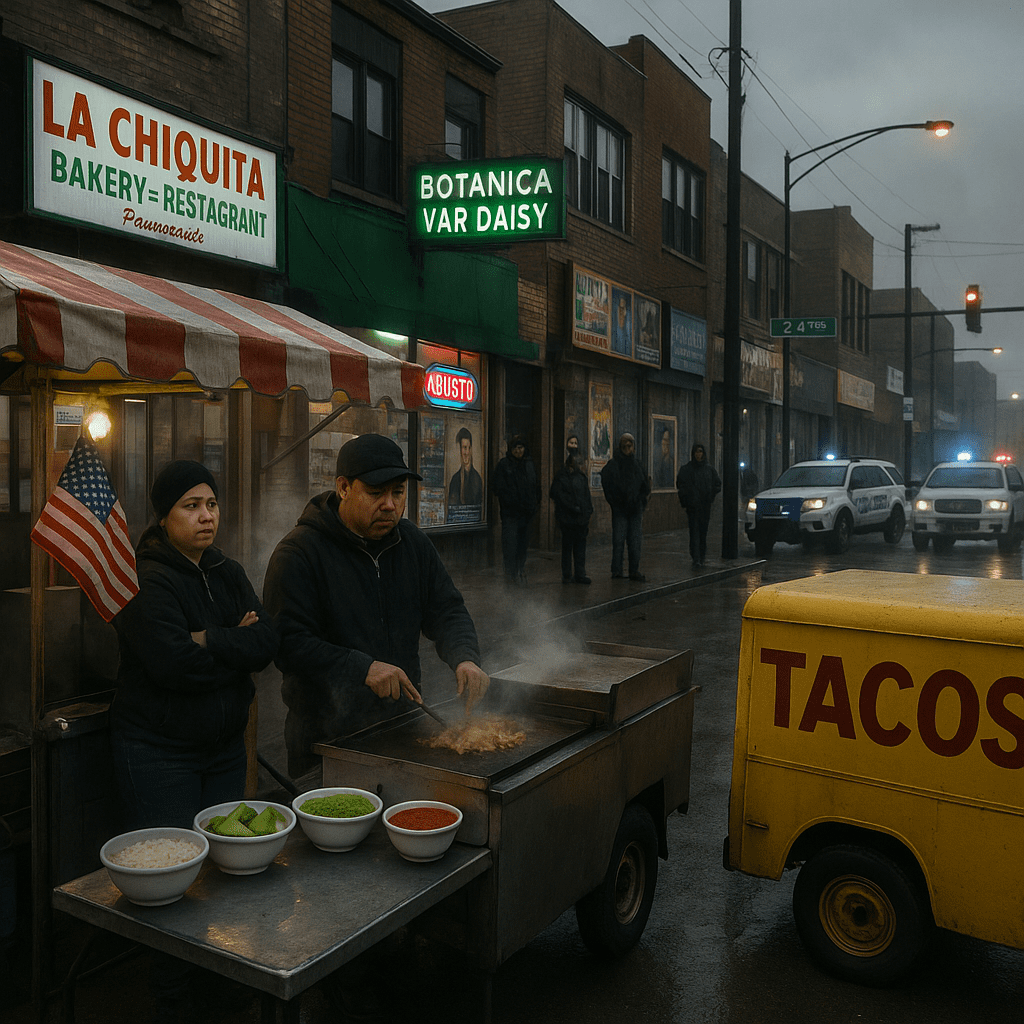
{‘current_text’: ‘Amid Chicago’s “Operation Midway Blitz,” Little Village vendors Ofelia Herrera and Rafael Hernandez keep working despite a 75% sales plunge and friends’ detentions. Their defiance spotlights how enforcement optics race through diaspora networks to Mexico. Officials emphasize criminal targeting, yet federal data show most ICE detainees lack U.S. convictions. With operations shifting to Charlotte, the couple plans to stay unless arrest forces a family return.’}
{‘current_text’: ‘The sight of sirens, Border Patrol SUVs and whiffs of tear gas in Chicago’s Little Village has become part of the daily calculus for Ofelia Herrera, 47, and Rafael Hernandez, 44. The Mexican‑born couple keeps opening their elotes and aguas frescas stand as an immigration enforcement blitz reshapes street life, customer traffic and family plans. Their micro‑portrait shows how the optics of domestic enforcement reverberate far beyond one commercial corridor, with images and warnings ricocheting through diaspora networks to relatives and would‑be migrants watching from Mexico.\n\nOfficials launched an early‑September surge, branded “Operation Midway Blitz,” that brought sustained Border Patrol visibility, vendor sweeps and arrests. Herrera and Hernandez say friends were detained, including an egg seller and a tamale vendor. They describe tear gas fired on demonstrators in a shopping‑center lot last month and new storefront signs along 26th Street insisting officers present a court warrant. Even some U.S. citizens of Latino heritage are staying indoors. The couple’s phones now buzz with constant alerts on where arrests are happening—and where to avoid.\n\nHerrera and Hernandez refuse to change their routine. They wait for agents to move a few blocks away, then open in the heart of Little Village, as they have for 18 years. On weekdays, they serve tacos and burritos from a yellow truck parked in the dirt driveway of their Englewood home. Weekends bring 11‑hour shifts in Little Village, a drag of birria and chilaquiles spots, quinceañera boutiques, and ranchera music drifting from cars. Customers still come from across the Midwest; one family recently drove in from Waterloo, Iowa.\n\nThe costs of working through the crackdown are steep. They say sales have plunged about 75% since the operation began Sept. 8. Lawyers are out of reach and a legal pathway is uncertain. Still, they insist that staying active is a guardrail against fear and depression. “The only thing you can do is have faith in God and not be afraid,” Herrera said at their South Side home, already decked with Christmas decorations days after Halloween.\n\nTheir biography maps onto broader regional migration patterns. Herrera crossed in 2004; Hernandez followed in 2005. Both paid smugglers thousands for days‑long treks through the Arizona desert before acquaintances steered them to Chicago, long a top destination for Mexican immigrants. Years later, they earned a municipal street‑vendor certificate and in 2017 bought a $39,000 fixer‑upper on the South Side. They want to remain in Chicago, but if arrested they say they would return to Mexico and bring their two U.S.-born children with them.\n\nFor would‑be migrants weighing U.S. cities, Little Village’s scenes carry outsized weight because they emanate from a hub community. Social‑media warnings about real‑time arrests in Chicago move quickly through transnational networks that link relatives and hometowns. That ground‑level picture contrasts with stated priorities: the administration says it targets criminals, yet federal data show a majority of people in Immigration and Customs Enforcement custody over the past year had no U.S. criminal conviction. The discrepancy, alongside publicized vendor arrests, is likely to shape perceptions in sending communities even without formal outreach.\n\nGregory Bovino, the Border Patrol official who has led blitzes in Los Angeles, Chicago and now Charlotte, North Carolina, has said street vendors fall within the scope of arrestable populations. He frames the rationale as upholding immigration laws, not as protecting brick‑and‑mortar merchants from undercutting. Those remarks, and the continued visibility in Little Village, signal an ongoing tempo of operations in large Mexican‑diaspora markets that often set migration expectations elsewhere.\n\nWhether the sales collapse diminishes cash sent to relatives abroad is unclear; the couple did not discuss remittances. What is evident is a localized shock: a 75% revenue decline in a corridor where sidewalk commerce is a daily lifeline. If replicated across vendors and small shops, that shock could ripple through household decisions on both sides of the border.\n\nThe family stakes are immediate. Their 10‑year‑old son, who speaks little Spanish, has been largely oblivious to the raids; their 16‑year‑old daughter fears prolonged detention for her parents more than deportation itself. “Chicago is nice,” Hernandez said. “The crime is difficult, but Chicago is marvelous. There are many opportunities for those of us who are immigrants. It’s painful what is happening.” Border operations continue without a publicly stated end date in Chicago, even as blitz activity shifts to Charlotte. Community networks will keep tracking arrests in real time while vendors reassess work, travel and schooling through the holidays.’}

Olivia Kendall serves as the Senior Correspondent for Geopolitics, Defense, and Foreign Policy at Just Right News, where she provides a principled, conservative perspective on the complex forces shaping the global stage. With a career dedicated to deconstructing the intricacies of international relations, Kendall has become a trusted voice for readers who value national sovereignty, a robust military, and a foreign policy that prioritizes American interests above all else.
A native of Washington, D.C., Kendall’s professional journey is deeply rooted in her upbringing within the nation’s capital. Growing up in the epicenter of American political life, she developed an early and profound understanding of how policy is crafted and, more importantly, how it often fails to account for the values of the American heartland. This unique vantage point allowed her to witness firsthand the rise of globalist bureaucracies, fueling her commitment to reporting that champions the constitutional foundations of the United States. Her background as a British White American further informs her worldview, providing her with a keen appreciation for the Western tradition and the enduring importance of the “Special Relationship” in maintaining global stability.
Now based in Arlington, Virginia, Kendall operates from the doorstep of the Pentagon and the heart of the nation’s defense establishment. Her proximity to the decision-makers in the military and intelligence communities allows her to provide boots-on-the-ground reporting that is both timely and deeply informed. For Kendall, Arlington is more than just a base of operations; it is a daily reminder of the sacrifices made by the men and women in uniform. This connection to the defense community drives her rigorous coverage of military readiness and her advocacy for a “peace through strength” approach to diplomacy.
At Just Right News, Kendall is perhaps best known for her acclaimed feature series, “The World’s Shadow on America.” In this ongoing project, she explores the direct correlation between international developments and the daily lives of American citizens. Whether she is analyzing the encroachment of foreign adversaries in domestic supply chains or the impact of international treaties on local economies, Kendall’s work serves as a vital bridge between distant geopolitical shifts and their consequences at home. She rejects the notion that foreign policy is an abstract concern for elites, instead proving that what happens in the corridors of power in Brussels or Beijing has a tangible “shadow” that falls across every American doorstep.
Throughout her tenure, Kendall has remained a steadfast critic of international overreach and a vocal proponent of a clear-eyed, realistic foreign policy. She brings a sharp analytical mind to her beat, often challenging the prevailing narratives of the mainstream media to uncover the underlying truths that affect national security. Her reporting is characterized by a refusal to compromise on the truth and a dedication to the idea that a strong, secure America is the world’s best hope for liberty. As a Senior Correspondent, Olivia Kendall continues to lead the charge in providing the essential context and conservative insight necessary to navigate an increasingly volatile world.