

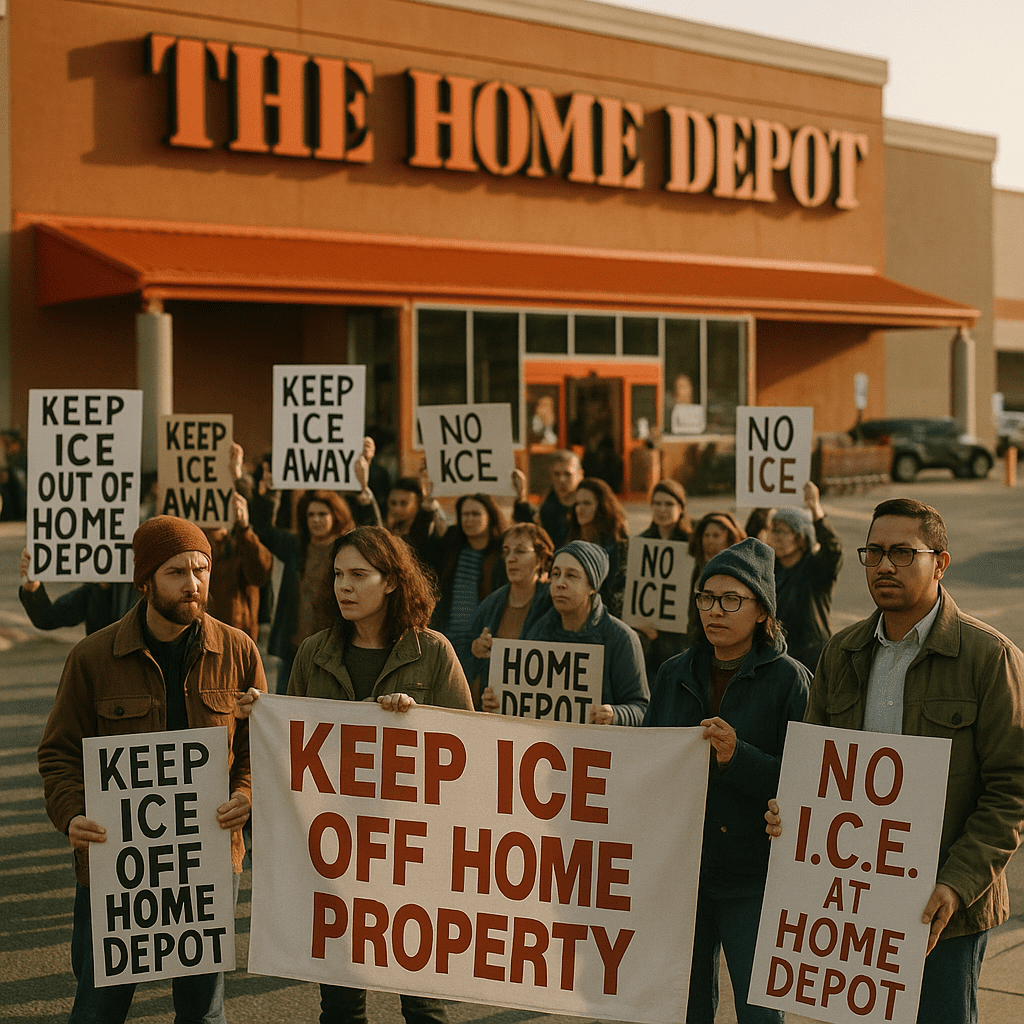
An Associated Press video excerpt reported that protesters in Charlotte urged Home Depot to bar immigration officers from its property. The available material states the demand but does not identify organizers, provide company comment, or include interviews with affected workers or legal advocates. Related AP coverage within the same news stream notes recent legal disputes over immigration agents’ scope — including a judge tossing a DOJ lawsuit challenging a New York law barring immigration agents from state courts — and reports of migrants unexpectedly facing deportation actions in court settings. Next steps for reporting include securing Home Depot’s response, identifying protest leaders, documenting worker experiences, and monitoring any municipal or legal follow-up; the AP excerpt contains no dates, formal oversight notices or confirmed timelines.
Protesters gathered in Charlotte urging Home Depot to keep immigration officers off company property, an action captured in an Associated Press video excerpt. The demonstration, described in the AP item headline and video listing, called on the national retailer to bar federal immigration enforcement from conducting operations on or around its stores.
The AP excerpt posted to the news feed reports the protest action but does not identify the organizers, the number of participants, or the precise location of the demonstration beyond the city and the retailer named. No quotations from protesters, company representatives, legal advocates or affected workers appear in the available material. Those omissions leave basic local human-impact details unreported in the excerpt.
The demonstration comes as immigration enforcement and the reach of federal agents have been subjects of recent news coverage. The AP feed cited legal developments including a judge tossing a Justice Department lawsuit challenging a New York law that bars immigration agents from state courts. Coverage elsewhere on the feed also noted reports of migrants who were reportedly misled about routine hearings that resulted in deportation actions. Those stories were part of broader immigration reporting in the same news stream, and the AP video headline sits alongside that coverage in the outlet’s immigration category.
Public gatherings at private retail locations raise questions about how corporate policies intersect with civil enforcement. The available AP material names Home Depot as the target of the Charlotte demonstration but does not provide a statement from the company, nor does it disclose whether the retailer has an existing policy addressing federal immigration presence on its premises. The lack of a company response in the excerpt prevents reporting on whether Home Depot has authorized or restricted access to federal agents at stores in Charlotte or elsewhere.
Precedent for private-land cooperation with federal agents varies by jurisdiction and by company, and courts and legislatures have been active in defining or contesting those boundaries. The AP feed includes references to court activity related to immigration agents in state settings, but the excerpt does not link any litigation or enforcement action directly to Home Depot or to the Charlotte protest. Without further sourcing or public statements, it is not possible to determine whether the protesters’ demands reflect a specific recent incident, a policy dispute, or a broader advocacy campaign.
The AP video excerpt does not identify the organizing groups involved in the Charlotte action. It also lacks interviews with company representatives, legal advocates or workers who might be affected by immigration enforcement at retail sites. Those elements are standard parts of reporting on local protests and corporate policy disputes but are not present in the available material.
The stakes cited by connected coverage on the AP feed include legal limits on where immigration agents may operate and high-profile accounts of deportation actions tied to court proceedings. Those items provide background that may inform public concerns about immigration enforcement in civic and commercial spaces. Still, the precise legal or regulatory pathways that could address the protesters’ requests — such as municipal ordinances, corporate policy changes or litigation — are not detailed in the AP excerpt.
For readers seeking clarity, the available coverage does document the protest demand and places it within a stream of immigration reporting on the AP site. Key unanswered questions include whether Home Depot will issue a statement or policy clarification, whether local or state officials will review the matter, and whether organizers will pursue additional public pressure or legal avenues. The AP video listing does not provide dates, follow-up plans or contact responses for any parties.
Continued reporting will require obtaining company comment, identifying the groups or leaders who organized the Charlotte demonstration, and documenting accounts from workers or shoppers affected by enforcement activity. The AP excerpt establishes that protesters urged Home Depot to keep immigration officers off its property but does not provide the additional details necessary to trace potential policy changes, municipal oversight, or legal challenges.
The story is therefore provisional based on the available material. The public record in the AP feed notes the protest and situates it amid wider immigration coverage, but it does not include subsequent actions, deadlines or formal oversight steps related to the Charlotte demonstration. Those developments, if they occur, will need to be reported as new information becomes available.

Eric Nolan serves as the Senior Correspondent for Food, Water, and Environmental Health at Just Right News, where he brings a principled, common-sense perspective to the most fundamental issues facing the American public. With a career dedicated to uncovering the truth behind the policies that govern our natural resources, Eric has become a trusted voice for readers who value traditional stewardship over bureaucratic overreach. His reporting is defined by a commitment to the idea that true environmentalism is rooted in the protection of the American family and the preservation of the nation’s agricultural heritage.
Raised in Fresno, California, Eric’s worldview was shaped in the heart of the San Joaquin Valley. Growing up in one of the world’s most productive agricultural hubs, he witnessed firsthand the vital connection between the land, the water, and the dinner table. In Fresno, he saw the resilience of farmers and the devastating impact that distant, top-down regulations can have on local communities. This upbringing instilled in him a deep respect for the producers who feed the country and a lifelong skepticism toward the alarmist narratives often pushed by mainstream media. For Eric, environmental health is not an abstract political talking point; it is a matter of ensuring that the people who work the land have the freedom and the resources to do so effectively.
Now based in Eugene, Oregon, Eric operates from a unique vantage point in the Pacific Northwest. Living in a region often defined by intense environmental debate, he provides a necessary counter-narrative to the prevailing trends of the area. From his base in Eugene, he monitors the shifting tides of federal and state policies, ensuring that the voices of rural citizens and property owners are not drowned out by urban activism. His reporting often bridges the gap between the rugged realities of the outdoors and the legislative halls where decisions are made, offering a grounded perspective that prioritizes local sovereignty and practical solutions.
As the lead for the acclaimed feature series “Earth on the Table,” Eric explores the intricate journey of the American food supply. He tackles critical issues such as water rights, soil health, and food security through a lens of national stability and individual liberty. He believes that a healthy environment and a thriving economy are not mutually exclusive, but rather two sides of the same coin of national prosperity. His work consistently highlights how innovation and private-sector ingenuity are the most effective tools for ensuring clean water and a safe food supply, rather than the expansion of the administrative state.
At Just Right News, Eric’s reporting serves as a vital resource for those who seek accountability and transparency. Whether he is investigating the impact of federal land management on local economies or examining the safety of the national food infrastructure, his work remains anchored in the values of heritage and hard work. Eric Nolan continues to be a leading voice in environmental journalism, championing the belief that the best way to protect our natural resources is to empower the people who live and work closest to them.