

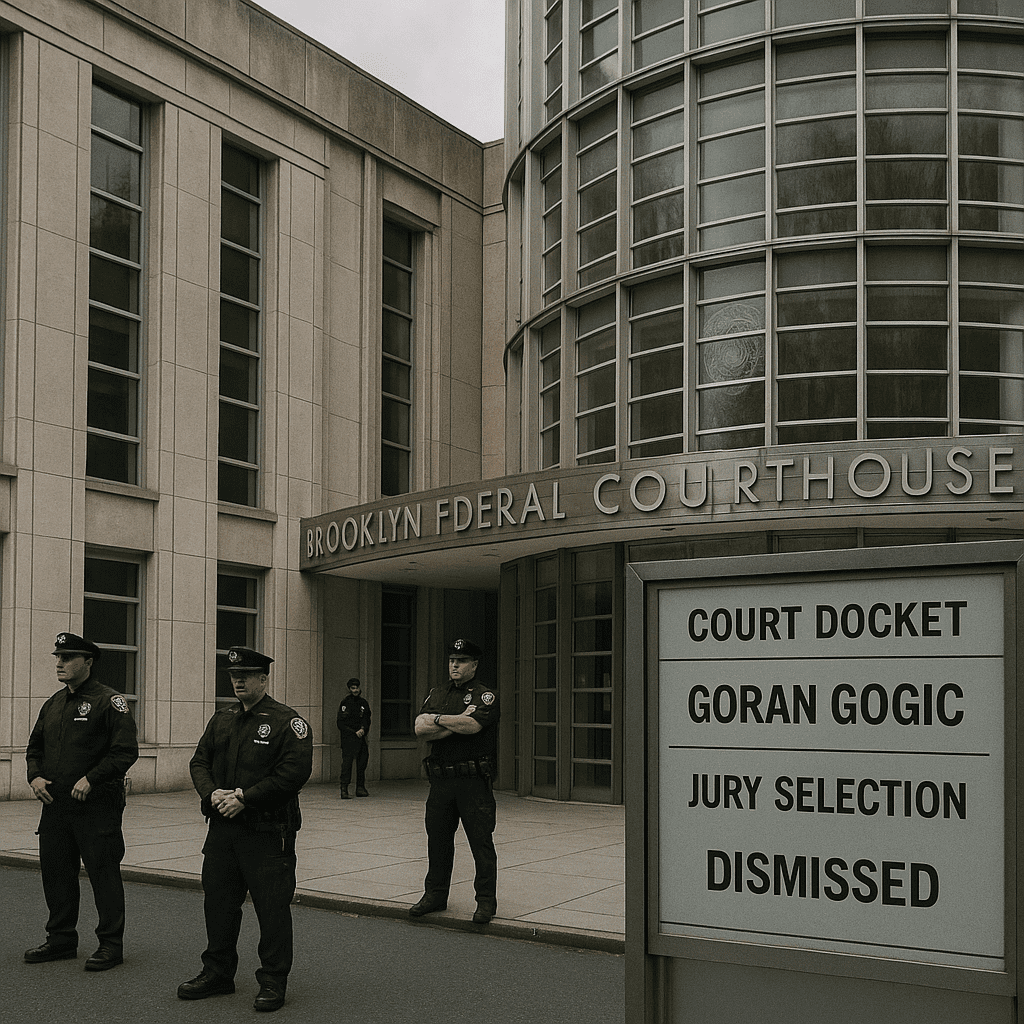
Three men were arrested for allegedly offering a juror $100,000 to return a not guilty verdict in the Brooklyn drug trial of former heavyweight boxer Goran Gogic, prompting a federal judge to dismiss the jury just before opening statements. Court papers and prosecutor statements describe recorded conversations in Albanian and English, repeated cellphone contacts by one defendant identified as Mustafa Fteja, and meetings on Staten Island where offers of $50,000 to $100,000 were discussed. Prosecutors told the court the men may have obtained jury information from “individuals connected to this trial.” One defendant was released on $150,000 bond, two were jailed, and the trial is paused for 30 days with an anonymous jury to be chosen when it resumes; a Dec. 17 conference is scheduled to set next steps.
Three men were arrested after investigators say they offered a juror $100,000 in cash to return a not guilty verdict in the Brooklyn federal drug trial of former heavyweight boxer Goran Gogic, prompting a judge to abruptly dismiss the jury on the day opening statements were to begin. The arrests halted proceedings and exposed investigatory details that prosecutors say point to coordinated efforts to corrupt a high‑profile case. Court filings and prosecutor statements indicate recorded conversations and targeted contacts with a juror, raising questions about whether trial information was leaked to outside associates.
Assistant U.S. Attorney Francisco Navarro told U.S. District Judge Joan Azrack that three individuals approached a juror and offered $100,000 in cash to return a not guilty verdict. Navarro said the men may have obtained a copy of the jury list or jury information from “individuals connected to this trial.” The prosecutor’s account was included in court papers and formed the basis for the abrupt dismissal of the seated jury.
Federal prosecutors in Brooklyn described a sequence of contacts they say began when one of the defendants, identified in court papers as Mustafa Fteja, repeatedly called a juror described as “John Doe #1” before arranging a meeting on Staten Island. The criminal complaint filed in Brooklyn federal court states that during the first meeting Fteja told the juror that associates in the Bronx were willing to pay him to return a not guilty verdict. Two days later, the complaint says, Fteja met the juror again and told him the group was willing to pay between $50,000 and $100,000.
Investigators say they obtained recorded conversations in which the defendants discussed the plan in both Albanian and English. The court papers include quotes from those recorded conversations, according to prosecutors, and an FBI agent wrote that the bribery scheme unfolded between Thursday and Sunday. Those recordings formed part of the case presented to the judge and the warrant affidavits used to support arrests.
One of the men charged, Mustafa Fteja, was released on a $150,000 bond after a court hearing. The two others, named in court filings as Valmir Krasniqi and Afrim Kupa, were jailed pending further proceedings. At their initial appearances, the three were not required to enter pleas and messages seeking comment were left for their lawyers, court records show.
Gogic, a native of Montenegro, was scheduled to stand trial on charges alleging violations and conspiracy to violate the Maritime Drug Law Enforcement Act. Prosecutors say Gogic and co‑conspirators worked with ship crew members to smuggle cocaine in shipping containers, using speedboats to hoist loads aboard commercial cargo vessels. Three shipments were intercepted by U.S. law enforcement, including 1,437 kilograms of cocaine aboard the MSC Carlotta at the Port of New York and New Jersey in February 2019 and 17,956 kilograms aboard the MSC Gayane at the Port of Philadelphia in June 2019. Prosecutors have said the Philadelphia seizure had a street value of over $1 billion.
Gogic has pleaded not guilty to the charges. His lawyer did not immediately respond to requests for comment, and defense counsel Joseph Corozzo told the judge in open court that he had informed the ex‑fighter the trial would not proceed on the day of the dismissals. Law enforcement officials described Gogic in filings as a “major drug trafficker” who operated on a “mammoth scale.” The court record also documents details about Gogic’s past as a professional boxer and his identification in allegations tied to large international narcotics shipments.
Prosecutors told the court that an anonymous jury will be selected when the trial resumes after a 30‑day break. John Marzulli, a spokesperson for federal prosecutors in Brooklyn, said the anonymous jury procedure would be used during the resumption of proceedings. Judge Azrack scheduled a conference for Dec. 17 to address next steps and case status.
The alleged bribery plot and the procedural response by the court underscore vulnerabilities in high‑profile prosecutions, according to the factual record presented to the judge. Recorded planning, repeated contact with a juror, and prosecutor assertions that jury information may have been obtained from people “connected to this trial” together suggest a level of organization that can threaten trial integrity. Those facts in the complaint and courtroom statements now form the immediate basis for heightened security measures and changes to how jurors will be protected and selected.
Court filings show investigators relied on contemporaneous recordings and phone contacts to build probable cause for arrests. The recorded conversations and the description of targeted outreach to a juror are central evidentiary elements cited by prosecutors. The judge’s decision to dismiss the jury and to pause the trial reflects the court’s immediate assessment that the integrity of the proceeding had been compromised.
The case will return to federal court under new protective measures. A Dec. 17 conference is on the docket to set the schedule for resuming trial, and prosecutors have indicated they will proceed with an anonymous jury when proceedings restart after the 30‑day break. The outcomes of initial detention hearings for the three accused will continue to affect pretrial posture, and court oversight will address whether additional charges, disclosures or sanctions are warranted as the investigation proceeds.

Chloe Foster serves as a Staff Writer for Just Right News, where she spearheads the outlet’s coverage of Media, Culture, and Information Integrity. In an era defined by rapid-fire digital communication and shifting societal norms, Chloe has distinguished herself as a vital voice for readers seeking clarity amidst the noise. Her signature feature series, “The Story Wars,” has become a cornerstone of the publication, offering a deep dive into the ideological battles currently shaping American life and the ways in which mainstream narratives are constructed, disseminated, and often manipulated.
Chloe’s unique perspective is informed by a life lived in two of the nation’s most influential cultural hubs. Raised in Los Angeles, California, she grew up in the shadow of the world’s most powerful media and entertainment apparatus. This upbringing provided her with a front-row seat to the “dream factory,” allowing her to observe firsthand how cultural exports are crafted and how they often diverge from the lived experiences of everyday Americans. Her time in Los Angeles instilled in her a healthy skepticism of manufactured consensus and a passion for uncovering the truths that lie beneath polished public relations campaigns.
Today, Chloe operates from Brooklyn, New York, a vantage point that places her at the epicenter of the modern media landscape. Living and working in a deep-blue urban environment as a conservative journalist has sharpened her reporting, requiring a rigorous commitment to intellectual honesty and a steadfast defense of traditional values. Her base in Brooklyn allows her to engage directly with the institutions and influencers who drive the national conversation, providing Just Right News readers with an “on-the-ground” look at the cultural shifts originating in the Northeast.
As a Hispanic woman, Chloe brings a nuanced understanding of community and heritage to her beat. She frequently explores how media portrayals of the Latino community often overlook the deep-seated faith, entrepreneurial spirit, and family-centric values that define it. Her work challenges the monolithic labels often applied by mainstream outlets, instead highlighting the diversity of thought and the conservative principles that resonate within her community.
In her role at Just Right News, Chloe views “Information Integrity” not merely as a buzzword, but as a mission. She believes that a healthy republic requires a media landscape where facts are prioritized over agendas and where the public is empowered to think for themselves. Through “The Story Wars,” she deconstructs the framing of major news events, exposing bias and providing the context necessary for readers to understand the broader cultural implications of the day’s headlines.
Chloe Foster’s reporting is more than just a collection of articles; it is a sustained effort to reclaim the narrative for those who feel sidelined by the prevailing media establishment. By bridging the gap between her West Coast roots and her East Coast base, she continues to provide essential commentary on the forces that define our shared American culture.