

Prosecutors halted the Brooklyn drug trial of former heavyweight Goran Gogic after three men were arrested for allegedly offering $100,000 in cash to a juror. Court filings say Mustafa Fteja repeatedly called and met the juror; recorded conversations in Albanian and English and phone records supported probable-cause claims. One defendant posted $150,000 bond; two remain jailed. Judge Joan Azrack set a Dec. 17 conference and ordered a 30-day pause.
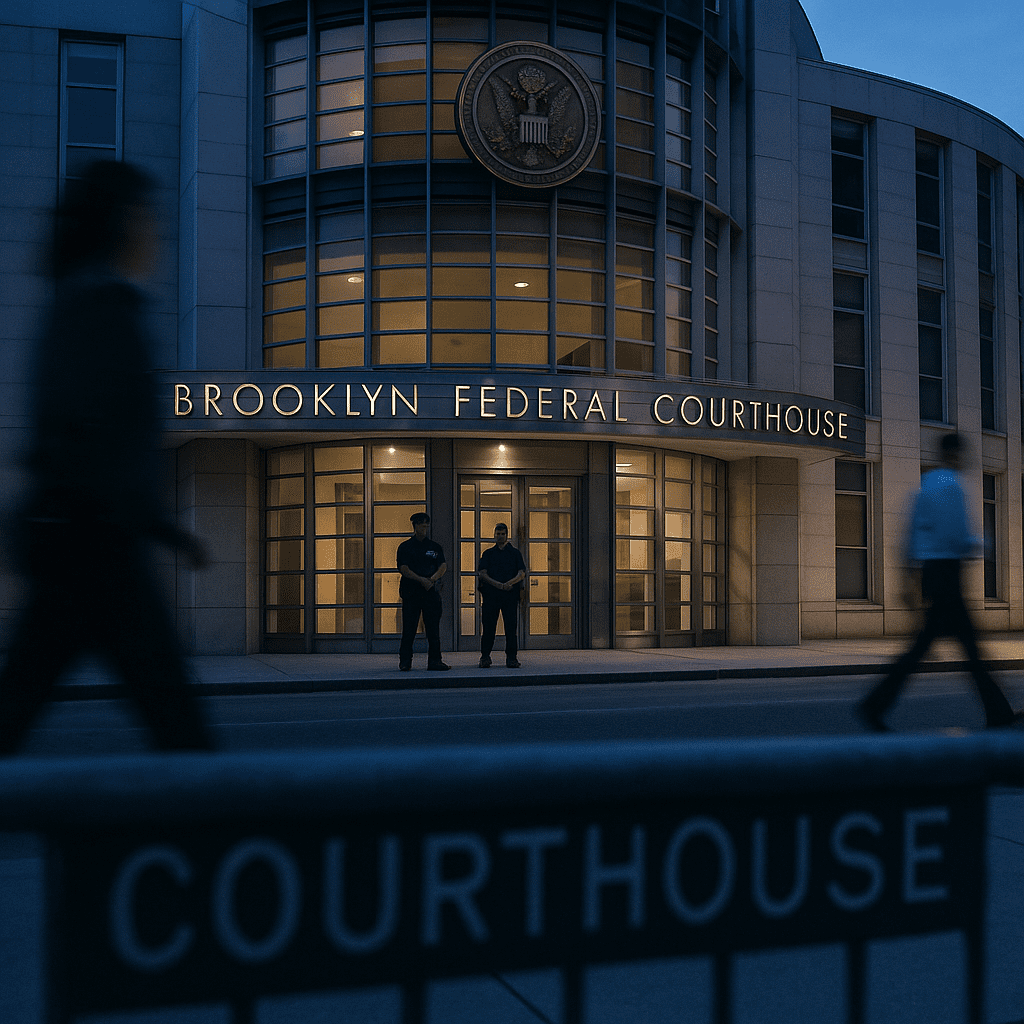
Three arrests and a federal complaint alleging an offer of $100,000 in cash to a juror forced an abrupt halt to the Brooklyn trial of former heavyweight boxer Goran Gogic, prosecutors and court filings show. The dismissal came just as opening statements were about to begin, and Judge Joan Azrack set a Dec. 17 conference and ordered a 30-day break while prosecutors and the court address the alleged scheme. John Marzulli, a spokesperson for federal prosecutors in Brooklyn, said an anonymous jury will be selected when the trial resumes.
Court papers and a criminal complaint filed by an FBI agent lay out the operational detail central to the prosecutors’ case. According to the complaint, the events unfolded between Thursday and Sunday. The document says Mustafa Fteja, identified in public filings as one of the defendants, already knew a juror described as “John Doe #1” and called him multiple times on his cellphone before arranging a meeting on Staten Island.
The complaint reports that during a first meeting Fteja told the juror associates in the Bronx were willing to pay him to return a not guilty verdict. Two days later, during a second meeting, Fteja told the juror they were willing to pay between $50,000 and $100,000, the filings say. Investigators recorded several conversations of the defendants planning the juror corruption plot; the court papers contain quoted excerpts and note the conversations were in Albanian and English. Assistant U.S. Attorney Francisco Navarro told the judge the three men may have obtained jury information from “individuals connected to this trial.”
One of the arrested men, Mustafa Fteja, was released on a $150,000 bond after a Tuesday hearing. The two others, Valmir Krasniqi and Afrim Kupa, remain jailed pending further proceedings. Messages seeking comment were left for their lawyers, the filings record.
The bribery allegation has procedural and investigative consequences. A federal judge’s immediate dismissal of the jury stopped the trial in its tracks and prompted the decision to select an anonymous panel after the pause. The dismissal also preserves prosecutorial flexibility to expand the investigation into who supplied jury contact details and whether the alleged payment offer ties back to broader criminal proceeds.
Prosecutors’ public statements and the complaint indicate a forensic-money thread already in evidence: recorded conversations and cellphone contacts. The FBI agent’s complaint documents repeated calls to the juror and at least two face-to-face meetings. Those communications provide a direct evidentiary trail that federal investigators typically integrate with technical records, court filings show in other cases; the public court papers in this matter, however, do not yet specify which additional financial or surveillance tools investigators have deployed.
Bank and financial records, surveillance video, structured-deposit patterns and cash-for-hire intermediaries are common lines of inquiry in juror-tampering probes, but the court papers made public in this case do not detail whether agents have traced cash deposits or followed money flows to and from the defendants. Law-enforcement officials in the filings have characterized Gogic as a “major drug trafficker” who operated on a “mammoth scale,” and prosecutors have highlighted past seizures linked to the broader investigation — including multi-ton seizures in U.S. ports cited in the underlying drug case.
Federal investigators will likely combine the recorded communications the complaint cites with cellphone records, location data and any surveillance to map meetings and transfers. The complaint’s reference to conversations in Albanian and English, and the allegation that Fteja already knew the juror, point to a networked operation in which intermediaries may have played a coordinating role. The public record does not yet show whether prosecutors have identified financial intermediaries, used grand-jury subpoenas for bank records, or executed search warrants tied to cash movements.
The scale of the underlying drug case increases the stakes. Prosecutors say Gogic and alleged co-conspirators were accused of conspiring to smuggle roughly 20 tons of cocaine to Europe, and the complaint links that case to multiple seizures, including a Philadelphia interception prosecutors said held cocaine with an estimated street value of over $1 billion. Those assertions underline why investigators would probe any allegation that the trial process itself was subject to corruption.
Defense counsel told the judge they informed Gogic the trial would not proceed that day. The filings record that Gogic has pleaded not guilty to charges under the Maritime Drug Law Enforcement Act, and that if convicted he faces a sentence of 10 years to life in prison.
The court’s next scheduled step is the Dec. 17 conference. In the meantime, prosecutors will continue the investigation into the alleged bribery plot, including tracing recorded communications cited in the complaint and determining whether additional charges or evidence will be disclosed at the upcoming hearing. The pause and the move to an anonymous jury reflect immediate judicial oversight of both the corruption allegation and the broader case.

Max Grant serves as the Senior Correspondent for Data and Financial Forensics at Just Right News, where he brings a meticulous, investigative eye to the complex world of numbers. In an era where media narratives often overshadow objective reality, Max operates on a simple but firm principle: while rhetoric can be manipulated, the ledger never lies. As the architect behind the acclaimed feature series “Numbers That Talk,” he has carved out a vital niche in conservative journalism, translating dense financial data into clear, actionable insights for the American public.
Max’s journey to the forefront of financial reporting began in Buffalo, New York. Growing up in the Queen City, he was raised with the grit and grounded perspective typical of the Rust Belt. Buffalo is a place that understands the value of a dollar and the consequences of economic shifts on the working class. This upbringing instilled in Max a deep-seated respect for fiscal responsibility and a healthy skepticism toward bureaucratic overreach. He carries the spirit of his hometown into every investigation, viewing his work not just as reporting, but as a form of public service dedicated to protecting the interests of taxpayers and everyday citizens.
Now based in Brooklyn, New York, Max operates from the heart of one of the world’s most influential financial and cultural hubs. This vantage point allows him to keep a close watch on the institutions that drive the global economy. Living and working in a city often defined by progressive policy experiments, Max provides a necessary counter-perspective, using his forensic skills to analyze the real-world costs of local and national governance. His proximity to the financial district ensures he is never far from the source of the data he deconstructs, yet he remains firmly rooted in the conservative values that prioritize transparency and individual liberty.
His beat, Data and Financial Forensics, is more than just a job title; it is a commitment to uncovering the truth hidden within spreadsheets and annual reports. In “Numbers That Talk,” Max dives deep into federal spending, corporate accountability, and the intricate web of international finance. He has a unique ability to spot the anomalies that others miss, identifying where public funds are being mismanaged or where economic policies are failing to deliver on their promises. His reporting is characterized by a relentless pursuit of clarity, stripping away the jargon to show readers exactly how their money is being used and how the economy is truly performing.
At Just Right News, Max Grant is recognized as a steady hand and a sharp mind. He understands that for a free society to function, its citizens must have access to the facts regarding their financial future. By combining his British heritage’s tradition of rigorous inquiry with an American drive for accountability, Max ensures that the numbers don’t just sit on a page—they tell the story of where the country has been and where it is headed. His work stands as a testament to the power of forensic journalism in holding the powerful to account and championing the principles of a transparent, fiscally sound nation.