

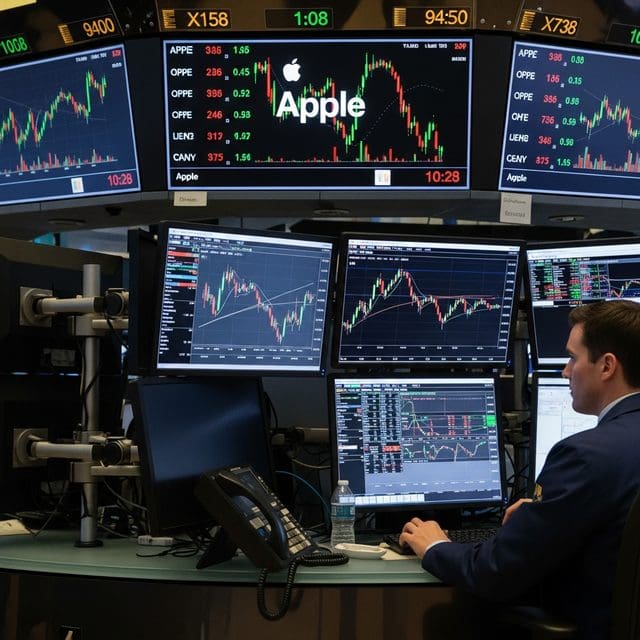
Rising chip costs and regulatory shocks in the biotech sector are driving a sharp divergence in market performance, with health care outperforming despite a drag from megacap technology names.
Global equity markets displayed a stark internal divide during the latest session. While the S&P 500 managed a modest gain of 0.15%, the headline figure masked a significant rotation away from high-growth technology toward defensive health care and industrial sectors. This shift comes as the ‘Invisible Economy’ of supply chain costs and regulatory oversight asserts itself over speculative momentum, challenging the narrative of an easy market climb. For the American taxpayer, this divergence illustrates how the costs of the artificial intelligence boom are beginning to trickle down into the prices of everyday consumer electronics.
In the technology sector, Apple shares traded lower after the company raised prices for its MacBook and iPad lines by as much as 25%. The firm attributed the hike to skyrocketing costs for memory and storage chips, a direct consequence of the massive infrastructure build-out required for AI data centers. This development has stoked fears that the AI boom is now generating inflationary headwinds for hardware manufacturers, potentially compressing margins across the tech supply chain. The Nasdaq lagged the broader market as investors reassessed the valuation of chipmakers and megacap tech names in light of these rising input costs. Furthermore, reports of a possible delay to OpenAI’s public debut further cooled sentiment in the high-valuation growth space.
Health care stocks provided the primary counterweight to tech weakness, though the sector was not without its own volatility. Amgen faced significant pressure following a recommendation from the European Medicines Agency to revoke marketing authorization for its autoimmune drug, Tavneos. The regulator cited drug-induced liver injury risks, including eight deaths, as the primary reason for the move, claiming the data used for its initial approval was misleading. This regulatory overhang follows a similar proposal from the FDA, sharpening the focus on drug-safety risks for biotech investors. Conversely, Australian health care giant CSL Ltd. saw a sharp rebound, recovering roughly A$12.2 billion in market value as investors rotated back into established medical names despite a weaker overall tape on the ASX 200.
Beyond the equity markets, the broader economic landscape remains complex for working households. While income growth has accelerated, inflation is beginning to rise beyond simple energy-price shocks, supporting continued consumer spending but at a higher cost of living. The AI infrastructure build-out is also creating new scarcities; electricity has emerged as a scarce commodity, forcing companies across the economy into the energy business. Water consumption is also a major flashpoint, with tech giants like Google, Amazon, and Microsoft launching desperate efforts to address the massive water use required for cooling data centers. These structural shifts suggest that while consumer spending remains supported by wage growth, the cost of the digital transition is increasingly being passed on to the end-user through higher utility demands and hardware prices.
Geopolitical tensions further complicated the session as the UN paused the evacuation of over 11,000 sailors in the Strait of Hormuz on June 25. Following Iranian objections and reports of a cargo ship being struck near Oman, maritime stability remains a critical concern for global trade and energy costs. Meanwhile, in the financial services sector, Malta’s Financial Intelligence Analysis Unit reported strengthened anti-money laundering preparedness, and Digital Wallet Group expanded its North American fintech operations with the launch of Smiles Mobile Remittance. These developments, along with the proposed combination of SEGRO and Prologis to create shareholder value, show a market in transition. For the Main Street investor, today’s market action serves as a reminder that index-level stability often hides significant turbulence in the core sectors that drive the modern economy.

Jordan Lee serves as the Senior Correspondent for Wall Street, Finance, and Monetary Systems at Just Right News. Based in the heart of the world’s financial capital, New York City, Lee brings a sharp, principled eye to the complex mechanisms that drive the global economy. His reporting is defined by a commitment to fiscal responsibility, the defense of the free market, and a deep-seated belief that a transparent monetary system is the bedrock of a free society.
Raised in Portland, Oregon, Lee’s perspective was forged in a city that has undergone significant cultural and economic shifts. His upbringing in the Pacific Northwest instilled in him a profound appreciation for the industriousness of small business owners and the importance of local economic stability. Watching the evolution of his hometown’s landscape sparked an early interest in how federal fiscal policy and large-scale financial trends eventually trickle down to the average citizen. This background provides him with a unique vantage point; he understands the growing disconnect between the policy-making elite and the reality of Main Street, a theme that frequently resonates throughout his work.
Now operating from his base in New York City, Lee bridges the gap between the high-stakes trading floors of Manhattan and the households of everyday Americans. He views the financial sector not merely as a collection of numbers and tickers, but as a vital engine of American prosperity that requires constant vigilance and accountability. His reporting often highlights the dangers of centralized financial control and the necessity of maintaining a system that rewards merit, risk-taking, and innovation.
As the creator and lead of the featured series, “The Invisible Economy,” Lee pulls back the curtain on the often-opaque world of monetary systems. He specializes in translating the dense jargon of central banking and international finance into actionable insights for the Just Right News audience. His work explores the “invisible” forces—such as inflationary pressures, regulatory creep, and the expansion of the administrative state—that erode the purchasing power of American families. By focusing on these systemic issues, Lee empowers readers to understand the hidden forces shaping their financial independence.
Lee’s journalistic philosophy is rooted in a steadfast commitment to traditional American values. As an Asian American professional who has navigated the competitive corridors of the financial world, he is a vocal advocate for meritocracy and the preservation of the American Dream. He believes that a stable currency and a predictable regulatory environment are essential for national sovereignty and individual liberty. His reporting frequently warns against the risks of government overreach in the private sector, arguing that the most effective solutions to economic challenges arise from competition and individual enterprise rather than bureaucratic mandates.
At Just Right News, Jordan Lee remains dedicated to providing a clear-eyed defense of the taxpayer. Whether he is analyzing market volatility or investigating the long-term implications of national debt, his mission is to provide the truth about where the money is going and what it means for the future of the country. Through his rigorous analysis and principled stance, Lee has become a trusted voice for those who value a strong, sovereign, and fiscally sound America.