

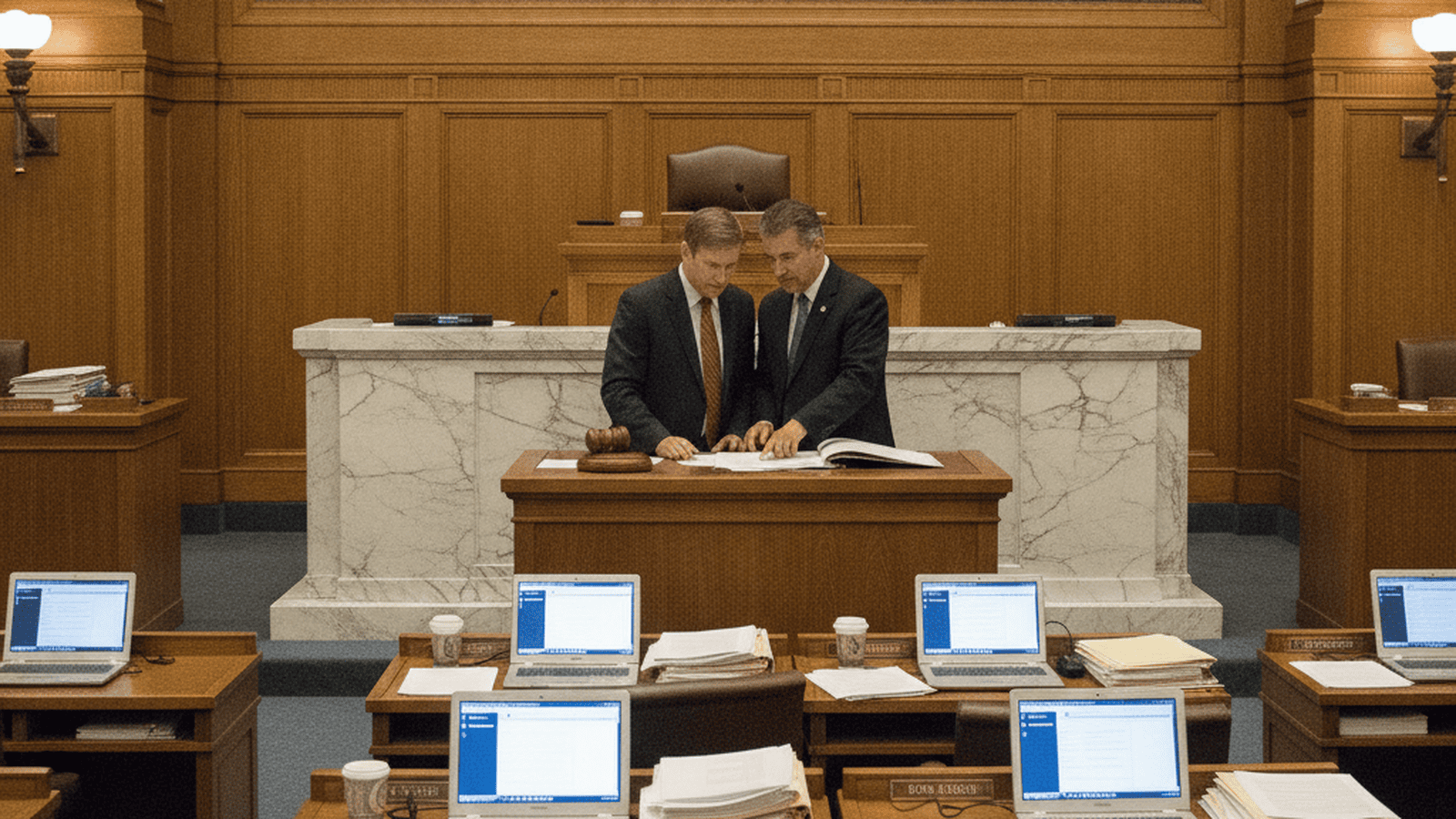
In 2010, Oregon voters elected a perfectly divided House of Representatives, leading to a historic power-sharing agreement. This 30-30 split in the United States resulted in the appointment of two Co-Speakers and equally divided committees.
TLDR: Following the 2010 elections, the Oregon House of Representatives faced a 30-30 deadlock. Rather than descending into paralysis, lawmakers established a unique co-speakership between Republicans and Democrats. This rare parliamentary realignment forced unprecedented bipartisan cooperation on budgeting and policy during the 2011 legislative session.
The 2010 midterm elections in Oregon produced a rare mathematical deadlock that fundamentally reshaped the state’s political landscape. Oregon voters delivered a perfectly balanced House of Representatives: 30 Democrats and 30 Republicans. This 30-30 split presented an immediate existential crisis for the 76th Legislative Assembly. In the American winner-take-all tradition, a tie usually signals paralysis, as the chamber cannot perform foundational duties—such as electing a Speaker, adopting rules, or making committee assignments—without a clear majority.
Intense negotiations followed the election between Republican leader Bruce Hanna of Roseburg and Democratic leader Arnie Roblan of Coos Bay. Both men were seasoned legislators who recognized that a prolonged stalemate would be disastrous for a state still struggling with the aftermath of the Great Recession. Rather than searching for a defector to break the tie, the leaders chose institutional innovation. They negotiated a comprehensive power-sharing agreement that would govern the 2011 session, a structural realignment not seen in the Oregon Capitol since the late 19th century.
Under the terms of this historic “Shared Gavel” agreement, Hanna and Roblan were designated as Co-Speakers. This necessitated a complete overhaul of the House Rules. Every legislative committee was restructured to maintain an equal 5-5 or 4-4 split between the parties. Furthermore, each committee featured co-chairs—one from each party—who had to agree on which bills would receive a hearing. For any piece of legislation to move out of committee and reach the House floor, it effectively required at least one member of the opposing party to cross the aisle, ensuring that no purely partisan agenda could advance.
This structural shift forced a profound transformation in the culture of the Oregon State Capitol. Lawmakers found themselves in a system where consensus was the only viable currency. The arrangement required unprecedented levels of transparency and communication. Staffers from both caucuses were forced to integrate their workflows, coordinating schedules and legislative priorities with a degree of cooperation rarely seen in modern American politics. The “Shared Gavel” experiment effectively empowered moderate members of both parties, as the path to the necessary 31st vote always led through the political center.
Despite widespread predictions of gridlock, the 2011 session proved to be remarkably productive. The evenly divided House successfully passed a balanced state budget, a feat that often eludes majority-controlled legislatures. They also navigated complex issues such as K-12 education funding, the establishment of a state health insurance exchange, and significant reforms to the public employee retirement system. Observers noted that the necessity of bipartisan buy-in acted as a natural filter, removing the most polarizing ideological proposals from both ends of the spectrum and focusing the assembly on pragmatic, middle-ground solutions.
However, the co-speakership was not without significant friction. The dual-leadership model naturally slowed the pace of governance, as every procedural decision required mutual consent. Hardliners in both parties occasionally criticized Hanna and Roblan for conceding too much to the opposition. The tension of the 30-30 split meant that the threat of a total breakdown was a constant shadow over the proceedings. Yet, the personal rapport and mutual respect between the two Co-Speakers served as a stabilizing force that prevented the experiment from collapsing.
The 2012 elections eventually broke the deadlock, returning a clear majority to the Democrats and ending the formal power-sharing era. Nevertheless, the 2011 session remains a landmark in United States political history. It serves as a powerful case study for political scientists on how institutional rules can be adapted to reflect a divided electorate. The legacy of the shared gavel remains a rare example of how structural changes can foster functional governance in a polarized era.

Dylan Brooks serves as the Senior Correspondent for Statehouses and Local Governance at Just Right News, where he brings a principled, constitutionalist lens to the often-overlooked machinery of state-level politics. As the lead voice behind the acclaimed feature series “Fifty Laboratories of Power,” Dylan has dedicated his career to the idea that the most impactful governance happens closest to home. His reporting consistently champions the Tenth Amendment, exploring how individual states can serve as testing grounds for innovative, conservative policy solutions that prioritize personal liberty and fiscal responsibility.
A native of Des Moines, Iowa, Dylan’s journalistic philosophy was forged in the heart of the American Midwest. Growing up in a community where local school board meetings and town halls were the bedrock of civic life, he developed a deep appreciation for the “retail politics” of the heartland. This upbringing instilled in him a fundamental belief that the American experiment is best preserved when power is decentralized. He carries the values of his Iowa roots into every assignment, maintaining a healthy skepticism of federal overreach and a steadfast commitment to the concerns of everyday citizens over the interests of the administrative state.
Now based in Madison, Wisconsin, Dylan operates from one of the nation’s most pivotal political battlegrounds. His location in a state capital known for its rigorous policy debates allows him to provide Just Right News readers with a front-row seat to the legislative process. From Madison, he tracks the ripple effects of statehouse decisions on local municipalities, ensuring that the connection between high-level policy and community impact is never lost. His work often highlights the success of conservative governors and legislatures in fostering economic growth, protecting parental rights, and securing the integrity of local institutions.
As an African American man in the conservative media landscape, Dylan offers a vital perspective on how limited government and free-market principles empower individuals and families. He frequently reports on how deregulation and school choice initiatives provide new avenues for success in underserved communities, challenging the monolithic narratives often presented by legacy media outlets. Dylan’s work is characterized by a commitment to the facts and a refusal to shy away from the complex realities of modern governance.
Throughout his tenure at Just Right News, Dylan has become a trusted authority for readers who value a rigorous, principled approach to the news. Whether he is dissecting a complex state budget or profiling a local grassroots movement, his goal remains the same: to provide the American public with the information they need to hold their local leaders accountable. By focusing on the “Fifty Laboratories of Power,” Dylan Brooks ensures that the vital work being done in statehouses across the country receives the national attention it deserves, always through a lens that respects the traditions and sovereignty of the American people.