

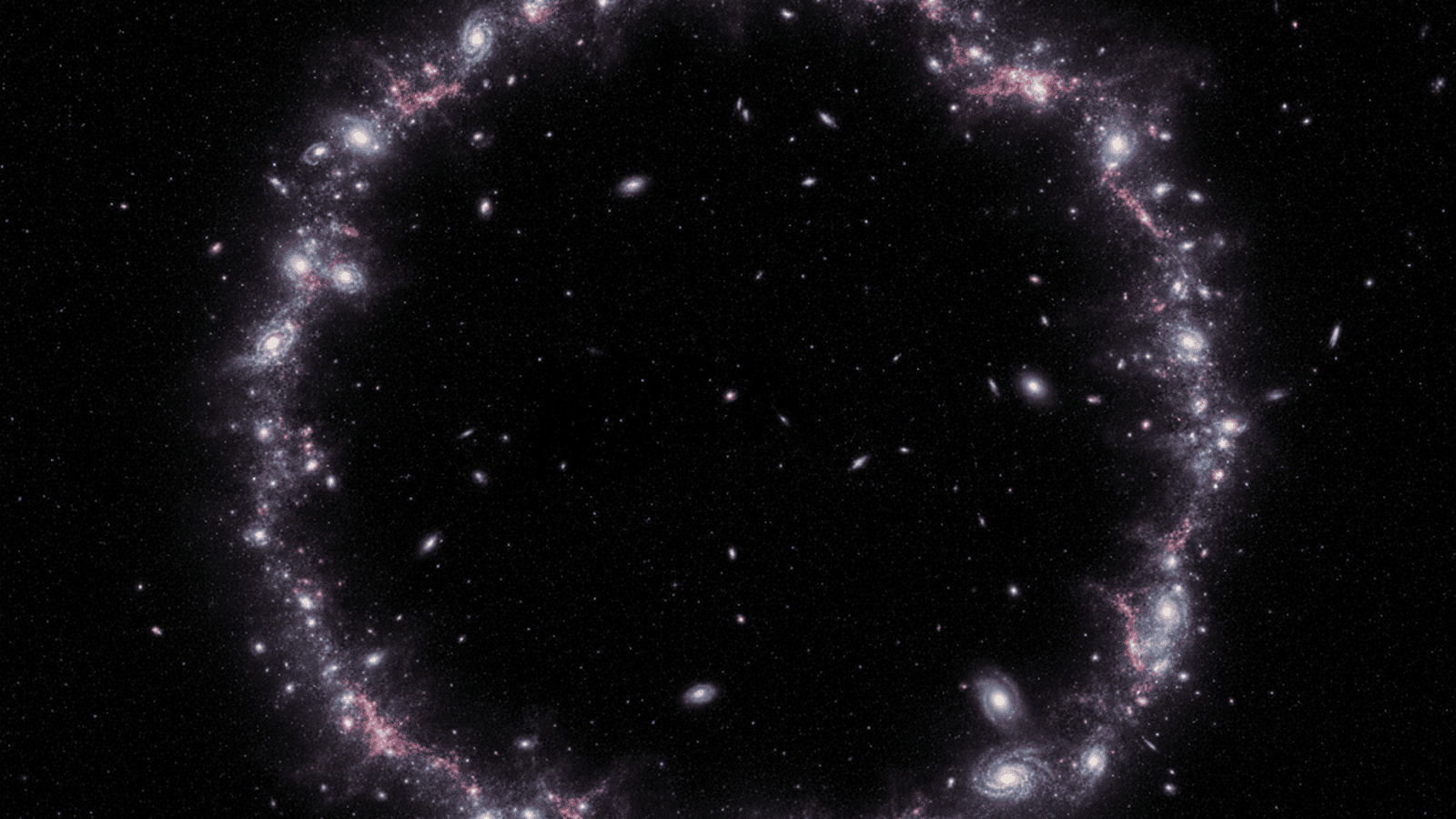
Researchers have identified a massive, ring-shaped structure of galaxies spanning 1.3 billion light-years in the distant universe. This discovery, known as the Big Ring, challenges the fundamental Cosmological Principle, which suggests that the universe should appear uniform on such large scales.
TLDR: Astronomers have discovered a gargantuan structure dubbed the ‘Big Ring,’ measuring 1.3 billion light-years across. Located 9.2 billion light-years away, its immense size contradicts the Cosmological Principle, forcing scientists to reconsider established theories regarding the large-scale evolution and uniformity of the universe.
Astronomers have identified a gargantuan structure in the distant universe that defies current understanding of cosmic evolution. Dubbed the “Big Ring,” this assembly of galaxies and galaxy clusters spans approximately 1.3 billion light-years in diameter. Located roughly 9.2 billion light-years from Earth, the structure is so large that it occupies a significant portion of the observable sky, though it remains invisible to the naked eye due to its extreme distance and faintness.
The discovery was led by Alexia Lopez, a doctoral researcher at the University of Central Lancashire, who presented the findings at the 243rd meeting of the American Astronomical Society. Lopez utilized data from the Sloan Digital Sky Survey (SDSS) to map the distribution of magnesium II absorbers. These are clouds of gas surrounding distant galaxies that absorb light from even more distant quasars. By treating these gas clouds as markers for the underlying matter, the research team identified a nearly perfect ring-like pattern that stands out from the surrounding cosmic background.
This finding is particularly significant because it contradicts the Cosmological Principle. This foundational tenet of modern astronomy posits that, on a large enough scale, the universe is homogeneous and isotropic. In simpler terms, the distribution of matter should look roughly the same in every direction and at every location. Current theoretical models, based on the Lambda Cold Dark Matter framework, suggest that the upper limit for the size of any coherent structure should be approximately 1.2 billion light-years. The Big Ring, along with other recently discovered features, suggests that this limit may be fundamentally incorrect.
The Big Ring is not an isolated anomaly. It is located in the same cosmic neighborhood as the “Giant Arc,” another massive structure spanning 3.3 billion light-years that Lopez discovered in 2021. The proximity of these two ultra-large structures—both at the same distance from Earth and in the same region of the sky—raises the possibility that they are part of an even larger, interconnected cosmological system. The existence of two such structures in a relatively small volume of space significantly reduces the likelihood that they are merely coincidental alignments of unrelated galaxies.
Several theories have been proposed to explain the existence of such massive formations. One possibility involves Baryon Acoustic Oscillations (BAOs), which are giant, spherical shells of matter created by pressure waves in the early universe. However, while BAOs are typically spherical, the Big Ring appears more two-dimensional and exceeds the standard size predicted for these oscillations. Another theory suggests the influence of cosmic strings, hypothetical one-dimensional defects in the fabric of space-time that could have acted as gravitational seeds for matter to cluster around during the universe’s infancy.
The discovery of the Big Ring forces cosmologists to re-evaluate the standard model of the universe’s birth and growth. If the Cosmological Principle is fundamentally flawed, it could mean that the universe is not as uniform as previously believed, or that unknown physical processes were at work during its earliest stages. This could necessitate a shift toward alternative theories of gravity or new models of cosmic inflation. Researchers plan to continue mapping the distant universe to determine if more of these gargantuan structures exist. Future observations from the Vera C. Rubin Observatory and the Euclid space telescope are expected to provide higher-resolution data, potentially revealing whether the Big Ring is a unique outlier or a common feature of the cosmic web.

Mason Reed serves as a Staff Writer for Just Right News, where he spearheads the Future Frontiers & Special Projects desk. In an era defined by rapid technological shifts and evolving social landscapes, Mason provides a steady, principled voice, examining the innovations of tomorrow through the lens of traditional American values. His work is most prominently featured in his signature series, “The Next Horizon,” where he explores the intersection of emerging technology, national sovereignty, and the preservation of individual liberty.
A native of San Diego, California, Mason’s worldview was shaped by the unique culture of his hometown. Growing up in a region defined by its strong military presence and its history of maritime industry, he developed a deep-seated respect for the institutions that provide national stability and the entrepreneurial spirit that drives the American economy. This upbringing instilled in him a belief that true progress is not found in discarding the past, but in building upon a foundation of proven principles. His reporting often reflects this San Diego influence, emphasizing the importance of a robust national defense and the necessity of maintaining a competitive edge in the global marketplace.
Now based in San Francisco, Mason operates from the heart of the world’s technological engine. Living and working in the Bay Area provides him with a front-row seat to the advancements—and the ideological challenges—emanating from Silicon Valley. While many in the region embrace a “move fast and break things” mentality, Mason’s reporting serves as a vital counterweight. He offers Just Right News readers a “boots on the ground” perspective, documenting how radical local policies and the concentration of tech power impact the everyday lives of citizens. His proximity to the industry allows him to cut through the marketing jargon of big tech to uncover the real-world implications for privacy, free speech, and the nuclear family.
In his “Future Frontiers” beat, Mason tackles complex subjects ranging from the ethics of artificial intelligence to the burgeoning private space race. He approaches these topics with a healthy skepticism toward centralized bureaucracy, championing instead the decentralized innovations that empower individuals. Through “The Next Horizon,” he highlights the pioneers and thinkers who are working to ensure that the future remains a place where human dignity and constitutional rights are protected. He believes that the rapid pace of change requires more than just technical expertise; it requires a moral compass rooted in the Western tradition.
Throughout his tenure at Just Right News, Mason has remained committed to the idea that the future is something to be shaped, not merely accepted. His writing is characterized by a rigorous defense of American exceptionalism and a belief that the country’s best days lie ahead, provided it remains true to its founding ideals. Whether he is investigating the impact of automation on the American workforce or profiling the next generation of aerospace engineers, Mason Reed ensures that his readers are equipped with the insights they need to navigate a changing world with confidence and clarity.