

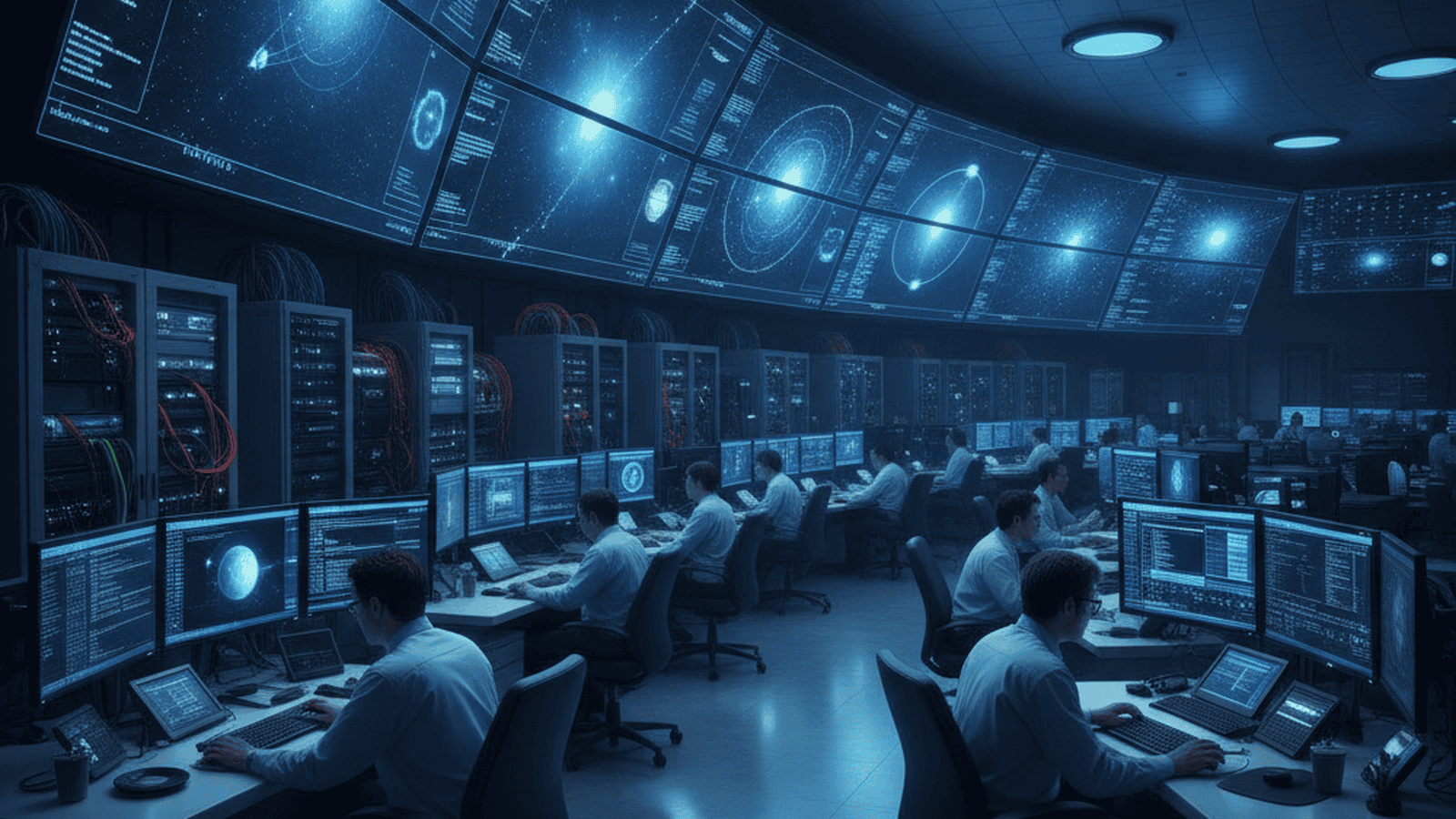
NASA scientists have deployed a deep learning model named ExoMiner to validate 301 new exoplanets from the Kepler mission data. The AI system operates on the Pleiades supercomputer, mimicking human expert analysis to distinguish true planetary transits from background noise.
TLDR: NASA’s ExoMiner, a deep learning neural network, has successfully validated 301 new exoplanets by analyzing archival data from the Kepler Space Telescope. By automating the verification process with superhuman consistency, the AI allows researchers to rapidly expand the catalog of known worlds beyond our solar system.
NASA’s Ames Research Center in California’s Silicon Valley has reached a new frontier in the search for worlds beyond our solar system. By deploying a sophisticated deep learning neural network known as ExoMiner, scientists have successfully validated 301 new exoplanets. These planets were previously classified as candidates in the massive archive of data collected by the Kepler Space Telescope. The discovery marks a significant shift in how astronomers handle the deluge of information provided by modern space missions.
The ExoMiner system functions by analyzing light curves, which are measurements of a star’s brightness over time. When a planet passes between its host star and the telescope, it causes a temporary dip in brightness known as a transit. However, identifying these transits is notoriously difficult because other phenomena, such as eclipsing binary stars or simple instrumental glitches, can mimic the signal of a planet. Traditionally, human experts had to manually vet these signals to ensure their authenticity, a process that is both time-consuming and prone to subjective bias.
To overcome these limitations, the research team trained ExoMiner on a vast dataset of previously confirmed planets and known false positives. The model utilizes a convolutional neural network architecture, a type of artificial intelligence particularly adept at recognizing patterns in visual or sequential data. By processing information through multiple layers of artificial neurons, the system learns to distinguish the subtle nuances of a true planetary transit from the noise of the cosmos.
One of the key advantages of ExoMiner is its transparency and consistency. Unlike many black box AI systems, ExoMiner was designed to follow the same logic and diagnostic tests used by human astronomers. This allows researchers to understand exactly why the model classified a signal as a planet. When tested against human experts, the AI demonstrated a higher level of consistency, as it does not suffer from fatigue or the varying levels of strictness that can affect human judgment over long periods of data review.
The validation of 301 planets in a single batch is a testament to the efficiency of government-led computational research. The project utilized the Pleiades supercomputer, one of the world’s most powerful calculation engines, located at the NASA Advanced Supercomputing facility. This hardware allowed the team to run complex simulations and process years of Kepler data in a fraction of the time it would have taken using standard methods. The newly confirmed planets vary in size and orbit, adding a diverse range of worlds to the existing catalog of over 5,000 exoplanets.
This breakthrough has immediate implications for the future of space exploration. With the James Webb Space Telescope now operational and the Transiting Exoplanet Survey Satellite continuing to scan the sky, the volume of incoming data is expected to grow exponentially. AI tools like ExoMiner will be essential for filtering this data, allowing astronomers to identify the most promising targets for atmospheric study. By pinpointing planets that reside in the habitable zone of their stars, these AI systems are narrowing the search for environments that could potentially support life.
The success of the ExoMiner project highlights the growing synergy between computer science and astrophysics. As machine learning techniques become more refined, they are being integrated into every stage of the scientific process, from data collection to hypothesis testing. NASA researchers are now looking to adapt the ExoMiner framework for use with data from other missions, ensuring that no potential world remains hidden in the noise of the stars.

Mason Reed serves as a Staff Writer for Just Right News, where he spearheads the Future Frontiers & Special Projects desk. In an era defined by rapid technological shifts and evolving social landscapes, Mason provides a steady, principled voice, examining the innovations of tomorrow through the lens of traditional American values. His work is most prominently featured in his signature series, “The Next Horizon,” where he explores the intersection of emerging technology, national sovereignty, and the preservation of individual liberty.
A native of San Diego, California, Mason’s worldview was shaped by the unique culture of his hometown. Growing up in a region defined by its strong military presence and its history of maritime industry, he developed a deep-seated respect for the institutions that provide national stability and the entrepreneurial spirit that drives the American economy. This upbringing instilled in him a belief that true progress is not found in discarding the past, but in building upon a foundation of proven principles. His reporting often reflects this San Diego influence, emphasizing the importance of a robust national defense and the necessity of maintaining a competitive edge in the global marketplace.
Now based in San Francisco, Mason operates from the heart of the world’s technological engine. Living and working in the Bay Area provides him with a front-row seat to the advancements—and the ideological challenges—emanating from Silicon Valley. While many in the region embrace a “move fast and break things” mentality, Mason’s reporting serves as a vital counterweight. He offers Just Right News readers a “boots on the ground” perspective, documenting how radical local policies and the concentration of tech power impact the everyday lives of citizens. His proximity to the industry allows him to cut through the marketing jargon of big tech to uncover the real-world implications for privacy, free speech, and the nuclear family.
In his “Future Frontiers” beat, Mason tackles complex subjects ranging from the ethics of artificial intelligence to the burgeoning private space race. He approaches these topics with a healthy skepticism toward centralized bureaucracy, championing instead the decentralized innovations that empower individuals. Through “The Next Horizon,” he highlights the pioneers and thinkers who are working to ensure that the future remains a place where human dignity and constitutional rights are protected. He believes that the rapid pace of change requires more than just technical expertise; it requires a moral compass rooted in the Western tradition.
Throughout his tenure at Just Right News, Mason has remained committed to the idea that the future is something to be shaped, not merely accepted. His writing is characterized by a rigorous defense of American exceptionalism and a belief that the country’s best days lie ahead, provided it remains true to its founding ideals. Whether he is investigating the impact of automation on the American workforce or profiling the next generation of aerospace engineers, Mason Reed ensures that his readers are equipped with the insights they need to navigate a changing world with confidence and clarity.