

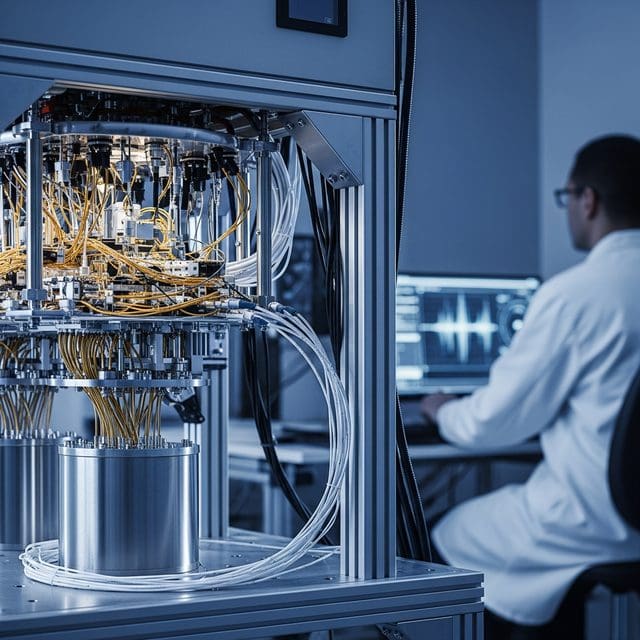
Recent discoveries in localization physics and hyperdimensional computing are pushing quantum technology out of the laboratory and into the realm of practical, high-speed national security applications.
The landscape of American innovation is being reshaped by a series of quiet but profound breakthroughs in the realm of quantum physics. This week, the frontier of what is possible in data processing and secure communication moved significantly closer to the citizen’s doorstep. As Silicon Valley continues to chase incremental gains in traditional silicon chips, a global cohort of researchers is proving that the future of the digital world lies in the subatomic. These discoveries are not merely academic; they represent the next theater of competition for national sovereignty and the protection of the private sphere.
At the Southern University of Science and Technology, physicists achieved a landmark observation in the field of condensed matter. By utilizing a sophisticated photonic platform, the team successfully identified five distinct phases of localization physics within a single quantum system. Published in Physical Review Letters, this research provides a vital map for understanding how quantum information can be preserved in a state of ‘localization’ rather than dissolving into the noise of its environment. For the layperson, this is akin to finding a way to keep a signal clear even in the middle of a hurricane. Mastering these phases is essential for building quantum computers that can operate without the constant threat of data corruption.
While the theoretical groundwork is being laid in physics labs, the Cleveland Clinic has demonstrated that the practical benefits of quantum systems may arrive sooner than skeptics predicted. Researchers there developed a quantum hyperdimensional computing model that reportedly operates 500 times faster than existing quantum methods. This leap in efficiency is a direct answer to the bureaucratic and technical bottlenecks that have long plagued the field. By utilizing high-dimensional vectors to represent information, this model allows for rapid pattern recognition and data analysis that could revolutionize everything from medical diagnostics to the tracking of complex supply chains. This 500-fold increase in speed suggests that the transition from classical to quantum dominance will not be a slow crawl, but a sudden sprint.
As these computational speeds increase, the necessity of securing our nation’s critical infrastructure becomes a matter of urgent public interest. On June 18, the Quantum Communication Fieldlab Rotterdam was launched to address this exact vulnerability. A coalition of founding partners, including Cisco, CGI, and Q*Bird, has begun the work of operationalizing quantum-secure communication. This initiative is designed to protect the essential nerves of modern society—power grids, water systems, and financial networks—from the emerging threat of quantum-enabled decryption. By leveraging the principles of quantum entanglement, these networks aim to create ‘unhackable’ links that would alert authorities the moment an unauthorized party attempts to intercept a transmission.
However, the path to a fully realized quantum age is still obstructed by the fragility of the technology. The industry is currently in a race to solve the problem of ‘noise’ and error. Amazon and QuEra have entered the fray with a bold timeline, promising to deliver useful quantum error correction by 2028. This commitment highlights a shift in the industry from merely building larger machines to building more reliable ones. For the American taxpayer and the defender of constitutional rights, the stakes of this race are high. If the West can lead the way in error-corrected, secure quantum systems, it ensures that the decentralized nature of the internet and the privacy of individual communication can be maintained against those who would use superior computing power to centralize control.
Looking ahead, the integration of these technologies into the broader aerospace and telecommunications sectors is already underway. NASA recently announced a public-private partnership with Relativity Space to launch the Aeolus atmospheric-science instrument to Mars, a mission that will rely on the very best in spacecraft operations and data handling. As we push further into the ‘Future Frontier,’ the marriage of quantum physics and traditional American industry will be the cornerstone of our continued leadership on Earth and beyond. The discoveries of this week serve as a reminder that while the technology is complex, the goal remains simple: the advancement of human knowledge in service of a free and secure society.

Mason Reed serves as a Staff Writer for Just Right News, where he spearheads the Future Frontiers & Special Projects desk. In an era defined by rapid technological shifts and evolving social landscapes, Mason provides a steady, principled voice, examining the innovations of tomorrow through the lens of traditional American values. His work is most prominently featured in his signature series, “The Next Horizon,” where he explores the intersection of emerging technology, national sovereignty, and the preservation of individual liberty.
A native of San Diego, California, Mason’s worldview was shaped by the unique culture of his hometown. Growing up in a region defined by its strong military presence and its history of maritime industry, he developed a deep-seated respect for the institutions that provide national stability and the entrepreneurial spirit that drives the American economy. This upbringing instilled in him a belief that true progress is not found in discarding the past, but in building upon a foundation of proven principles. His reporting often reflects this San Diego influence, emphasizing the importance of a robust national defense and the necessity of maintaining a competitive edge in the global marketplace.
Now based in San Francisco, Mason operates from the heart of the world’s technological engine. Living and working in the Bay Area provides him with a front-row seat to the advancements—and the ideological challenges—emanating from Silicon Valley. While many in the region embrace a “move fast and break things” mentality, Mason’s reporting serves as a vital counterweight. He offers Just Right News readers a “boots on the ground” perspective, documenting how radical local policies and the concentration of tech power impact the everyday lives of citizens. His proximity to the industry allows him to cut through the marketing jargon of big tech to uncover the real-world implications for privacy, free speech, and the nuclear family.
In his “Future Frontiers” beat, Mason tackles complex subjects ranging from the ethics of artificial intelligence to the burgeoning private space race. He approaches these topics with a healthy skepticism toward centralized bureaucracy, championing instead the decentralized innovations that empower individuals. Through “The Next Horizon,” he highlights the pioneers and thinkers who are working to ensure that the future remains a place where human dignity and constitutional rights are protected. He believes that the rapid pace of change requires more than just technical expertise; it requires a moral compass rooted in the Western tradition.
Throughout his tenure at Just Right News, Mason has remained committed to the idea that the future is something to be shaped, not merely accepted. His writing is characterized by a rigorous defense of American exceptionalism and a belief that the country’s best days lie ahead, provided it remains true to its founding ideals. Whether he is investigating the impact of automation on the American workforce or profiling the next generation of aerospace engineers, Mason Reed ensures that his readers are equipped with the insights they need to navigate a changing world with confidence and clarity.