

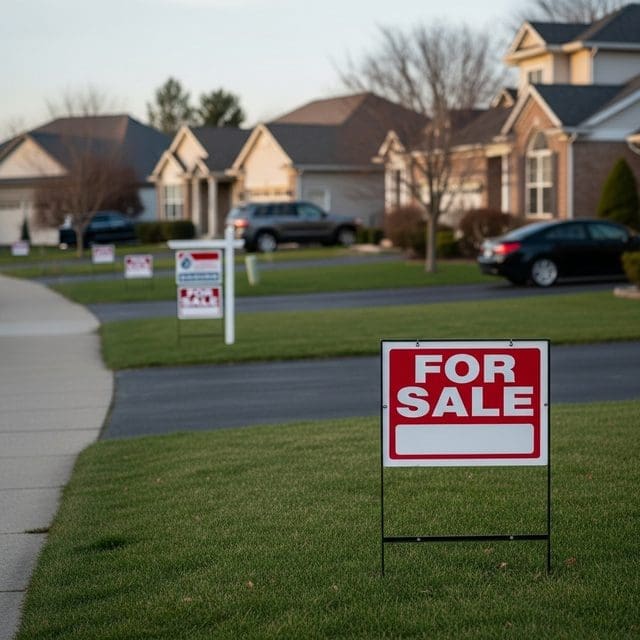
The Federal Reserve’s decision to hold rates steady under new Chair Kevin Warsh dashes hopes for mortgage relief, further entrenching a housing market freeze that penalizes first-time buyers.
The American dream of homeownership remains increasingly out of reach as the Federal Reserve, under the new leadership of Chair Kevin Warsh, signals a commitment to a “higher-for-longer” interest rate environment. In his debut meeting of the Federal Open Market Committee on June 16-17, 2026, Warsh oversaw a decision to leave the target interest rate unchanged. However, the accompanying projections have dimmed market hopes for near-term relief, suggesting that rate increases are more likely than cuts in the latter half of 2026. This hawkish shift has sent ripples through the housing sector, where the 30-year fixed mortgage rate currently sits at approximately 6.5%, a significant climb from the 6.09% seen earlier this year.
For the average American household, this policy translates to a stagnant and expensive housing market. The elevation of rates has created a persistent “lock-in” effect, where homeowners with existing 3% or 4% mortgages refuse to list their properties, fearing the massive jump in monthly payments that would accompany a move. This lack of inventory forces first-time buyers to compete for a dwindling supply of homes, often at prices that remain stubbornly high despite broader economic cooling. Realtor.com reports that this freeze is effectively paralyzing the move-up market, leaving young families with few options but to continue renting in an equally squeezed market.
The scale of the affordability gap is staggering and highlights the disconnect between federal policy and local reality. Current market analysis suggests that to return to 2019 affordability levels—where mortgage payments accounted for roughly 21% of median income compared to over 30% today—the economy would require a 35% drop in home prices, a 56% surge in household income, or mortgage rates falling back to 2.65%. None of these scenarios are currently on the horizon. Instead, the Cleveland Fed’s yield-curve model continues to flash warning signs of weak growth and elevated recession odds, even as the central bank maintains its focus on curbing inflation through restrictive credit.
While the Trump administration celebrates industrial wins, such as the June 18 announcement that Intel will manufacture semiconductor chips for Apple domestically, the domestic housing infrastructure remains strained by these macroeconomic levers. The AI boom is further complicating the cost of living by driving up energy demand; companies like Rumble are acquiring tens of thousands of Nvidia chips, turning electricity into a scarce commodity. While a recent U.S.-Iran ceasefire agreement provided a temporary reprieve in oil prices, which fell over 4% to three-month lows, these gains are often offset by the rising costs of financing and the mounting pressure on service workers. This is evidenced by the 99.6% strike authorization vote by registered nurses at Brigham and Women’s Hospital, who are protesting 0% cost-of-living raises in an era of soaring expenses.
Local sovereignty and private property rights are increasingly caught in the crosshairs of federal monetary policy. As Warsh downplays forward guidance and declines to participate in traditional “dot plot” forecasting, the burden of uncertainty falls on the taxpayer. Traders are already shifting bets toward an October rate hike, which would further pressure mortgage and credit costs. Without a shift toward market-driven supply solutions or a significant reduction in the federal regulatory barriers that drive up construction costs, the current “frozen” state of the housing market appears set to endure. The Rockefeller Foundation has mobilized over $450 million for community economic opportunity, but such private initiatives face a steep uphill battle against a federal interest rate environment that continues to prioritize price stability over the immediate needs of the American homebuyer.

Deborah Cole serves as a Senior Correspondent for Just Right News, where she spearheads the network’s coverage of Housing, Infrastructure, and Mobility. With a career defined by a commitment to rigorous reporting and a focus on the fundamental pillars of American community life, Deborah brings a principled perspective to the complex issues that dictate how and where we live. Her work is grounded in the belief that sound policy, fiscal responsibility, and respect for private property are the essential foundations of a prosperous society.
Originally from Boston, Massachusetts, Deborah’s upbringing in one of the nation’s oldest and most historically significant cities deeply influenced her professional trajectory. Growing up amidst the architectural legacy and dense urban planning of New England, she developed an early appreciation for the importance of durable infrastructure and the role of local tradition in shaping neighborhoods. Her perspective is informed by the classic American values of her hometown—hard work, community cohesion, and a healthy skepticism of top-down bureaucratic mandates that often overlook the unique needs of individual citizens.
Today, Deborah operates from her base in Austin, Texas, a city that serves as a primary laboratory for her reporting. Austin’s rapid expansion and its status as a hub for innovation and migration provide her with a front-row seat to the most pressing challenges in modern infrastructure and housing. From the Lone Star State, she chronicles the tensions between rapid growth and the preservation of the American Dream, often highlighting how market-driven solutions and deregulation can address the housing shortages that plague many of the country’s metropolitan areas.
At Just Right News, Deborah is perhaps best known for her signature feature series, “Where We Live.” Through this platform, she explores the intersection of public policy and private life, moving beyond mere statistics to tell the stories of families, small business owners, and local developers. Her reporting frequently highlights the importance of mobility—not just in terms of transportation and transit, but as a vehicle for economic opportunity and social stability. She remains a staunch advocate for the taxpayer, consistently scrutinizing government spending on large-scale projects and advocating for transparency in how infrastructure dollars are allocated.
Deborah’s beat is more than just a collection of policy topics; it is an investigation into the physical and legal structures that allow families to flourish. Whether she is reporting on the impact of zoning laws on suburban development or the necessity of maintaining the nation’s highway systems, her work is characterized by a dedication to the facts and a respect for the constitutional principles that protect the rights of homeowners.
As a Senior Correspondent, Deborah Cole continues to be a vital voice for Just Right News, providing the audience with the clarity and context needed to navigate an ever-changing landscape. Her reporting ensures that the values of individual liberty and local sovereignty remain at the forefront of the national conversation regarding the future of our cities and towns. Through her tireless efforts, she remains committed to informing the public on the issues that hit closest to home.